

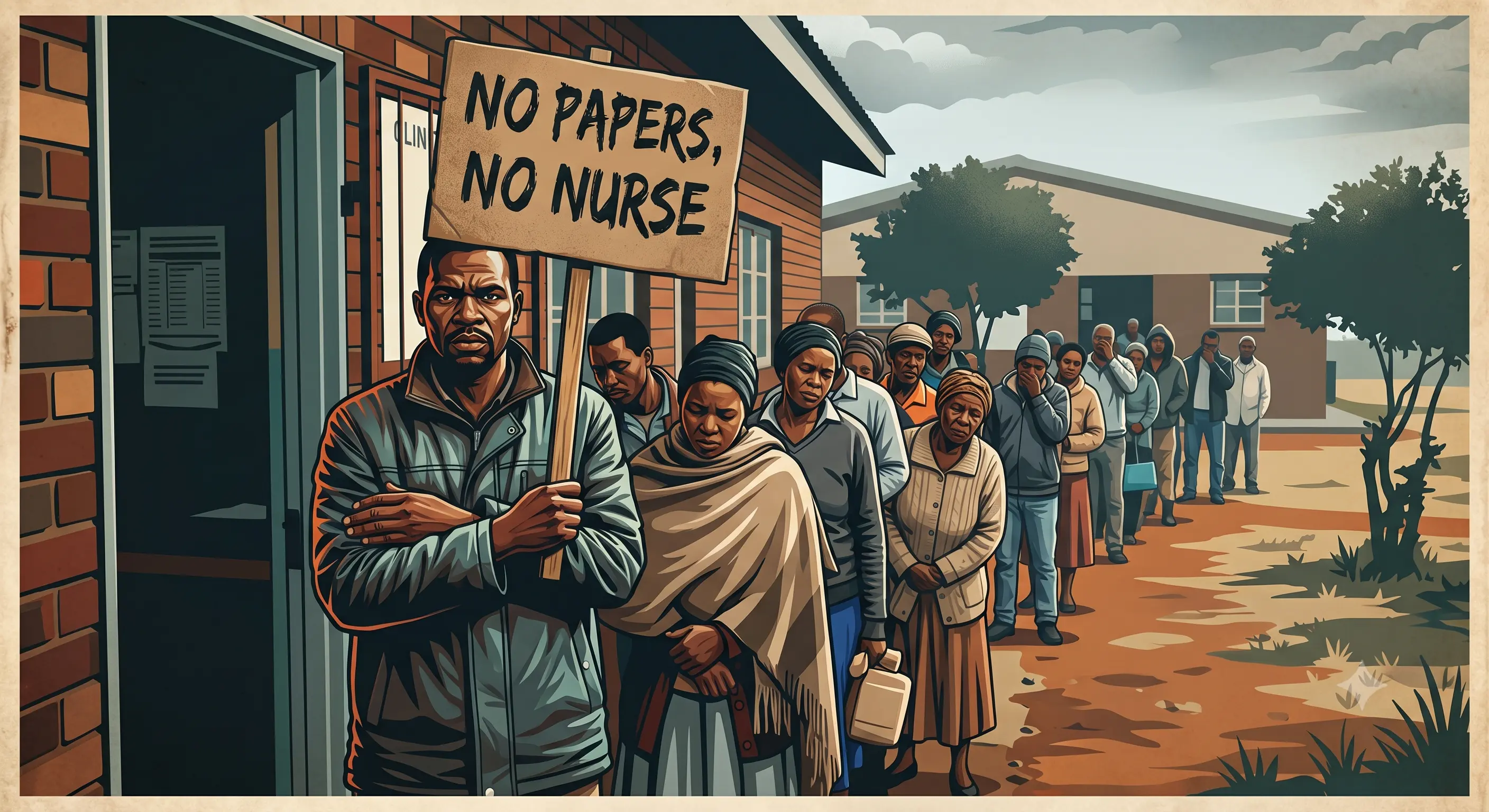
A man stands outside a clinic in Gauteng holding a placard. He is not asking anyone to leave the country. He is asking them to produce a piece of paper before a nurse will look at a cough, a wound or a fever in a child. Behind him, a queue of the sick has stopped moving. Somewhere further back, a Malawian grandmother does not know whether to stay or to walk home and die there instead, quietly, without the indignity of being asked for papers first.
This is South Africa in 2026. Not the South Africa of matric pass-rate press releases or growth forecasts from the banks. The other one. The one where a citizen-led movement called March and March and an older outfit called Operation Dudula, which means 'force out' in Zulu, are doing just that. They have made it their business to stand between sick people and the doctors meant to treat them. A court had to order them, in November last year, to stop blocking migrants from health facilities. A court order was required to permit access to a hospital. That tells you most of what you need to know about where the country has arrived.
I want to be careful here because this is not an article about South Africans being cruel by nature. They are not. I have buried too many of them, married too many of them, sat with too many of them in hospital corridors and funeral parlours to believe that. This is a column about something narrower and considerably more interesting. It is about what happens when a nation that built its entire moral identity on the wrongness of excluding people by birth becomes the same nation that, three decades later, excludes people by birth again, only this time with better slogans.
There is a particular gap worth dwelling on here: the gap between what an institution says about itself and what it actually does when nobody important is watching. This story sits squarely inside that gap. Here is a nation that fought a war against the idea that where you were born should determine what you were owed. Apartheid was, at bottom, a doctrine of birthplace. You were a homeland person or a city person, a Bantustan citizen or a Republic citizen and your rights bent accordingly. The whole moral architecture of the liberation struggle rested on the claim that this was monstrous.
And yet the academic literature on this is not subtle.
Researchers at the Southern African Migration Project noted, as early as 2004, that the very nation-building project the new government pursued after 1994 — the project designed to forge a shared South African identity out of the wreckage of apartheid's divisions — produced, as an unintended consequence, a sharper hostility towards outsiders than existed before. Sociologists have a phrase for it: non-racial xenophobia. It is a tidy academic way of saying that the instinct to draw a hard line around who belongs did not disappear with apartheid. It simply changed its target.
That is the heart of it. The observation that ought to be made with a particular weary relish reserved for institutions caught in their own contradictions. The new South Africa did not abolish the old logic of belonging. It nationalised it.
No argument like this earns its keep without a scene because an abstraction has never yet changed anyone's mind on its own. So consider Mossel Bay, a town most people associate with whale watching and a decent round of golf. Recent unrest saw five Mozambican nationals confirmed dead by their own government.
Consider the Cameroonian shopkeeper in Durban, twenty years in the country and married to a South African. He was attacked by men who did not pause to ask about his papers because the papers were never really the point. He has not opened a case with the police, not because nothing happened to him but because, in his own words, he has no faith that the system will do anything about it if he does.
Consider, too, a Malawian man who could not produce documentation quickly enough for law enforcement officers. The officers who were meant to be protecting him judged him. He died after being beaten and placed in the boot of a car. Human Rights Watch describes the source for that account as credible. I will let the word sit there because some sentences do not need adjectives from me to be unbearable.
The specific detail carries moral weight that the abstract noun cannot.
Xenophobia is an abstract noun. The boot of a car is not.
And here is the twist, the one that turns the whole thing on its head in a single sentence. It sits in plain sight in every report on this crisis. The grievances are real. The official unemployment rate climbed to 32.7% in the first quarter of this year. For the fifth consecutive year, it has sat above 30%. Youth unemployment among those aged 15 to 24 now exceeds 60%. Public hospitals are overwhelmed. Schools are full. Housing waiting lists stretch for years. None of that is invented and none of it should be waved away by anyone writing from a comfortable distance. The anger is not manufactured. It is the address that is wrong.
Every serious study of this crisis and there have been a great many, reaches the identical and inconvenient conclusion. Foreign nationals are not the cause of South Africa's unemployment, its crime rate or its collapsing municipal services. They are a smaller share of the population than the rhetoric suggests. They are, if anything, net contributors through the small trading economy that keeps so many township high streets alive.
Yet a 2018 Pew survey found that 62% of South Africans believed immigrants were a burden taking jobs and benefits. A further 61% believed immigrants were more responsible for crime than other groups. A more recent survey from the Inclusive Society Institute found that 73% of South Africans report not trusting African foreign nationals at all or not very much. The facts and the feelings have gone in opposite directions and feelings, as any politician will tell you, count.
This is the twist and it is not a comfortable one. On 25 May this year, senior government ministers sat down at the Union Buildings, the official seat of the Presidency, engaged with the leadership of March and March to discuss how to address what they called illegal immigration. Whatever the intention behind that meeting, its effect was to hand a vigilante movement a chair at the table of government. A grievance that had been shouted on the street was now being negotiated in the room where the laws are made.
That is not appeasement. That is a promotion.
There is a paradox here too plain to dress up. A country built by people who were once forced to carry papers to justify their presence in their own land is now demanding papers from others to justify theirs. The passbook has not gone. It has changed hands.
And here, I think, is where a theological voice has something to add that a purely secular commentary cannot quite reach. Scripture is unambiguous and repetitive to the point of insistence on this exact question. The Hebrew law code returns to the stranger, the sojourner, the foreigner within your gates. It lands with a frequency that should embarrass anyone who treats it as incidental. You shall not oppress a stranger, the book of Exodus says, for you yourselves were strangers in the land of Egypt. It is not a suggestion. It is a memory weaponised into a command.
Remember what it felt like to be the outsider - and do not do that to someone else now that you hold the keys.
South Africa knows precisely what it felt like to be the outsider in its own country. Disenfranchised in law. Suspected by default. Required to prove, constantly, that its presence was legitimate. That memory is not ancient history. It is one generation deep. The men who built Operation Dudula and March and March were themselves born into a country that demanded their grandparents carry a dompas to walk down a street. The amnesia required to stand at a clinic door today, demanding someone else's papers, is not a small amnesia. It is close to total.
None of this is an argument for open borders as a moral reflex. Certainly not an argument that the South African state has no right to manage migration, employment and public services with competence and order. It plainly does, and its repeated failure to do so honestly is itself part of this story. The National Action Plan on Racism and Xenophobia, which the government points to when pressed, has been criticised by researchers at the University of the Witwatersrand.
The plan contains what they describe, not unkindly, as almost no actual plan. A country that cannot govern its own borders with competence will always be vulnerable to those who promise to do it with cruelty instead.
What this is, instead, is an argument for honesty about where the anger is being correctly aimed and where it is being deliberately misdirected. The councillor who has not collected the rubbish, the minister who allowed a vigilante movement into the room where policy gets made. Decades of corruption that hollowed out municipal capacity long before the first Zimbabwean trader set up a stall. These are legitimate targets for fury. A Mozambican shopkeeper trying to keep his family fed is not.
It is worth remembering that the most dangerous untruths are not the ones we are told but the ones we tell ourselves. Because we believe those completely, and defend them without being asked to. The untruth South Africa is telling itself is that the stranger at the gate is the reason the house is falling down. The more uncomfortable truth, the twist nobody wants in the final chapter, is that the house was already falling down. The stranger simply arrived in time to be blamed for the cracks.
A nation that survived its own pass laws ought to recognise a pass law when it sees one being rebuilt, however differently it is dressed. The tragedy is not that South Africa has forgotten this lesson. The tragedy is that it learned it so well the first time that it knew exactly how to inflict it on someone else.
Reverend Lionel Jean Michel is a journalist, communication specialist and thought leader. He writes on faith, governance and looks at the moral compass that guides both individuals and institutions.