


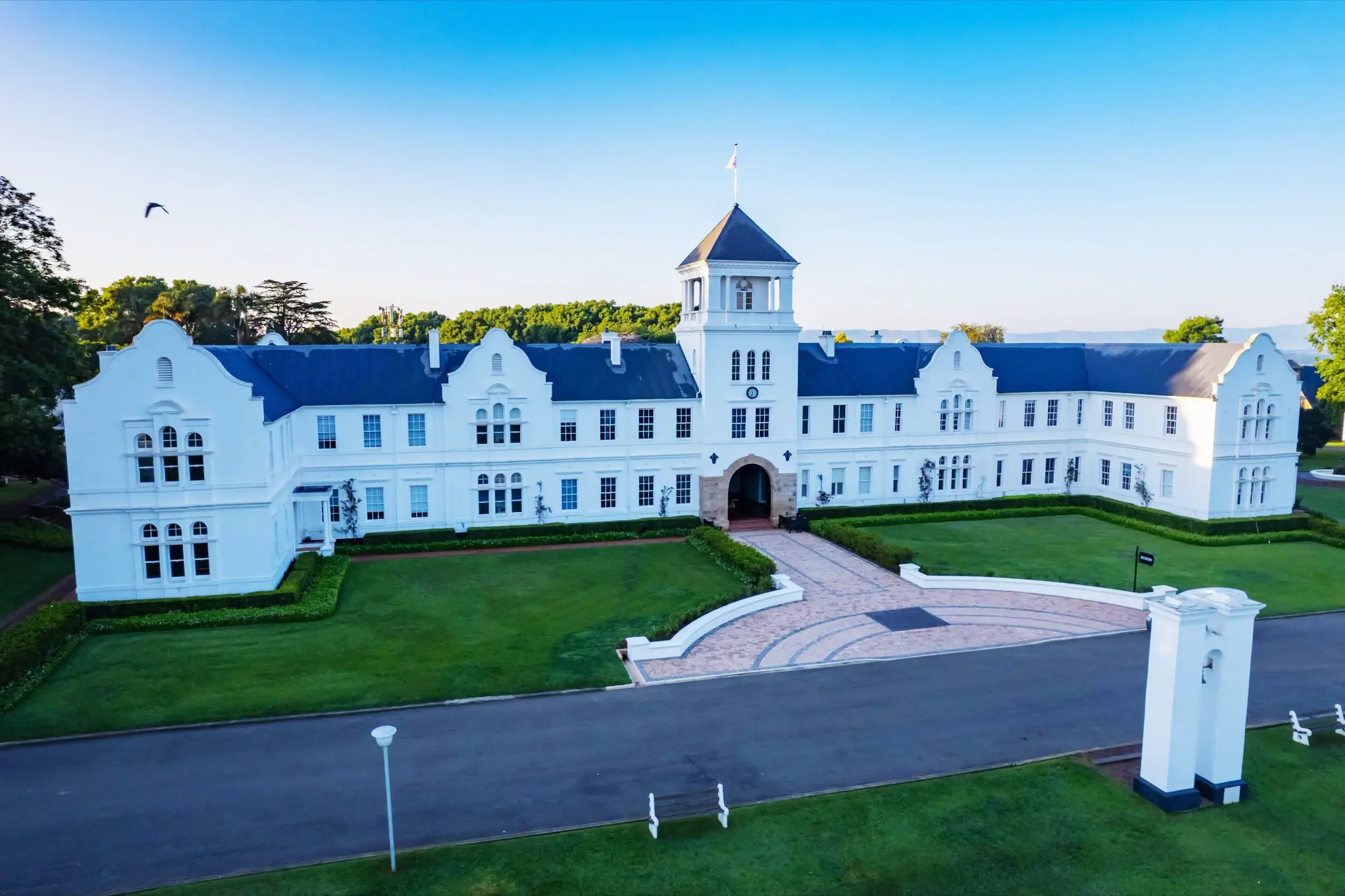
I am always reading insightful articles about South Africa's most expensive schools and what they cost to attend each year. Hilton College in KwaZulu-Natal Midlands is the most expensive school in South Africa.
It will cost you R451 557 to send your son to this school this year. Other schools topping the R400k mark for annual school fees include: Michaelhouse, Roedean School for Girls and St Andrew's College.
Fees are the easiest number to brag about over a braai but we never really review who owns South Africa's most valuable school real estate.
Fees are rented status, while the dirt beneath the classrooms, quads and cricket pitches is owned wealth.
Interestingly, when you look at the value of the land rather than what parents pay annually, the league table flips upside down. Hilton doesn't even feature near the top.
Hilton's estate is enormous. Its website says the property measures 1 600 hectares. Its own nature reserve bordering the uMgeni River, stocked with zebra, impala, wildebeest, giraffe and more than 300 species of birds.
Michaelhouse, its Midlands neighbour and closest rival when it comes to school fees, sits on 680ha. St Andrew's College in Makhanda reportedly has roughly 310ha.
By hectare count, these are the undisputed heavyweights of South African schooling. Hilton alone could swallow roughly 15 times the size of St Stithians' 105ha estate in Sandton and have left over room.
Here's the problem with bragging about hectares in the Midlands: land at that scale doesn't trade like a residential stand. KwaZulu-Natal farmland, however picturesque, generally trades between R15 000 and R120 000 a hectare, depending on land use, water rights and region.
I checked Property24 and Private Property for the latest listings for parcels in Hilton and Michaelhouse in the size-class cluster toward the lower end of that band. A 600ha property near Bergville and a 1 730ha property near Dargle are both asking under R20 000 a hectare, while smaller, more accessible lifestyle plots push toward the top of it.
Run Hilton's 1 600ha through the full R15 000 to R120 000 range and you land on a value of somewhere between R24 million and R192m impressive acreage, a modest bank balance next to what's coming.
Michaelhouse, on 680ha, comes in between R10m and R82m. None of this makes Hilton or Michaelhouse a bad investment for their boys — outdoor classrooms and open space are worth plenty in an education no balance sheet captures — but hectares in the Midlands don't translate into comparable commercial land value.
In the Midlands, size buys you scenery far more than it buys you commercial value. What shows up on a balance sheet is location.
Now look at St Stithians in Sandton. On paper, 105ha tucked between Bryanston and Randburg sounds almost modest next to Hilton's sprawling estate. But Sandton is not the Midlands. This is some of the most expensive dirt in sub-Saharan Africa, sitting inside a node where small serviced residential stands alone trade from upwards of R20m to R50m a hectare and that's a conservative comparison.
Ultra-prime pockets like Sandhurst have been reported trading closer to R150m a hectare for small stands. And this is before you even start talking about the land's broader commercial and mixed-use potential.
Apply a conservative institutional discount for a huge undivided parcel, because nobody is subdividing a working school into stands overnight, and St Stithians' land is potentially worth between R1 billion and R2.1bn. That's roughly a fifth of Hilton's hectare count.
Compare the two valuations: at the pessimistic end, St Stithians is worth several times Hilton's land; at the optimistic end, about 80 times. Fifteen times smaller, up to 80 times more valuable. That makes St Stithians a potentially multibillion-rand property sitting on one of Sandton's largest private landholdings — and it happens to run a school on top of it.
And then, once again, Cape Town wins. If Sandton land looked expensive, brace yourself for Rondebosch. Bishops Diocesan College, founded by Robert Gray, the first Anglican Bishop of Cape Town in 1849.
The school is also known as the custodian of South African rugby's origin story, as it is credited with hosting some of the first recorded rugby matches in South Africa.
The school also sits on prime southern suburbs real estate. It is a fraction of St Stithians' size, let alone Hilton's. But it sits in the middle of one of the most tightly held, most desirable residential and institutional pockets in the country, wedged between UCT, Bishopscourt and Newlands.
Blending residential and commercial land benchmarks for the area, Rondebosch supports both, with listings for built homes (if you can find one for sale because stock is in huge demand and low supply) in the Claremont/Rondebosch bracket running from roughly R28 000 to R55 000 a square metre.
Comparable raw land in the southern suburbs benchmarks closer to R12 000/km². A defensible blended rate for undeveloped land on a site like this sits around R12 000/km², well below what a built house on the same erf would fetch.
Run the maths on Bishops' 20.56ha campus (205 600km², according to Bishop's official school history page on its website) at that rate and you arrive at a land value of roughly R2.47bn.
Bishops, on barely 20ha and dwarfed by Hilton's 1 600ha, is potentially the most valuable piece of school-owned land in the country.
Hilton has roughly 78 times the land of Bishops and is worth, even at the top end of the estimates, only around a 13th as much.
St Andrew's, one of the oldest and most storied names in South African schooling, barely registers on a pure land-value basis — its roughly 310ha of Eastern Cape ground doesn't carry the price tag that a Cape Town or Sandton postcode commands.
Next time you're assessing the wallet-flattening fees, shake up the perspective to a property lens and ask what the land is worth.
Fees of R451 557 a year buys prestige, tradition, exceptional grounds, world-class academics and a very fine rugby fixture list.
It unfortunately does not buy a seat at the wealth table when it comes to real estate ownership in South Africa. The top of that table is set in Rondebosch, with Sandton keeping the seat warm two provinces over.
Estimated valuations in this article are modelled estimates based on regional land benchmarks, real comparable listings and publicly available campus size data — not professional valuations. None of the schools' land is on the market, nor is it likely to be but the numbers are worth ruffling a few feathers over.
