

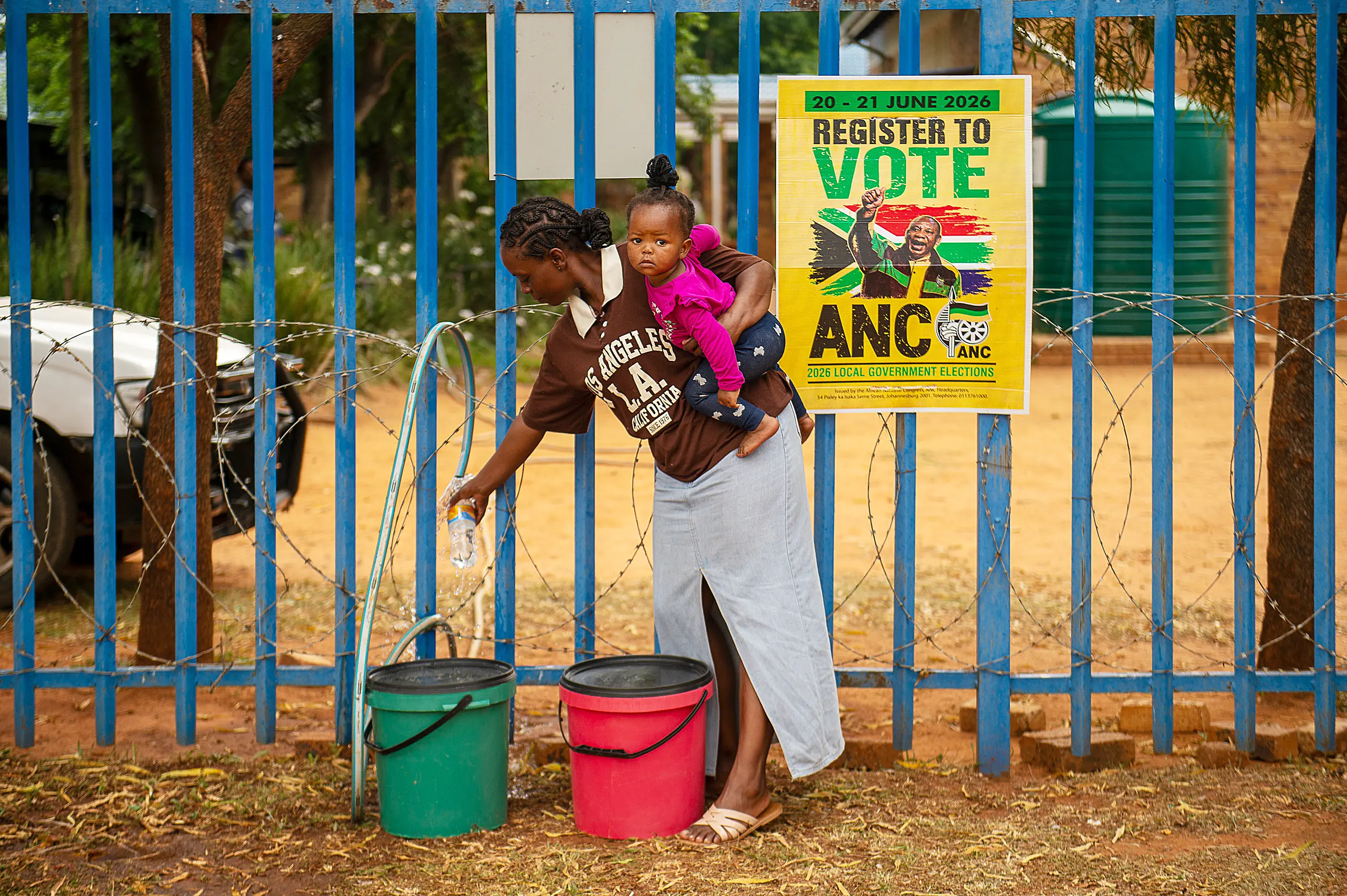
In Bronkhorstspruit, the water made children sick. Hundreds of them. The Auditor-General had told Parliament that nearly half the country’s drinking water systems failed microbiological safety standards, that almost every wastewater treatment works failed at least one effluent quality test, and that infrastructure projects were delayed by an average of 32 months. The crisis was foreseeable. It was avoidable. It arrived anyway.
This is the ground on which we are asked to vote.
On 4 November, South Africa holds local government elections.
The last time we did this, turnout fell from 58% to 46%. Among 18- and 19-year-olds, 90% did not register in 2021. Fewer than one in five voters aged 20 to 34 were on the roll. A 2025-26 Electoral Commission survey found that 76% of young people believe political parties pay too little attention to their concerns.
Youth unemployment among 15- to 24-year-olds sits at 61%.
Twenty-one-year-old Mnqobi Mhlongo put it plainly: “There is no difference, whether we vote or we do not. Nothing will change.”
That sentence carries the weariness of a generation that has watched every election promise dissolve into burst pipes, uncollected refuse and councillors who treat a woman’s body as a service fee.
The word for this is not apathy. It is a quiet, settled refusal.
Our politics has become uninteresting. That is the harshest thing one can say about a country that once produced Steve Biko, who was 30 when the security police killed him, and Nokuthula Simelane, who was 23 when apartheid’s police lured her to Johannesburg, tortured her for five weeks on a North West farm and disappeared her in 1983. Her remains have never been found.
The people who fought this country’s monster were young and they were certain that the future was theirs to make. They did not wait for permission. They did not ask their oppressors to be less offensive. They organised.
Now we have a politics that flinches at its own reflection.
The ANC feels insulted when it is associated with corruption, as though the word were a slur invented by ungrateful children rather than a description of what people live through every day. The councillor who doesn’t live in the same community they lead, the normalised burst sewer pipes, the dirty water tap that doesn’t work.
When Gwede Mantashe was confronted with allegations that municipal officials were demanding sex in exchange for jobs, he responded with a crude isiXhosa dismissal, a word for female genitalia deployed in a country bleeding from a GBV epidemic.
The ANC instructed him to apologise. The apology does not wash away the water.
The DA is no better at owning what it is. It continues to deflect charges that its priorities exclude the majority, even after a court ruled that its Cape Town is reminiscent of pre-1994 days. A city where spatial apartheid is not a memory but a municipal budget line.
The party that governs the housing crisis in Cape Town is the same arithmetic of neglect wearing a different colour.
Neither party will own the stereotype that people’s lived experience has confirmed.
The ANC hears “corrupt” and reaches for its struggle credentials. The DA hears “not for black people” and reaches for a screenshot of “a well-governed Mother City”. Both reach for the past because the present is indefensible.
Sisonke Msimang, writing in this newspaper in 2019, put the matter beyond sentiment: “The future belongs to those who have no memories of Mandela, and no illusions” about the New Dawn.
That is not a threat to the liberation project but the most honest sentence written about it in years. The young people staying home on 4 November are not suffering from a failure of memory. They are suffering from a surplus of evidence. They have watched the ANC treat corruption as an insult rather than a description and they have watched the DA deny what a court has ruled about its Cape Town.
And then there is Herman Mashaba, a man who built a fortune on black hair and now lectures black South Africans on whom to mourn. Telling us to grieve a queen while soiling the name of former Mozambican president Samora Machel, a man who died on our soil travelling from a meeting about our liberation.
This is the poverty of our politics: a millionaire who cannot tell a liberator from a trespasser, and parties that cannot tell accountability from betrayal.
Msimang also wrote that “we are not just proximate to the mundane inequality that made apartheid successful; we are complicit” and, worse, unprepared to see it.
That complicity is what the ballot box has been asked to absolve every five years and it is why the young refuse the absolution.
A politics that cannot remember Nokuthula Simelane, 23, tortured for five weeks, disappeared in 1983, her remains unfound, has no business demanding gratitude.
A politics that cannot tell a liberator from a trespasser has no business demanding a single vote.
Look elsewhere and the refusal is visible.
In Serbia, a leaderless student movement began with a concrete canopy that collapsed at a train station in Novi Sad, killing 16 people. It grew into plenums, street assemblies, a national refusal of corruption and negligence. Within two years it had torn up 14 years of Aleksandar Vucic’s dominance.
In Brazil, students were the first to mount large-scale resistance when Bolsonaro took power and they kept marching through budget cuts, through a coup conviction, through the long ugly aftermath.
In France, it began in a Paris sub-urb in September, with school pupils blocking their gates over crumbling buildings and teacher shortages.
Within weeks it had become the biggest youth protest movement in decades, with students holding daily general assemblies, voting on demands and refusing to disperse.
An 18-year-old named Elisha told a reporter: “We are neglected. We are abandoned.” Another, Mai-Lan, said young people were “inheriting an indebted France”.
The graffiti on the walls of Paris read: “Tomorrow Is Cancelled.”
When a government that had ignored them for years suddenly promised dialogue, the students answered with the same weariness South African young people know: “We won’t fall for it again.”
They did not wait for the perfect party. They organised.
We have the world in our pocket. A South African teenager can watch Serbian students dismantle a strongman on the same screen that shows Bronkhorstspruit mothers filling buckets from a tanker.
The media’s task in this election season is not to tell young people to vote. It is to show them what refusal and organisation have looked like elsewhere and to ask the obvious question: What would it take here?
The water is running out. The pipes are failing. The men in charge are old and they are drinking from a different tap. The young people of Brazil, Serbia and France did not begin with an election. They began with a street, a Lekgotla, a demand that could not be ignored. The ballot is one tool. It is not even the first one. Msimang’s “no illusions” is not a counsel of despair. It is an instruction to build something that does not depend on the men who sold the springs.
Liberation is a practice, not a promise, because it lives in the refusal to drink poisoned water quietly, in the pickets and street assemblies that begin with a single concrete canopy, in the young who have always decided that the future is not a gift from their elders but a thing they will have to take.

Matuba Mahlatjie is a journalist and strategic communications specialist.