


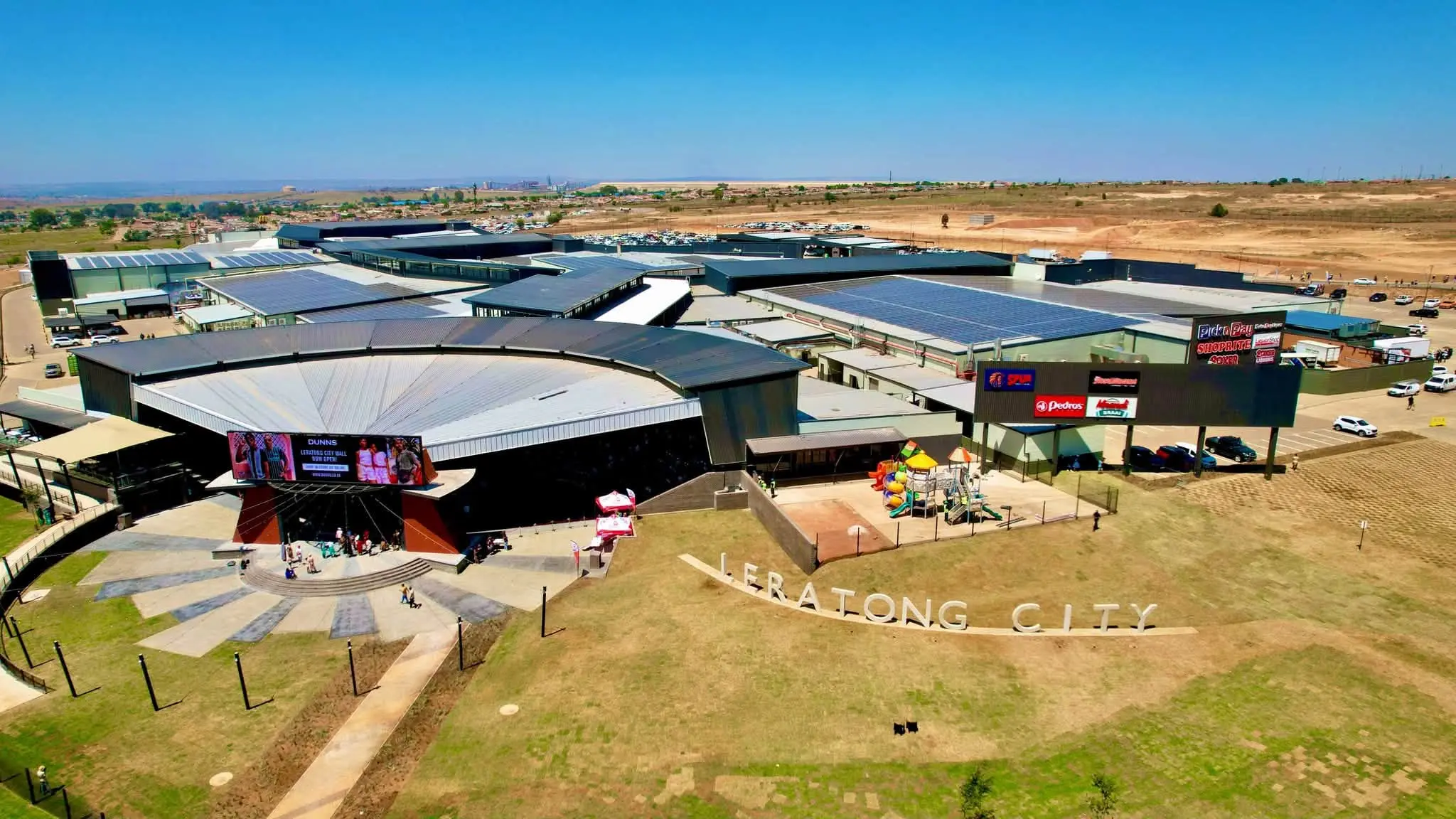
Walking into the colossal, new Leratong City Mall on a sunny morning in Jozi, you feel the magnetic energy of opening day almost immediately. Songs and chanting in local vernacular funnel through the corridors and grow louder the closer you get to the centre’s anchors: Shoprite and Boxer.
As is a rite of passage on opening day, the ritual has both anchors out in full force, with staff outside their storefronts competing to see who can chant the proudest and loudest.
As you move through the sea of singing employees, the energy is electric. Pulsating African energy at its finest, with goosebumps multi-plying. It makes one emotional. And why not? There’s plenty to be excited about because this centre will provide employment opportunities for the Kagiso township over the road.
I wasn’t the only one feeling it. Jason McCormick, whose family business, McCormick Property Development, built its first development in 1983 and has been developing township malls ever since, told me he had tears in his eyes that morning as he watched the new cashiers smiling and singing while their friends noticed them in store.
Leratong City Mall has its preliminary certificate from the Green Building Council of South Africa, which puts it on track to be the first township mall in South Africa to get its EDGE certification. It’s a green rating created by the International Finance Corporation, part of the World Bank Group. To earn it, a building has to prove it saves at least 20% on energy and water compared to a standard building and the same goes for the carbon baked into its materials.
A big part of the savings sits on the roof, where 5 376 solar panels produce 3.3MW at peak. McCormick told me solar covers almost 40% of the group’s energy needs and lifts the return on a development from about 10.5% to 11%. Going green has become as much a business decision as an environmental one.
For decades, headlines about townships have focused on unemployment and poverty. GG Alcock, the author of KasiNomics and their follow-up books, has spent years arguing that the headlines miss most of what’s happening on the ground. In April last year, he told BusinessTech that the numbers he has access to add up to an informal economy turning over R750 billion a year and that this captures only two-thirds to three-quarters of it. Scale that up and you land somewhere between R1 trillion and R1.125 trillion.
Drawing on Trade Intelligence research, Alcock puts spaza shops at R190bn a year across 100 000 outlets and township fast food at R90bn across 50 000 outlets. Taxis turn over R50bn a year and savings stokvels move another R44bn.
“If you take a mirror to the formal economy, you will find every sector represented in the informal economy,” Alcock said. “We need to recognise that these are real businesses built by township entrepreneurs.”
McCormick, who calls Alcock the flag bearer for this market, sees the same thing in his own numbers. “There’s so much more cash in these townships than is being recorded,” he told me. “We see it through our trading densities, through our turnover, through our rental escalations.”
A woman builds 10 single rooms in her backyard and rents each one out for R1 500 to R1 800 a month. That’s up to R18 000 a month that will never show up as a formal job in an official survey but it goes towards groceries and school shoes.
Where there’s no mall nearby, McCormick says township residents take a taxi to do their main shopping. A one-way trip costs between R18 and R25. If you live on a grant of less than R2 000 a month, that’s a huge slice of your money. Bring the shops to the people and the money stays in their pockets.
He has little patience for critics who say South Africa doesn’t need another mall. “They’re commenting from their armchairs in the suburbs,” he said. “Get out of your armchair.
Come and visit the townships.”
Then there are the jobs.
McCormick’s team received more than 21 000 CVs through an online platform that checked each applicant’s proof of address and prioritised people living within 8km of the mall. The retailers chose about 2 500 of them. Building the mall created another 1 096 construction jobs. Roughly one in eight applicants got a job, which tells you as much about the hunger for work as it does about the opportunity.
None of this happens unless the building stands with solid bones. Leratong wasn’t a straightforward build. The structural engineers were STRUXIT. Structural engineers design a building’s skeleton: where the columns go, how thick the floors are and how much weight the roof can safely carry. At Leratong, the roof carries thousands of solar panels. The mall also has an amphitheatre for up to 4 000 people and mining-inspired steel structures at the entrances.
STRUXIT says the shopping centre’s roof structure uses about 40% less structural steel than typical market benchmarks, demonstrating how intelligent design can translate into material and cost savings.
The engineering innovation extends to the 1 980m² amphitheatre, where 65 tonnes of structural steel span up to 32m without intermediate columns. A clever solution was integrating the roof gutter into the primary structure, allowing it to double as the compression chord of the main trusses and reducing their depth by 250mm.
Fewer columns mean more open floor space, giving the mall flexible shop sizes and wide walkways that can host markets and pop-up stalls.
“The exciting part of engineering is finding ways to make ordinary materials perform multiple functions. At Leratong, even the gutter became part of the primary structure,” says Chris Truter, the director at STRUXIT. “It’s these kinds of design decisions that allow us to realise ambitious architectural ideas without throwing more steel at the problem. By saving steel in areas hidden above ceilings, we can invest more in public spaces, where the structure itself becomes something worth celebrating.”
Now for the less shiny side. Not everyone buys the KasiNomics argument. Toby Chance, a former DA spokesperson for small business development, wrote a sharp response to Alcock in 2019.
He called Alcock’s estimate of real unemployment “a thumbsuck” and argued that “poor people selling to poor people cannot spur meaningful upliftment and will never create high rates of economic growth”. I suppose it makes one wonder what happens to the spaza shops near Leratong now that the supermarket chains have opened across the road.
McCormick admits South Africa has far too many shopping centres. He says townships are the exception because they were ignored for so long.
McCormick secured the Leratong land in 2008 and planned to build in 2014 but had to shelve the project because the bulk infrastructure needed a R106 million upgrade that government hadn’t done. This time round, his company paid close to R100m for external infrastructure, including about R50m for government substations, which it hopes to claw back through rates and taxes.
The number to watch over the next few years is the cost of occupancy, which is the rent a tenant pays as a share of what it sells. McCormick says that at Alex Mall, his flagship, it sits under 6%. In retail property, that’s a healthy figure, and it’s why tenants renew. If Leratong gets close to that, the township economy would have proved its case.
Leratong City Mall drew in 69 414 people on its opening day. The chanting will stop eventually and soon enough opening day will become an ordinary Tuesday afternoon. That’s when we find out what Leratong really is. But with McCormick Property Development just one mall away from its 100th township development, Kagiso is in good hands.
