Balancing act: The SABMiller PLC Alrode brewery and bottling plant in Johannesburg. South Africa’s ban on
alcohol sales in 2020, introduced to prevent Covid-stressed hospitals having to handle injuries caused by
drunkeness, put projects worth about R12.8-billion on hold. (Waldo Swiegers/Bloomberg/Getty Images)
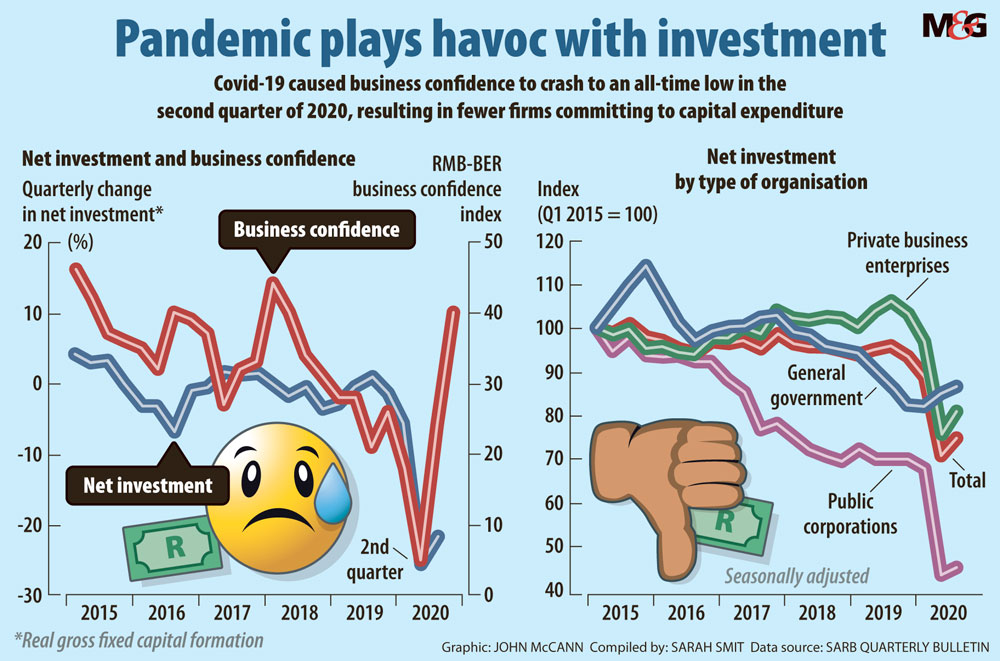
Capital expenditure has been on the decline for years, but Covid-19 sent investment in machinery, factories and the tools of industry into a tailspin.
Recently, the effect of Covid-19 restrictions on investments by alcohol companies has dominated headlines.
South African Breweries (SAB) has cancelled a total of R5-billion in capital expenditure since the first alcohol ban was announced in 2020. Last year, Heineken cancelled a R6-billion investment to build a new brewery and Distell deferred more than R300-million of capital expenditure.
Alcohol companies weren’t the only businesses faced with the dilemma of having to rethink their investment spend: In 2020 the Hospitality Property Fund, a subsidiary of Tsogo Sun, had to suspend its capital expenditure programme amid huge declines in tourism. Airports Company South Africa chief executive Mpumi Mpofu said the drop in air traffic would be accompanied by considerable reductions in investments.
 (John McCann/M&G)
According to data released by Nedbank this week, in the second half of 2020 the number of new capital expenditure projects fell by 60%, while the value dropped by 24%. Nedbank’s Capital Expenditure Project Listing, which tracks investment commitments by the public and private sectors, notes: “The Covid-19 pandemic had a devastating impact on investment plans in 2020.”
For the year as a whole, a total of 32 new projects were recorded, the lowest since the listing started in 1993. The value of the projects amounted to R66.2-billion, the smallest since 2004.
The country’s investment woes did not begin in 2020. Data from the South African Reserve Bank shows that investment in fixed assets has steadily decreased since 2015. But, in the second quarter of 2020, the country saw a record 59.8% contraction in gross fixed capital formation.
Though investment recovered slightly after Covid-19 restrictions were lifted, economists forecast that, as economic uncertainty regarding the government’s response to the pandemic persists, the virus will continue to hit capital expenditure in 2021 and beyond.
Sanisha Packirisamy, an economist at Momentum Investments, says South Africa’s capital expenditure problem largely rests on stalled private sector activity. About 60% of the country’s capital expenditure is spent by the private sector. “In order to fix South Africa’s investment story, a lot of it actually relies on propping up private spend,” Packirisamy says.
“In South Africa for the last couple of years we have seen negative growth in that private component and it has been driven that way because of high policy uncertainty.”
Uncertainty and low demand existed before Covid-19. “What the pandemic really does is exacerbate those issues even more. Because with the restrictions on say, for example, alcohol sales, or just in general the restricted movement of people, demand lessens,” Packirisamy says. “This has a direct impact on the willingness of businesses to invest in the current climate.”
According to data compiled by the Bureau of Economic Research, business confidence crashed to an all-time low in the second quarter of 2020 and recovered considerably by the end of the year.
But the index also shows that business confidence has generally not recovered to pre-2008 financial crisis levels.
Packirisamy says that investment encourages longer-term economic growth. “When you talk about SAB building a factory, you may not necessarily see the direct impact. But it does foster some sort of positive sentiment about investing in the country,” she says.
“If [we], as consumers, go out and spend R100, that shop owner gets R100, which he can put back into his business. So you get a multiplier effect. But it’s all happening now… So the multiplier is actually smaller. But if SAB builds a factory, there are higher multiplier effects. Because you then build confidence in the economy. They also hire more workers, who get a salary. And they can spend it in the economy.”
Rosemary Anderson, the national chairperson of the Federated Hospitality Association of Southern Africa, says Covid-19 will probably be the last straw for the industry already flailing in an unpredictable economic environment.
“Tourism and hospitality is totally dependent on the environment within which it operates,” Anderson says, adding that poverty and
crime is already a deterrent for investors. Covid-19 means the survival of businesses hangs in the balance, Anderson added. “The closure of large businesses in this sector will be a bloodbath and the resultant loss of jobs upstream and downstream will be catalytic. This will take decades to reverse.”
The chief executive of the South African Forum of Civil Engineering Contractors, Webster Mfebe, says in 2020 the industry had about R50-billion less capital expenditure than in 2019. “In 2021, it is not expected to be much better,” he adds.
The top constraints on investment in construction are “a severe lack of demand for building by the private sector and a significant lack of confidence in the economy in general”, Mfebe says. The pandemic only added to the sector’s woes when construction was put on hold during the lockdown, he says.
Mfebe adds that over the years corruption has also become a stumbling block for investment in infrastructure. “This phenomenon robs the country of the much-needed infrastructure. Money is lost through the incapacity of the state to deal with this.”
Though the government’s plans to roll out infrastructure may help the industry, there is a general lack of confidence in the government’s ability to see this through, Mfebe said
A recent report by the National Planning Commission identified “weakened capability and corruption in state-owned entities and state institutions, coupled with private investment stalling in response to diminished confidence in
South Africa’s future” as contributing to declines in capital expenditure.
“Infrastructure development is critical to attaining our long-term goals. In the context of a developing country seeking significant structural change, the public sector must lead this effort,” the report reads.
Nedbank economist Johannes Khosa agrees, but says the government’s fiscal constraints will make pouring more money into infrastructure difficult. The government must also create an environment that enables private investment, he says.
Loadshedding, slow structural reforms and muted growth have caused the long-term decline in investment spending, Khosa says.
The Nedbank data notes that the outlook for fixed investment in 2021 remains highly uncertain. The researchers expect fixed investment to contract by a further 2.6% in 2021. This is a much slower rate of decline than the projected 18.2% for 2020.
“Looking ahead into 2021, though we expect some recovery because of the hope around vaccinations, that isn’t going to happen immediately and directly translate into companies coming back and committing to capital expenditure,” Khosa says.
“Instead it is likely companies will focus on recovering the revenues they lost last year … So this year in terms of investment spending it is going to be another difficult year.”
Khosa says major commitments by companies to participate in the government’s investment drive may also be delayed as a result of the pandemic. Some will only get going in the next three to five years, he says.
President Cyril Ramaphosa’s investment drive was not immune to the impact of Covid-19. Yunus Hoosen, head of Investment South Africa, told the Mail & Guardian this week that seven out of the 152 projects announced at the South African Investment Conference have since been delayed because of the pandemic. The delayed projects hold a value of R22.3-billion. However, the vast majority of the projects have not been affected.
Mikel Mabasa, the chief executive of the National Association of Automobile Manufacturers of South Africa, says investment by the car industry is in a good spot.
Major car manufacturers that were on the verge of pulling out of the country have not withdrawn current capital expenditure commitments.
But, he says, the current economic uncertainty will probably mean fewer commitments will be made this year. “We think that some of the companies will definitely suspend or postpone some of their announcements.”
But, says Mabasa, other companies will forge ahead with new investments. Last week, Toyota announced it would start manufacturing a new model, the Corolla Cross, in the country this year. This is expected to create 500 new jobs.
“So you will have a combination of both: those who still want to commit to investment, like Toyota, and those that will take a much more cautious approach,” Mabasa added.
Khosa says cautiousness will probably be the trend into 2021 and beyond. “Just look at it from a personal point of view: if you are not certain about the future, you are not likely to make long-term commitments, like buying a house or a car. You don’t know if you will have a job tomorrow, so chances are you will just postpone it until you have some direction.”
[/membership]