National Freedom Party members at the launch of the party's 2014 election manifesto at Mehlareng Stadium in Tembisa, South Africa. The killing of a NFP candidate at Nongoma has sent the party’s candidates in KwaZulu-Natal into hiding in fear for their lives. (Photo by Gallo Images /Sowetan / Mohau Mofokeng)
On 27 August the ANC was left with few options after the party failed to meet the deadline to register candidates for the local government elections with the Electoral Commission of South Africa (IEC).
The party’s leaders came up with several plans. One, which they made public, was to approach the electoral court and request that it compel the IEC to reopen and extend its candidate registration for an extra two days.
The Mail & Guardian has since learnt that the ANC’s top brass also negotiated with smaller political parties it has formed coalitions with, to trade a chunk of their proportional representatives (PR) for the ruling party’s wardless candidates.
The ANC faced huge electoral losses in 95 municipalities.
According to officials from smaller parties, including Al Jama-ah leader Ganief Hendricks, ANC deputy secretary general Jessie Duarte made the ANC’s intentions known during a meeting in Cape Town while on the campaign trail earlier this month.
ANC spokesperson Pule Mabe said, “To the best of my recollection the NEC [national executive committee] hasn’t formally engaged on that.”
The ANC appears to be following the National Freedom Party’s (NFP) 2016 elections playbook after it failed to submit candidates to the IEC by the due date. Other political parties would use the NFP to get its members to vote for them by claiming that the party had endorsed them.
Hendricks said ANC president Cyril Ramaphosa and Duarte each spoke to him, proposing that the ruling party take the lion’s share of their PR candidates list in the City of Cape Town.
Al Jama-ah has submitted 40 candidates in Cape Town for both PR and ward council seats. At the time, the ANC had failed to submit a single candidate in its PR list in all 116 wards.
“They were in crisis and they had an NEC [national executive committee] meeting and they were not sure whether the candidate nominations would reopen. The president handed the phone to Jessie and they said they were going to report back to the NEC whether we would support them legally in the court case,” Hendricks said.
“They asked, seeing that we have 40 candidates on the PR list and we are only going to win about four, [whether] the other 36 [could] be [re]placed with ANC people and we agreed because, as a political party leader, I saw an opportunity, and the opportunity was the governing party telling their voters to vote with Al Jama-ah,” he said.
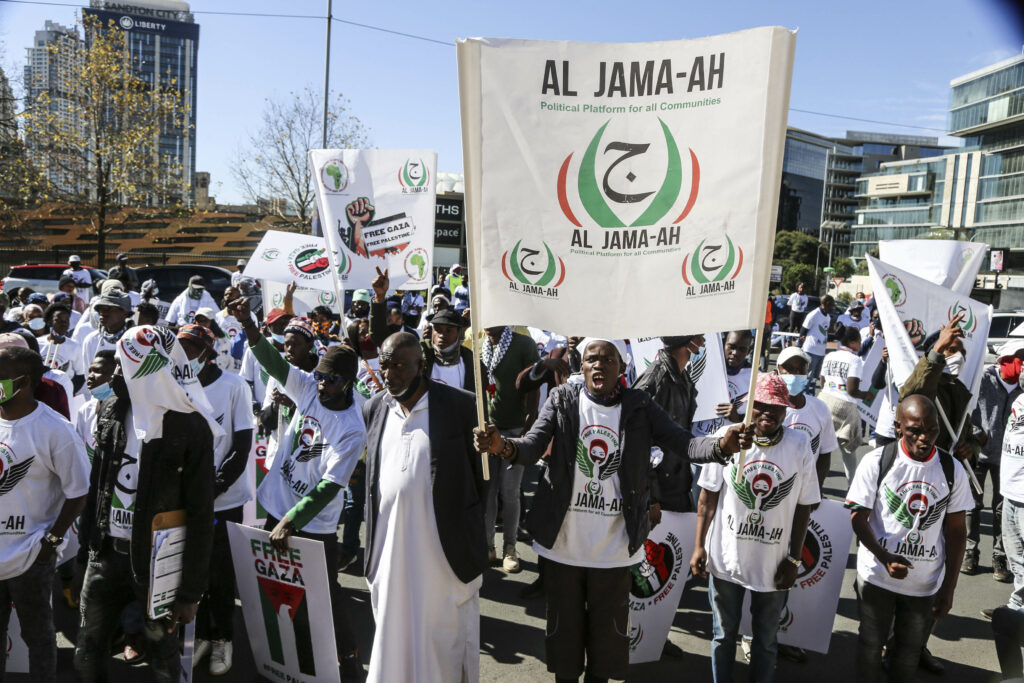 Supporters and members of the Al Jama-ah Party at the #FreePalestine march at the United States Consulate on May 21, 2021 in Sandton, South Africa. (Photo by Gallo Images/Luba Lesolle)
An ANC source in the Zululand district municipality, where the party had failed to submit ward and proportional representation candidates in several local municipalities, said “informal talks” had taken place with the NFP about a similar arrangement.
The Zululand district municipality includes Ulundi, Nongoma and Vryheid, which are controlled by the Inkatha Freedom Party (IFP), and Pongola and eDumbe, which are run by the ANC.
The ANC had been set to lose the ground it had gained in the Zululand district municipality — historically a stronghold of the IFP — without a single vote being cast.
Although sources in the NFP said the talks had been initiated by the ANC, a regional ANC official, who asked not to be named, said that they had been initiated by the NFP.
“Here it was different though, in that the NFP was begging us that we should vote for their candidates and that they would put our guys on the PR list because we didn’t have ward candidates or PR. It is them who came to us,” the ANC source said.
“It was just informal talks, nothing formal.”
A source in the NFP confirmed that there had been discussions with the ANC but only at the district level. “The comrades at the district level did hold informal talks with the ANC at the time. We did not intervene because it was their own initiative in response to what was happening at the time. There was no discussion with the ANC at the national level.”
The discussions remained at the informal level in the region and came to an end on 6 September, when the IEC reopened voter and candidate registration.
Lawrence Dube, the ANC spokesperson for the Abaqulusi region, said the party was not looking at coalitions in the district. “No party goes into an election not wanting to win it outright. Coalitions only happen when there is nothing else that you can do.”
Although Ramaphosa has said the ANC should not consider going into coalitions, smaller party leaders that are already aligned with the ANC in hung municipalities have indicated that talks are already in progress.
Hendricks said Duarte had already made it clear that Gauteng provincial leaders would endorse Al Jama-ah in Laudium.
“She came to Cape Town to launch the campaign and we had lunch at a Malay restaurant and we discussed the City of Johannesburg position and we told her that we are prepared to continue with our arrangement and we want to strengthen the ANC there from our two seats to five seats and they were very happy with that,” he said.
“They are happy we don’t make demands; we leave it to the mayor to decide which one of our members they want to work with … We have 30 ward candidates in Tshwane and it would be nice for the ANC to tell people to vote for Al Jama-Ah.”
Addressing the national executive committee (NEC) during his political overview in July, Ramaphosa said the ANC’s experience since the emergence of coalitions in 2016 had demonstrated that “coalition governments are incapable of effectively driving development, providing quality services and ensuring proper accountability”.
“There have been discussions that we must get used to coalition governments, but we cannot and must not because coalitions do not deliver. We need to ask ourselves what is the nature, scale and complexity of the challenge facing local government. We need to consider the impact of counsellor selection and deployment,” he said at the time.
Instead of looking at coalitions, Ramaphosa proposed an overhaul of the party’s selection of mayors, councillors and municipal senior management.
NFP secretary general Canaan Mdletshe said the party had not held any discussions with “any party” about coalitions or electoral alliances.
“We are entering the election with the intent of winning as many wards and municipalities as possible. After the elections, if there is a need, then maybe we can talk about coalitions,” he said.
[/membership]