Dr Rosali Smith is confident the planthopper insects from South America will do their job in destroying the invasive weed. (Delwyn Verasamy/M&G)
In the vast sea of invasive water hyacinth clogging the eutrophic (plant-dense, animal life-choking) Hartbeespoort Dam, Rosali Smith is hunting for insects.
Not just any insects. She’s after tiny water hyacinth planthoppers (Megamelus scutellaris).
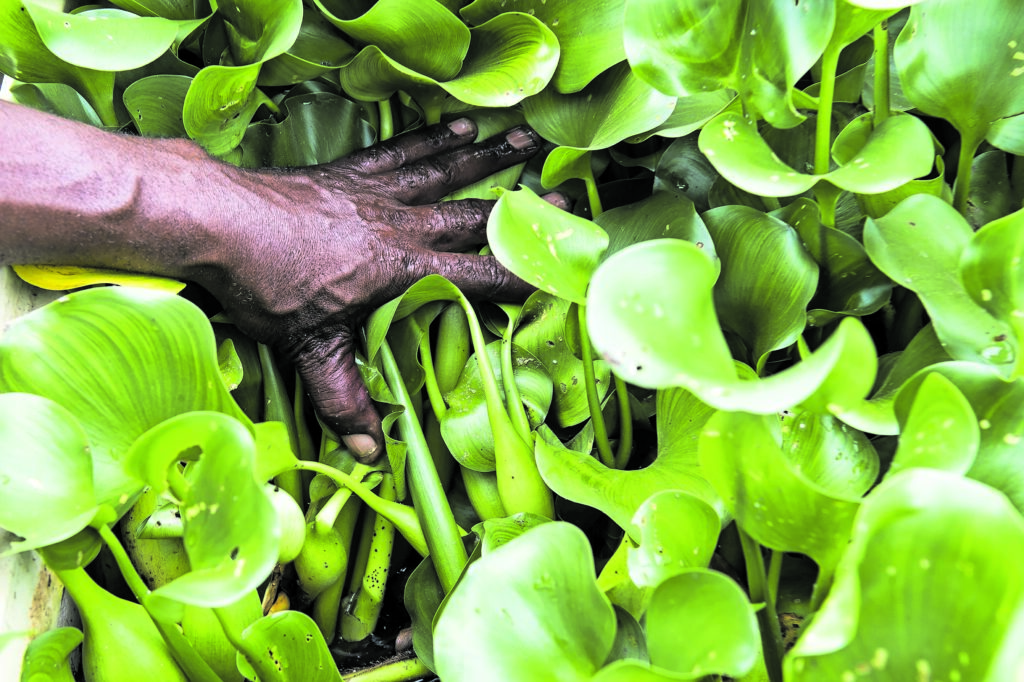
Smith, a postdoctoral fellow at the Centre for Biological Control (CBC) at Rhodes University, plunges her hands into the polluted water and pulls out several free-floating aquatic weeds to inspect them for signs of insect damage.
Eventually Smith finds what she is looking for. “We’ve got insects,” she exclaims. She shows off the cluster of innocuous pale-cream bugs and nymphs hopping on the base and bulbous stems of the weeds. “It’s good to see them,” Smith grins. “They’re definitely picking up here.”
Since 2018, these miniscule bugs have taken on a big, endemic problem — the fast-growing superweeds that have plagued Hartbeespoort Dam for more than 50 years.
 (Delwyn Verasamy/M&G)
Water hyacinth, described as the world’s worst aquatic weed, originates in Brazil. It smothers waterways in choking mats, harming aquatic biodiversity. And its infestations rack up hefty costs in efforts to reduce its pernicious spread.
But it’s in their natural enemies, the host-specific planthoppers native to South America, that the problematic plants have met their match.
“What the planthoppers do is they will suck the sap from the leaves, or even the stems, depending on how dense the numbers are, and then the leaves will turn yellow, and then brown and curl,” Smith says. “It does stress the plant and the biocontrol agents are so good because they prevent the plants from even producing flowers.”
Each water hyacinth flower produces thousands of seeds, which remain viable in the sediment for up to 25 years.
In 2017, the department of water and sanitation stopped all herbicide applications on Hartbeespoort Dam, which led to the water hyacinth covering nearly half of the water body by August that year, according to an unpublished paper by Professor Julie Coetzee, the director of the CBC, and colleagues in the unit.
The paper describes how a decision was taken for the CBC to embark on an “inundative biological control programme” in 2018, involving large-scale releases of the newest water hyacinth biological control agent — the planthopper. Although the insect was first released in South Africa in 2013, it had not yet been released at Hartbeespoort Dam.
Since then, nearly 300 000 of the mass-reared bugs have been released on the dam. This has been shown to successfully manage the infestation with “unprecedented reductions” in the water hyacinth coverage.
According to the paper, the biological control of water hyacinth in South Africa has been constrained by cool temperatures and highly eutrophic waters that curb biological control agent population build up and enhance plant growth.
“However, inundative releases of the control agent, Megamelus scutellaris, at the Hartbeespoort Dam have shown for the first time that water hyacinth can be managed successfully using biological control as a standalone intervention, despite eutrophication and a temperate climate.”
Sentinel-2 satellite imagery showed a reduction in water hyacinth from more than 40% to less than 10% over two consecutive years since the planthoppers were first released in 2018, while field surveys confirmed a corresponding increase in the bug population density.
According to the paper, eradicating the plant is highly unlikely because of the size of the dam and the extensive seed bank in the sediment. “So we have to learn to live with water hyacinth. However, we can aim to keep the weeds below a level that is damaging using biological control so that the dam remains open for use.”
Biological control is not a silver bullet for invasive species but is a “green herbicide”, Smith says. “In some systems our approach is our constant presence, constant communication with stakeholders and just inundating plants with insects. At the end of the day, on a long-term basis, it’s more environmentally friendly, more effective and cost-effective.”
According to Coetzee, biological control relies on the use of natural enemies of the invasive to feed on and reduce the populations of the weed. “This method of control is safe because the agents are tested under strict quarantine measures to ensure they are host-specific and will not pose a threat to our indigenous species.”
Biological control doesn’t aim to eradicate the invasive plant, but rather to reduce it to an “economically or ecologically acceptable level of control”, she adds.
The root of the problem lies in the nutrient-enriched waters of Hartbeespoort Dam, because of poorly treated wastewater from the infrastructural collapse of sewage treatment plants.
“The effluents from these facilities are the principal contributors to the nutrient loads of many reservoirs including Hartbeespoort Dam,” according to the paper. “The proximity to major urban areas and agricultural zones have resulted in extreme nutrient loads entering the dam through its tributaries, notably the Crocodile, Magalies, and Hennops rivers.”
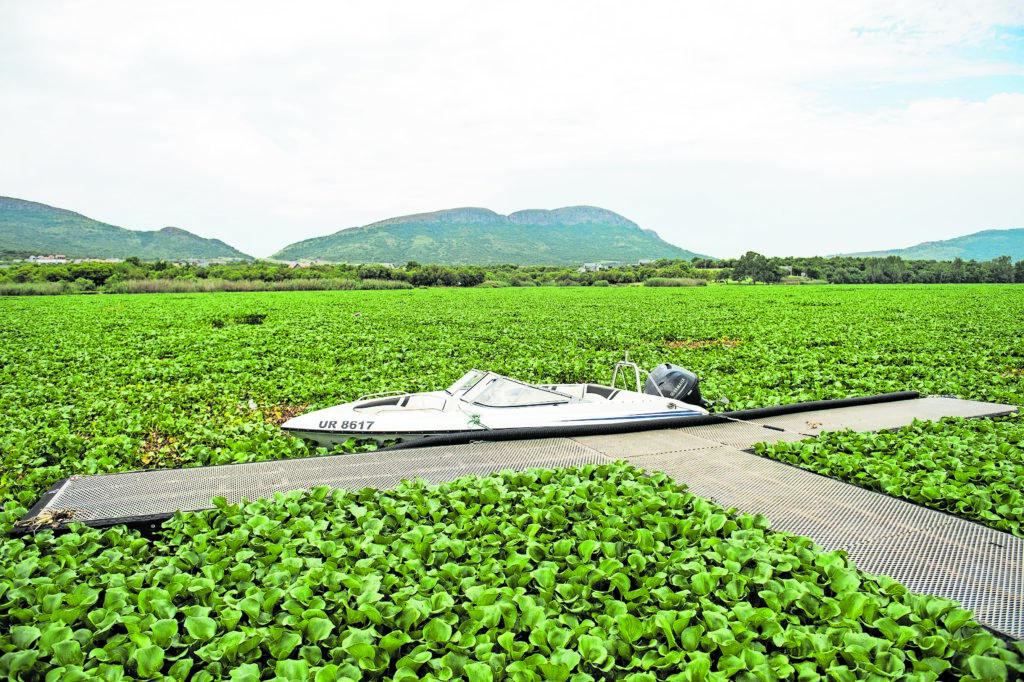 A green ‘herbicide’: The water hyacinth feasts on the nutrient-rich Harties water. (Delwyn Verasamy/M&G)
The dam, it says, was considered a hypertrophic (overgrown) lake in the 1970s because of nutrient pollution and remains “the country’s most hypertrophic impoundment”, providing the ideal conditions for invasion by water hyacinth.
“The reason water hyacinth is doing so well and why it’s so hard to manage it, is because of water quality,” Smith says. “Our water is rich in nutrients and that’s why we are struggling with sites like Hartbeespoort Dam and Roodeplaat Dam. There’s sewage running into the rivers and dams directly.
“Because the water is so enriched there’s alway going to be something replacing something, where your system is shifting between states. If the water hyacinth isn’t here, then you’ve got the cyanobacteria [blue-green algae]. If it’s not cyanobacteria, then it’s common salvinia [an invasive floating fern] … and that’s because of water quality.”
Research and implementation of water weed biological control at Hartbeespoort Dam has cost the CBC about R1.8-million a year, including salaries, operation and running costs, rearing tunnels, quarantine facilities and insect rearing.
The nonprofit CBC received R22-million for aquatic weed research from the department of forestry, fisheries and environment for four years, from 2018 to 2021. But funding that should have arrived in April this year has not yet been awarded for the next cycle, and the CBC is now reliant on private donations.
Coetzee says that although it has had to retrench staff and is using reserve funds, the CBC remains open to help its collaborators at dams such as Hartbeespoort “to keep biological control agents on the dam to help reduce the dam caused by water hyacinth and other invasive species”.
As part of a citizen scientist programme, the planthoppers are reared in specially designed tunnels, particularly in spring after large-scale germination of water hyacinth seed, and then strategically released on the dam in batches by local residents.
“It worked so well with the planthoppers in winter,” says Theo Sandenberg, the maintenance coordinator at an upmarket estate, home to three rearing tunnels. “I put in heaters for them and they’re doing well.
“But the hyacinths have suddenly pitched up again in the last month and completely taken over. It’s really bad. It took us four hours to get a boat out of the dam because of all this stuff. We can do nothing on the water.”
Smith, looking out at the dense deep-green carpet of water hyacinth, feels confident the planthoppers will do their jobs. “The insects can do it again,” she smiles. “I think it can be mind-boggling how these tiny little insects can affect all of this. But sometimes we underestimate nature.”
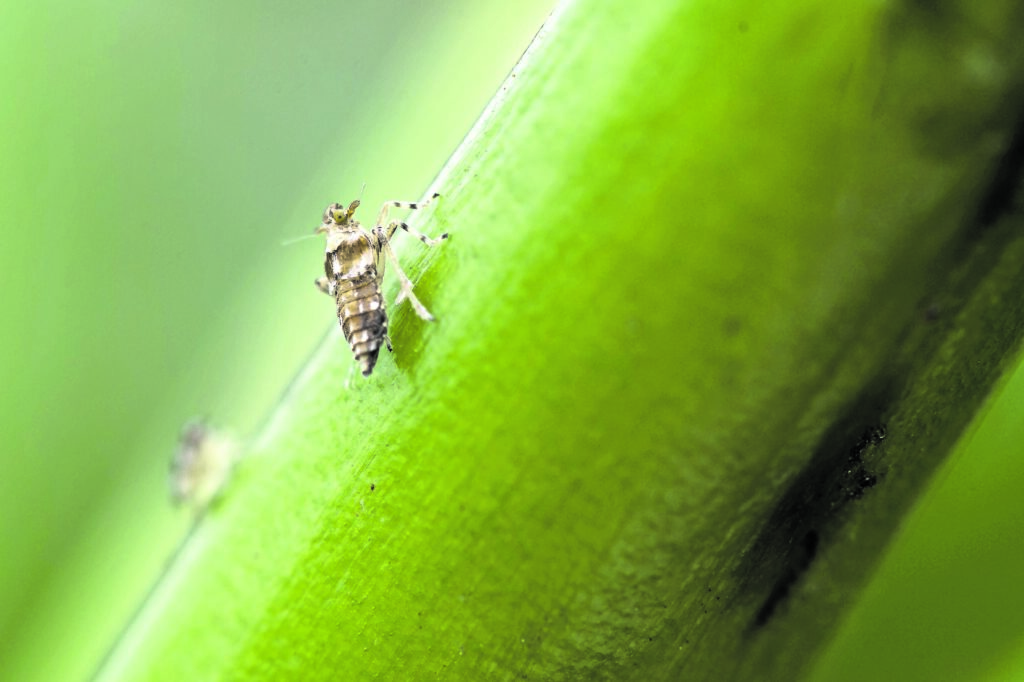 Tiny bug, big name: A Megamelus scutellaris. (Delwyn Verasamy/M&G)
A procession of bugs to clean up human messes
- Hartbeespoort Dam has been hypertrophic (overgrown) since the 1970s.
- Water hyacinth was chemically controlled in the 1980s but eutrophication was never addressed.
- During the early 1990s, a classical biological control programme was implemented for water hyacinth on the dam, involving congeneric weevils, a moth, and a mite, followed by a mirid in 1997. Despite the successful establishment of this suite of agents, successful biological control on the system was limited by cold winter temperatures and herbicide applications that continued until 2017.
- In 2007, the Hartbeespoort Dam remediation programme, Harties Metsi a Me, was initiated.
- By 2015, hundreds of millions of rands were spent.
- By 2017, the department of water and sanitation pulled the plug on funding.
[/membership]