Emergency: Nurse Salome Nkoana at Tembisa Hospital . The increased demand in Gauteng for oncology services has led to the establishment of treatment centres in the Chris Hani Baragwanath and Dr George Mukhari academic hospitals. (Guillem Sartorio/AFP)
‘I don’t think that my sister would have lived this long with cancer had she not received the care that she was receiving at Charlotte Maxeke hospital,” said Muntu Nyathi, who is from Bushbuckridge in Mpumalanga but who currently lives in Daveyton, Ekurhuleni.
Nyathi buried his sister, Sharlotte, on 29 January. He spoke of how she had lost her battle to what was initially thought to be breast cancer, but was eventually identified as cancer of the lungs.
Sharlotte, 42, was diagnosed with breast cancer in 2018 after having been referred to the breast care clinic at Helen Joseph Hospital. After her diagnosis, she underwent chemotherapy followed by hormonal therapy and radiation at Charlotte Maxeke Johannesburg Academic Hospital.
Later in the same year, she underwent surgery.
“One of her breasts was removed, I just can’t remember which one. We thought she was healed after the surgery, but they didn’t see that the cancer had spread to her lungs,” said her brother.
The mother of two started getting sick in December last year and when her cough persisted, the family agreed that she needed to get checked. The back and forth journey to Helen Joseph and Charlotte Maxeke hospitals resumed after it was confirmed that she had lung cancer.
“It was difficult seeing her like that because she was more than just a sister, she raised me. I had to make sure that she did not miss any of her appointments or take her medication. But I honestly can’t complain about the treatment she received because I was there with her, I guess it was her time,” said Muntu.
Sharlotte died on 14 January.
The Nyathi family’s experience is contrary to that of more than 2 000 patients that are on a waiting list to receive cancer treatment in Gauteng.
Charlotte Maxeke and Steve Biko Academic hospitals are the only ones in the province that offer radiotherapy and, since parts of Charlotte Maxeke went up in flames in April last year, cancer services have been limited.
Activists from the Cancer Alliance and the Treatment Action Campaign marched to Premier David Makhura’s office in November, demanding that he urgently address what they termed a “cancer crisis”.
According to the alliance, people with prostate cancer might have to wait for up to five years to get radiotherapy at Charlotte Maxeke. For those needing radiotherapy for breast cancer, the wait could be up to a year. Those awaiting cervical cancer treatment could wait up to six months.
“Nothing has happened since our march last year,” said the Cancer Alliance’s Salomé Meyer.
She said cancer was not regarded as a priority disease, which had resulted in those provinces that did offer treatment not being able to offer it adequately.
“What we have currently is that women are being screened for cervical cancer and that is because there’s a policy that is in place. There’s a policy for breast cancer but unfortunately that policy has not been implemented because the provinces don’t have money to train our primary healthcare staff how to do a clinical breast examination, and we don’t have enough mammograms. They are busy with the lung cancer policy and the prostate cancer policy but to a certain extent, the policies mean nothing because the provinces don’t have the money to implement them,” Meyer said.
The spokesperson for Gauteng’s health MEC, Kwara Kekana, said Gauteng’s oncology services had experienced increased demand, which was stretching existing treatment centres.
“In order to keep up with the provincial demands for cancer treatment it has become a need to establish treating centres in the other two central hospitals being Chris Hani Baragwanath Academic Hospital as well as Dr George Mukhari Academic Hospital,” she said.
Kekana added that a chemotherapy treatment centre had recently been opened at Chris Hani Baragwanath.
There was also progress being made in establishing radiotherapy services at Chris Hani Baragwanath and Dr George Mukhari, which, Kekana said, was delayed by the Covid-19 pandemic.
“The two hospitals are working together with the provincial and national departments of health on the project. The latest progress on the project is that the Linac machines arrived from overseas around November 2021. Each machine has been procured at the cost of R52-million. The process of preparing ground for the turnkey radiology buildings is underway.”
But Meyer said the machines would only be operational in 2023 because the department realised after completing the order that they needed bunkers for the apparatus. This poor planning again leaves public sector cancer patients at a severe disadvantage, she said.
Out of 20% of all patients who had a recurrence of breast cancer while waiting for radiation, 10% had died since 2019, according to Louise Turner, chief operating officer at the Breast Health Foundation.
She said poor record keeping of cancer patients as well as the inadequate training of nurses who worked at primary health facilities contributed to South Africa losing patients to a disease that could be cured if detected early.
The communications manager at the Democratic Nursing Organisation of South Africa (Denosa), Sibongiseni Delihlazo, said nurses who specialised in fields such as oncology were readily not available at South Africa’s facilities.
“The very same government is no longer willing to enrol the many nurses into various specialities like oncology. This means that you will simply have general nurses with no speciality training caring for patients with those limitations.”
Delihlazo added that the department of health and the treasury should be blamed for compromising the quality of healthcare, instead of blaming overworked nurses who often did not have the necessary resources.
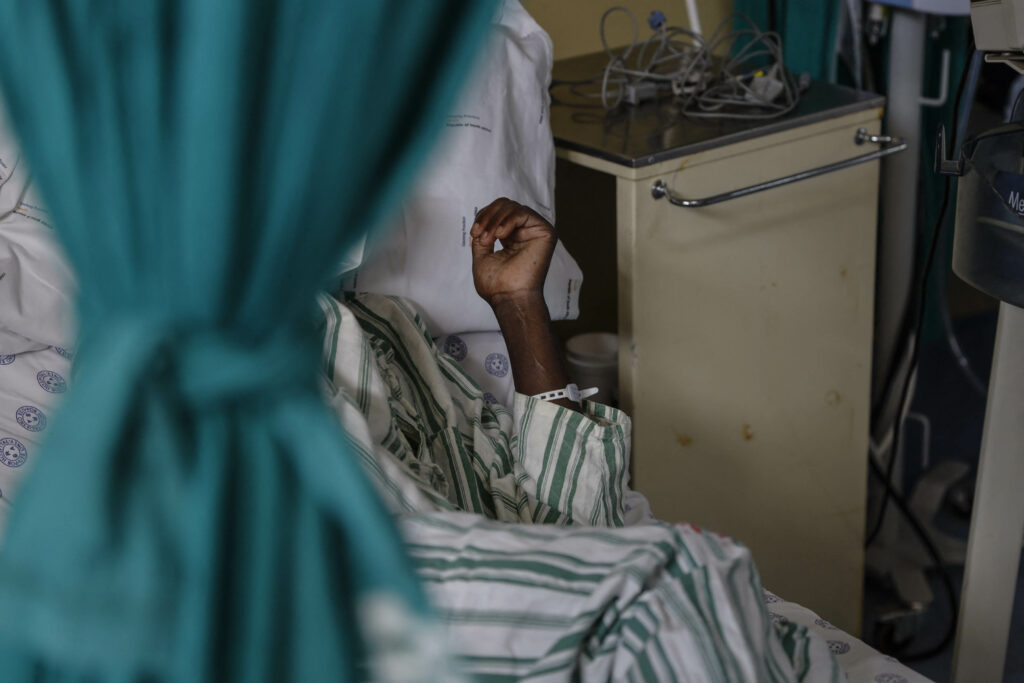 Poor record-keeping, nurses not having speciality training and a skills drain has led to inadequate care of cancer patients. (Photo by Guillem Sartorio / AFP)
There has also been a drain in the healthcare system, with student nurses either not being retained when they are about to do their year of community service, or not being absorbed by provincial governments when they have completed that year, she said.
And most of these nurses, whose studies were funded by taxpayers, ended up working in the private sector. About 40% of general practitioners and nurses provide services to just 17% of the population, which has medical aid.
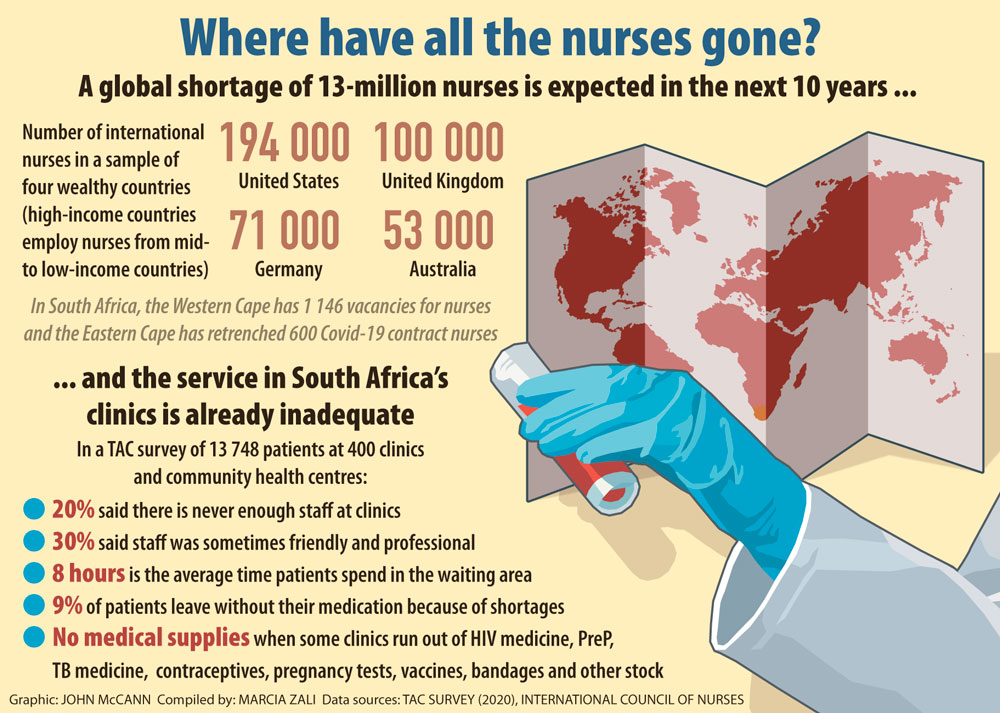
High income countries were also targeting nurses from low- to middle-income countries in their recruitment drives.
The International Council of Nurses reported that before Covid-19, the global shortage of nurses was estimated at 5.9 million, with 89% being in low- to middle-income countries. And one out of six of the world’s nurses was expected to retire in the next 10 years, which means that 4.7 million nurses would need to be trained to replace those who retired.
According to the council’s report, in the next 10 years, the global shortage of nurses will reach an estimated 13 million.
This will mostly affect sub-Saharan countries because of the migration of nurses to developed nations. Currently, 194 000 international nurses are working in the United States and 100 000 are in the United Kingdom. Germany has 71 000 international nurses and Australia has 53 000. France, Canada and Switzerland are also reported to be seeing an increase in the number of international nurses.
Germany had 27 400 vacancies in 2019, with 150 000 nurses needed by 2030. The UK’s National Health Service had 39 813 nursing vacancies in September 2021.
Denosa said the report should be a wake-up call for South Africa, which has been releasing nurses instead of retaining them.
At least 600 Covid-19 contract nurses have been let go by the Eastern Cape health department. Gauteng health does not have enough funds to retain about 900 nurses that are supposed to do their community service at healthcare facilities in the province.
The Western Cape has vacancies for more than 1 146 nurses, 150 doctors, 35 pharmacist assistants, 11 pharmacists, four dentists, 95 for allied health staff and 86 for emergency medical services.
During the first, second and third waves of Covid-19, non-emergency services such as elective surgery were suspended at health facilities, which contributed to long waiting lists.
All surgical waiting lists in various surgical disciplines in the Western Cape were also affected, and the provincial health department has since made them a priority, with R21-million being allocated for the procedures.
“At Tygerberg for instance, we have fortunately been able to maintain a normal number of theatre lists during this fourth wave, but have thus far been unable to implement additional theatre lists; our current priority in this regard is to maintain our normal theatre capacity whilst simultaneously managing our Covid and non-Covid admissions,” according to the deputy director in the Western Cape health department, Mark van der Heever.
“At Groote Schuur Hospital, we have started re-prioritising all patients awaiting surgeries and have allocated additional operating time to address these priorities.”
But this has not been the case at Rob Ferreira Hospital in Mpumalanga, where surgeries had to be suspended in January because of broken air conditioners.
Despite reports in Caxton’s Mpumalanga News that the air conditioners had been fixed during a visit by the province’s health MEC, Sesakani Manzini, the Democratic Alliance told the Mail & Guardian that this was not the case.
The DA’s head of legislature operations and research in Mpumalanga, Ashleigh Trichardt, said the contractors that had been appointed to fix the air conditioners were not able to do so.
She said air conditioners were just the tip of the dysfunctional health system iceberg at Witbank and Rob Ferreira hospitals.
Trichardt alleged that families had sought help from the DA after relatives at both hospitals had died because of malpractice and negligence by doctors and nurses.
There was nearly R8 billion in claims for negligence in the province, and Trichardt believed that these had added to Mpumalanga’s financial woes.
The Special Investigating Unit (SIU) released a statement on Wednesday saying it had received authorisation from President Cyril Ramaphosa to investigate allegations of corruption and maladministration in the Mpumalanga health department for the period 2018 onwards.
 (John McCann/M&G)
The dire conditions at hospitals have pushed some patients to turn to the private sector, despite not having medical aid.
Evaton West resident Zandile Ndlovu had to apply for medical aid when she needed to have hernia repair surgery in August 2019. Prior to this she was placed on a waiting list and given a six-month prescription of pain medication while awaiting for a date in the public health sector.
“I applied for medical aid in December of the same year, consulted in January, and I was booked for surgery in just two weeks. To this day, I have not received a call about my surgery, which was supposed to have been done at Jabulani hospital,” said Ndlovu.
It was the constant pain that drove her to medical aid. The bill for a hernia mesh replacement cost close to R12 000 for the surgeon and the assistant, R11 500 for the mesh, and the facility claimed almost R33 000.
Ndlovu said that despite being overburdened, not everything in the public health sector was broken — but there was space for much improvement.
She experienced “the good side” of the sector when her four-year-old daughter was diagnosed with autism.
“She attends speech therapy, occupational therapy, neurology and went to see an audiologist hassle free at a government hospital. The private route would exhaust our medical benefits since autism is not exactly a chronic condition and doesn’t have prescribed minimum benefits,” Ndlovu said.
Ntsako Khosa did not apply for medical aid, but paid cash at a private facility for the delivery of her children in 2019 and 2021, because of the negative stories that she had heard about public health facilities, including the inhumane treatment that some pregnant women experienced.
“On a scale of one to 10, the treatment at public facilities is probably on the negative side if I were to rate it,” said Khosa. “I’ve heard that some children have gone blind, others got hit during labour and it’s just emotionally traumatising from what I’ve heard. I didn’t want to go through that.”
She first went to Kopanong Provincial Hospital to have an ultrasound for her first pregnancy but was told to come back on a different date because there was no doctor available.
“I looked at the area and it wasn’t clean or welcoming and I just didn’t want my baby to be born there. But, depending on where you go, the health system is efficient because if I compare Soweto and Midvaal, Soweto is more efficient, and that is for all health services. My experience in Midvaal was worse and things got better when we moved to Joburg,” she said.
[/membership]