Disruption: Soweto residents protest in front of Maponya Mall against the wave of violence and looting that affected Gauteng and KwaZulu-Natal in July last year. Photo: Luca Sola/AFP
In July 2000, in the hangover from the Mandela years, the Anti-Privatisation Forum (APF) was born.
The forum brought together activists against the privatisation of the public sector and the basic services it is obliged to provide. The APF’s long-term vision was “to bring about radical changes in the character and content of democracy in South Africa so that ordinary poor and working people can have popular and effective control over their lives”.
Just over two decades later, in July 2021, civil unrest erupted.
The afflictions APF activists were fighting — prohibitive municipal tariffs and services being cut off, all against the backdrop of large-scale unemployment — are just as acute now. The private sector is still picking up the slack where the public sector has failed, a reality that some say threatens to deepen divisions in the world’s most unequal society.
Business Unity South Africa president Bonang Mohale did not mince words last week when he called the country “a failed state”.
“We are a failed state because inequality is widening, black graduates are roaming the streets helplessly, public education has collapsed, public hospitals continue to fail the poor and the vulnerable, lawlessness has become an epidemic,” Mohale said during a webinar.
The government and the private sector, Mohale added, must work together to grow the economy to stop the crisis boiling over as it did in July last year.
Economists who spoke to the Mail & Guardian would not go so far as calling South Africa a failed state. They did, however, speak about the difficulties that arise when the private sector is brought in to mend the state’s frailties — and how these challenges may be overcome.
Sifiso Skenjana, chief economist at IQbusiness, said South Africa is a fragile state rather than a failed one. That fragility, he said, “is on the back of social infrastructure collapsing with people going into extreme poverty”.
Skenjana agreed with the sentiment that restoring South Africa’s crumbling economic framework will require the participation of both the public and private sectors. “Why would the private sector be sitting on the sidelines to begin with? When we create vacuums, do they create a vulnerability for higher sales?” he asked.
“So, if you create a vacuum at Eskom you ultimately devalue the asset and create an opportunity for the bidding to be open vultures that are waiting on the sidelines … None of us can afford to sit it out and rely on the other for it to function.”
But, Skenjana pointed out, “a lot of problems are perpetuated by the private sector as well”, such as wage inequality, the biggest driver of inequality in South Africa.
“We really need to redefine this idea of being honest participants in the growth agenda for the country and I don’t think we’ve got there yet,” Skenjana said.
“The private sector continues to be the drivers of uneven growth in the country and we are just not having honest conversations about that. We all need to come to the party in a more productive way.”
Independent economist Duma Gqubule was also reluctant to call South Africa a failed state, but said: “The state is failing to meet most of its obligations towards the people. It has failed in most cases, to provide proper education, to provide proper healthcare and so forth.”
He warned that structural reforms, which in many cases have manifested in the private sector being tasked with resuscitating defunct state entities, “is code for privatisation, deregulation and the wholesale withdrawal from network industries”. Privatisation, Gqubule added, won’t solve any of South Africa’s economic problems.
Referring to Eskom’s unbundling — through which electricity transmission will be taken out of the power utility’s sole control and transferred to various independent operators — Gqubule said: “It is just going to result in two economies.
“It will create an elite that is able to get off the grid and Eskom will serve the majority of South Africans. Private markets are designed to cherry pick prime customers. So you can’t have private sector solutions to public policy issues … That is what happens in healthcare and in education.”
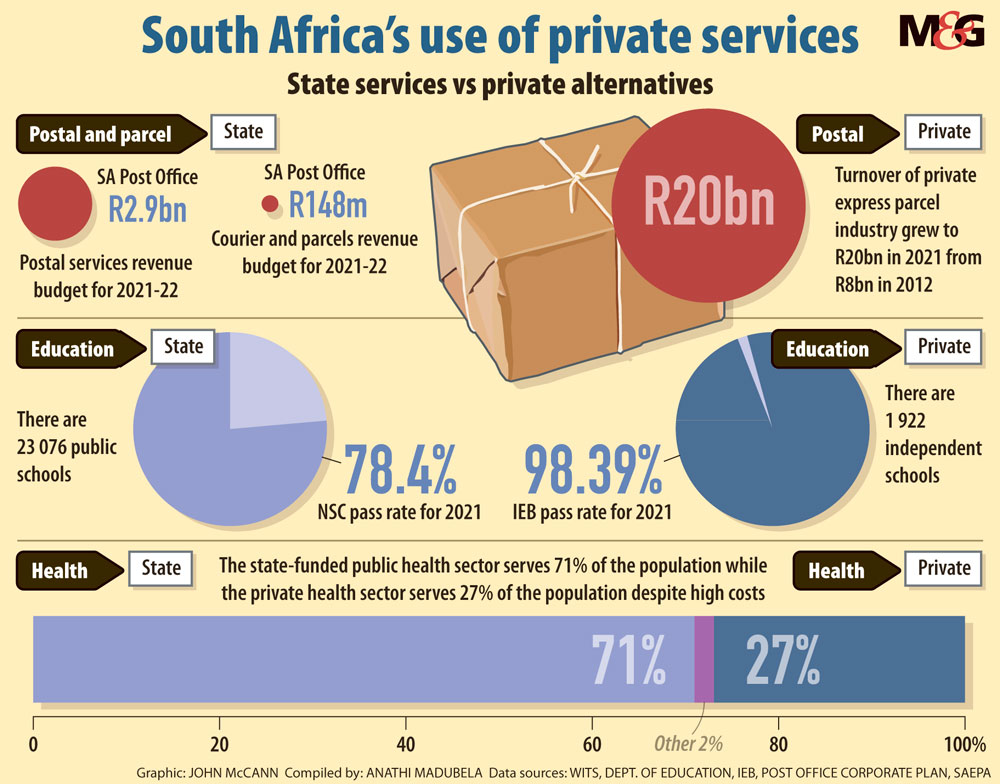
According to Statistics South Africa, in 2020, 72% of surveyed households used publicly-funded healthcare facilities, while 27% said they would first consult a private doctor, clinic or hospital. The percentage of individuals covered by a medical aid scheme was 15.2% in 2020.
Data shows that private healthcare practitioners are far less stretched than their colleagues in the public sector.
The 2020 South African Health Review found that there were 43.2 medical practitioners and specialists per 100 000 of the uninsured. This means that one doctor would serve about 2 314 people. The Competition Commission’s health market inquiry, released in 2019, found that there were 1.75 private practitioners for 1 000 of the insured population. This translates to about one doctor for 571 patients.
 (John McCann/M&G)
Similar disparities can be seen in education. According to the most recent data from the department of education, 95.1% of learners were in public schools in 2019. Only 4.8% were enrolled in private schools. The data also shows that for every one educator in the public sector there are about 30 learners. One private sector educator serves about half as many learners.
Researcher Dale McKinley, an Anti-Privatisation Forum co-founder who at times served as its spokesperson and treasurer, noted that privatisation is often to the detriment of the poor. “Those are the biggest victims. It exacerbates existing divisions — class, race and others.”
The private sector, McKinley said, is interested in one thing: profit. “So when your whole purpose is profit, you’re going to make decisions and run things on that basis, to make money. And we know of course, when that happens those who can’t afford are left out of the picture.
“So, for the upper and middle classes, those who can afford it, can look at the private sector and say, ‘They’ll do a better job and we can pay. So we don’t care.’ But for the vast majority, it’s the other way around,” he said.
Development economist Ayabonga Cawe agreed that the private sector’s main incentive is profit. This means, for example, the private sector does not have the same incentive as the government to provide water to townships or far-flung rural areas.
“That has an implication on margins. So you’re not going to do it if it is not subsidised. Instead, you’re going to go to people who can pay … I think that’s the difficulty. The market mechanism by its nature, driven by profit as it is, can’t deal with some of the historic backlogs and the historic inequities that we have in South Africa. It is not geared for that.”
But, Cawe added, “That is not to say we want to discourage private investment in certain areas.
“If you say you want to bring in privatisation, and you’re interested in doing it properly, you should do it in a way that’s mutually beneficial for the state. It should also encourage the private sector to create a new basis of competition — rather than handing over to a pseudo state in the private sector.”
Mark Barnes, a finance and markets analyst who, as a onetime chief executive of the South African Post Office, where he was tasked with turning around the dysfunctional state company without privatising it. He agreed that the private sector will use its capital to advance the interests of the elite, which it represents.
For this reason, there has to be a way for the private sector to make investments that add to state capacity that are also in its best interest, Barnes said. “These investments will then knit together in a way that is also in the country’s best interest.”
If, for example, a company needs to transport goods across the country, it is in its best interest to have safe roads and a functioning rail system.
“If you invest that capital, which you have some vested interest in, you can then go with your capital to the state and say, ‘I am prepared to invest this, if you become my partner’ … The state’s benefit is that it has a fixed transport system and the business can make its margin.”
This is “a virtuous partnership”, Barnes said, adding that it may not represent solutions to the government’s more grandiose goals, such as closing the wealth gap. “But what we will solve is a smaller subset to a broken system, where the outcome is in the vested interests of all the contributing parties.”
Barnes argued that South Africans should forget the term “privatisation”, saying it was a swear word.
“There is no case study for the solution to South Africa. There is no blueprint. Privatisation is not a word that we need to embrace in this country. What you need is something completely different and unique, designed by South Africans for South Africa.”
He added: “We’ve got to focus on assets and not on the shareholders. We’ve got to focus on building capacity and it has to be self-evidently virtuous and profitable for all participants.”
Anathi Madubela is an Adamela Trust business reporter at the Mail & Guardian
[/membership]