A juvenile leopard cat, seized by authorities during an anti-smuggling operation, is seen past suspected smugglers during a press conference announcing the seizure of trafficked exotic animals in Surabaya on March 27, 2019. (Getty)
Two days and a few clicks. That’s how easy it was for a team of Avaaz researchers with no background in investigating wildlife trafficking to find 129 items of harmful wildlife trafficking content on Facebook.
The “frightening” volume of content included posts selling or seeking cheetahs, monkeys, pangolins and pangolin scales, lion cubs, elephant tusks and rhino horn, according to the investigation by the global campaign group.
Facebook is a “thriving online marketplace” for the illegal wildlife trade, its report said. “Social media has played a major role in the creation of a vast and easily accessible online market for wildlife, where traffickers exploit the global reach and relative anonymity of platforms to reach new customers and evade detection — facilitating an often deadly trade.”
And with more than 2.9 billion active users a month, Facebook is a “major enabler” of this illegal trade.
One post Avaaz researchers stumbled upon was a Facebook page that specialises in the trade and export of “Pangolin Scales & Rhino Horn to Vietnam, China, Hongkong, Malaysia, Singapore from Africa”, which puts out a call for bidders on their animals and products. Pangolins are the world’s most trafficked mammals and are critically endangered.
In another, a seller states that an African grey parrot is available for “rehoming” — a code the report said is often used by traffickers to indicate that an animal is for sale, which is confirmed on this post by prospective buyers asking for a price.
Algorithms sending users into trafficking rabbit hole
In the weeks after collecting the posts, which were verified by wildlife trafficking experts from the Alliance to Counter Crime Online, Facebook made 95 wildlife-focused recommendations to Avaaz’s researchers through notifications and the social media platform’s “suggested groups” feature.
According to the report, 54% of wildlife recommendations directed researchers to groups containing potentially harmful wildlife trafficking content, such as tigers, leopards, African grey parrots, and ocelots, all included in Appendix I of the Convention on International Trade in Endangered Species of Wild Fauna and Flora (Cites), which lists the most endangered species.
In addition, 76% of recommendations directed the researchers to groups with posts seeking to buy or sell live animals, probably in violation of Facebook’s policies.
“By promoting potentially harmful wildlife trafficking content to users through their recommendation systems, Facebook allows traffickers to reach a wider audience than they would otherwise and creates the conditions for users with a casual interest in wildlife to be dragged into an international wildlife trafficking rabbit hole.”
Facebook, the report said, appeared to remove just 13% of the posts before researchers reported them and then removed less than half — 43% — of these posts a week after researchers reported them through Facebook’s “report post” tool.
Facebook’s efforts ‘don’t match scale of the issue’
In 2018, Facebook joined the Coalition to End Wildlife Trafficking Online aiming to reduce the illegal online wildlife trade by 80% by 2020. Facebook has adopted a number of policies related to the trade in endangered and live non-endangered animals and started to include alerts to warn its users about potential wildlife trafficking content when they search for certain keywords.
But the report said its efforts to date “clearly do not match the scale of the issue”, citing research that shows, too, that Facebook’s policies are “enforced sporadically”, particularly in languages other than English.
Avaaz said its research represents “only the tip of the iceberg”, underlining the need for immediate action from Facebook and other social media platforms. Among its recommendations are the need to strengthen and enforce policies to end wildlife trafficking and expand moderation efforts to detect illegal sales and policy violations as well as to “detox” their algorithms to ensure they do not boost wildlife trade.
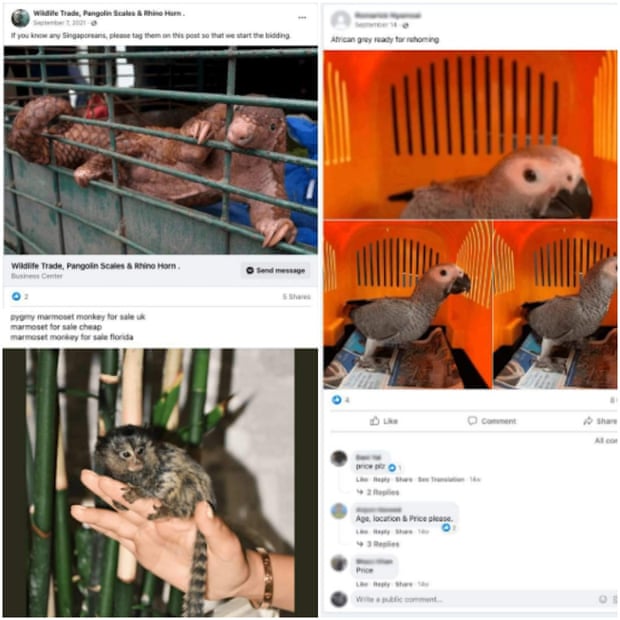 Screenshots taken from Facebook by Avaaz researchers.
Facebook’s parent company, Meta, questioned the validity of Avaaz’s methodology and sample size, and told The Guardian the results did not reflect the work it had done to combat wildlife trafficking. “We’ve pioneered technology to help us find and remove this content; launched pop-up alerts to discourage people from participating in this trade.
Between January and May 2021 in Indonesia and the Philippines alone, it removed more than 1 900 Facebook Groups linked to wildlife trafficking as a result, Meta said. “This is an adversarial space though, and the people behind this awful activity are persistent and constantly evolving their tactics to try and evade these efforts.”
Pandemic boost for online wildlife trade
Ray Jansen, the founder and former chairperson of the African Pangolin Working Group, told the Mail & Guardian it had bust two pangolin traders who were advertising on Facebook in 2021 and again this year.
“However, it is very uncommon and largely phishing scams, that is, they don’t have the animal, but try and trick you out of money. We don’t see the wildlife trade here via social media like Central and West Africa. Bear in mind that the illegal trade of wild animals in those countries is often related to bushmeat and not international illicit trade to Asian countries.”
Adams Cassinga, the founder of the nonprofit Conserv Congo in the Democratic Republic of the Congo (DRC), which works to fight wildlife trafficking, told the M&G that Facebook has increasingly gained momentum as a tool to traffic wildlife.
“One of the reasons that has made this much more obvious, is because of the pandemic,” Cassinga said. “Many people found themselves confined in an area so the client who used to travel abroad, or from other cities, didn’t find it easy anymore to do that. And this made some traffickers very desperate. And they will start posting certain things on Facebook … and also on many other social platforms including Instagram and Whatsapp.”
Illegal activity follows legal activities, said Didi Wamukoya, the director of counter wildlife trafficking at the African Wildlife Foundation (AWF). “When commerce moved largely online due to the pandemic whereby people wanted to avoid physical contact, illegal trade also moved online with traffickers taking advantage of online marketplaces or using their social media handles or the dark web to market their illegal products.”
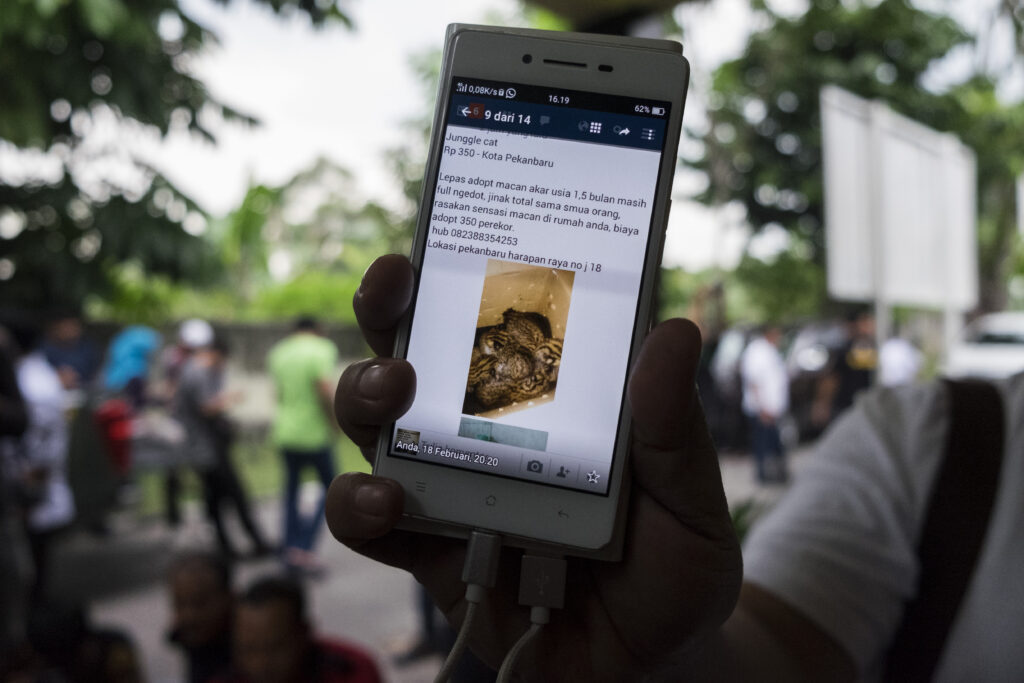 Baby Langur secured by officers from a suspected illegal wildlife trader on Facebook at Pekanbaru on February 22, 2017 in Riau, Indonesia. PHOTOGRAPH BY Afrianto Silalahi / (Photo credit should read AfriantoSilalahi/Future Publishing via Getty Images)
Making contacts
There are several kinds of traffickers who follow this illegal route, said Cassinga. “Mainly it’s new traffickers who do not understand the risks of the use of technology in committing a crime. Secondly, it’s desperate traffickers who want to make a bit of money by all means possible. Thirdly, it’s traffickers who are trying to break into the international market and do not have anybody to connect them.
“However, all three will put small items [online] … It also opens the door for them to have contacts. Once the contact is established, they develop further on other platforms such as voice calls and Whatsapp. So they don’t use Facebook so they can sell per se — they use these social platforms to have contacts.”
For a seasoned trafficker pushing tonnes of ivory, pangolin scales and hundreds of birds, “Facebook is not going to be the tool he uses. He will understand already that it’s a dangerous game and he will keep it safe”.
Cyber-enabled wildlife crimes
The AWF, said Wamukoya, runs a wildlife cybercrime investigation programme. “AWF is also training wildlife agencies to investigate cyber-enabled wildlife crimes, including seizing, handling and extracting digital evidence from electronic devices as well as presenting digital evidence in court.
“Being a new modus operandi for wildlife traffickers and due to the underground nature of this type of crime, there is little data and information about the volumes of wildlife products trafficked online and amount of e-money exchanged and earned as proceeds from cyber-enabled wildlife crime.”
Through working with the Maisha Group in the DRC, AWF was able to uncover a wildlife trafficking network with actors from the DRC, Angola and China who were using social media platforms to advertise sales of wildlife products. “One of the key players in this ring, Salomon Nkumiku Mpay was arrested and prosecuted in DRC and disappointingly sentenced to only four months imprisonment.”
The AWF, Wamukoya said, has been able to support authorities in Kenya and Uganda to arrest 133 offenders undertaking cyber-enabled wildlife crime. “Most of these offenders used their mobile phones to advertise for sale, procure or sell wildlife products and send or receive proceeds of illegal wildlife trade.”
[/membership]