Leash: Party insiders say if ANC president Cyril Ramaphosa is re-elected his actions will be scrutinised by a national executive committee that includes Paul Mashatile , who hopes to be elected deputy president of the party. (Rajesh Jantilal/AFP)
NEWS ANALYSIS
President Cyril Ramaphosa is edging closer to retaining — and regaining — his status as the leader of the governing party, but is likely to be ring fenced by a national executive committee (NEC) focused on “managing” him until the 2024 national and provincial elections.
Although Ramaphosa has survived the hostile parliamentary debate about the failed attempt to impeach him, signalling that he is a shoo-in for a second term as party president at the upcoming ANC elective conference, he will lead an NEC dominated by allies of Paul Mashatile, who will probably be elected as the party’s deputy president.
This is likely to see the president being tightly managed by the NEC to ensure that key conference resolutions about the economy are implemented — one of the major complaints from Ramaphosa’s critics in the party with regard to his first term.
Last week’s events, which saw many ANC leaders come out in defence of Ramaphosa over the Phala Phala fracas, were seen as a test of whether he would be able to be the party’s chief campaigner in the lead up to the 2024 elections.
His political advisers and allies were encouraged by public responses to Phala Phala — in particular the sentiment that the president had not stolen state funds, but had rather been robbed of his own money at his game farm in Limpopo.
In internal ANC polls, Ramaphosa has remained a more popular figure than the party itself. The ANC projects that, with Ramaphosa, it stands to get 48% of the vote in the 2024 elections, but without him it is likely to attain just 40%.
Despite this popularity, like his predecessor Jacob Zuma, Ramaphosa’s second term will probably be muddied by scandal, making it easier for his detractors to elbow him out before his projected end of term.
Those who surround the president are said to have started focusing on ensuring that they have a suitable candidate in place — not Mashatile — as his deputy, should Ramaphosa be recalled by the party over Phala Phala ahead of 2024. Their realisation may, however, have come too late.
Mashatile’s campaign has gained traction around the country, with no other viable contender emerging from the anti-Ramaphosa camp for the deputy president position.
At the same time, ANC branches backing Ramaphosa are split between Oscar Mabuyane and Ronald Lamola as deputy president, while the faction’s leadership has named Senzo Mchunu as their favoured candidate for the position.
There is a general feeling among ANC leaders — including those in the Ramaphosa faction — that the old guard needs to give way to the next generation of leaders.
Insiders who elaborated on this sentiment agreed that the Zuma and Ramaphosa terms were centred on the unionists who had helped them take office.
One party leader explained that former ANC president Nelson Mandela had handed the party over to those exiled from South Africa during apartheid, who in turn had handed power over to trade unionists. The latter, he said, have been losing their base because of the implosion of labour federation Cosatu and its affiliates.
“Unionist time is over,” the party leader said.
Much like Zuma, Ramaphosa — who comes from a union background — has lost favour with Cosatu and the South African Communist Party (SACP) as his time in office has progressed.
Ramaphosa and his ally, Gwede Mantashe — another former trade unionist — have recently been booed, heckled and eventually chased out of Cosatu events, signalling an end to the marriage.
Cosatu and the SACP, which have been in a tripartite alliance with the ANC since the early 1990s, have not backed Ramaphosa for a second term, choosing instead to remain neutral in the ruling party’s internal leadership battle for the first time since 2007, when they came out in support of Zuma.
The disadvantage to the Ramaphosa faction is their lack of understanding on the ground, one insider said, arguing that the ANC president had surrounded himself with national leaders who had little to no constituency.
“Unionists must hand over the party to the next generation and the third motive force — people who understand the ground,” said one high-ranking NEC member.
“Partly why we could frustrate unionists during campaigning is because they don’t know the ground. There are a number of them holding key positions — think finance, economy, energy and labour — those positions are held by unionists and that will change,” they said.
The insider believes that the next crop of NEC members will be younger, vibrant and more ready to understand people on the ground.
But they insist that Ramaphosa must still lead this new cohort.
ANC leaders in the Mashatile camp are of the view that the ANC needs to be firm with its president and the implementation of resolutions.
The ANC is unlikely to come out with new resolutions in this conference, but Ramaphosa will face a more hostile NEC, which will hold him accountable, the ANC insider said, adding that the key to the party’s election strategy must be a commitment to fix beleaguered power utility Eskom and hold non-performing ministers to account.
“The biggest opposition to the ANC is the energy crisis and second is the performance of the economy. The performance of the ANC will depend on whether the opposition have a story to tell.
“[The] conference will give us a collective and beyond conference you will see a more radical, impatient NEC that will not take any nonsense from cabinet ministers like Pravin Gordhan,” the ANC leader said.
Ramaphosa’s indecisiveness has frustrated even those closest to him.
In a recent interview with the Mail & Guardian ANC treasurer general hopeful Gwen Ramokgopa attested to this, saying his allies had at times hoped that Ramaphosa could be “more decisive” when dealing with non-performing ministers.
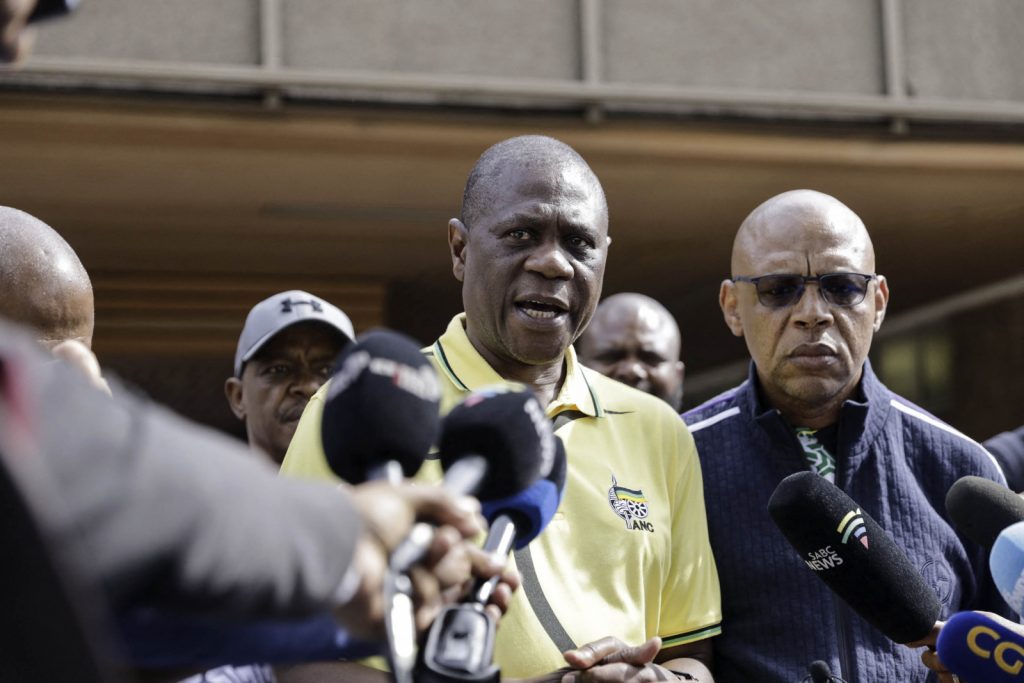 Paul Mashatile. (Guillem Sartorio/AFP)
Ramokgopa said he had demonstrated he could be decisive as the president of the ANC and the country, but not so when dealing with his colleagues.
“Maybe some of the attributes may seem a sign of weakness and, yes, we also have wished that he could be much more stringent and much more decisive, especially in terms of performance, you know, here and there with some of our colleagues,” Ramokgopa said.
“So yes, there’s no one who is without mistakes. We all are human. I guess you would also consider him as ordinary as all of us. But yes, he also has this responsibility. Being a leader, both your positive and your negative attributes become exposed. But I think overall, he has taken us through uncharted terrain.”
On Wednesday, a number of provinces, including Gauteng and KwaZulu-Natal, held provincial general council meetings or briefings with their branch delegates to reaffirm their voting and policy mandates.
KwaZulu-Natal had earlier threatened to dump Mashatile as their choice for deputy president after his failure to deliver branch nominations in Gauteng, Limpopo and the Eastern Cape for Zweli Mkhize and for not publicly committing to the Mkhize slate.
The provincial leadership had approached Mchunu — who failed to make the ballot as deputy on Ramaphosa’s slate — to stand as Mkhize’s deputy, but he declined, hoping to secure nomination from the floor from branches backing the president for a second term.
As a result of this, as well as discussions over the weekend with Mashatile’s camp, the province decided to continue its support for him.
ANC KwaZulu-Natal spokesperson Mafika Mndebele said on Wednesday that the province had decided to stick with Mashatile as its candidate for deputy to Mkhize.
“The position of KwaZulu-Natal as pronounced still stands,” Mndebele said.
Limpopo and the Eastern Cape reaffirmed their support for Ramaphosa in their own provincial general councils.
Both provinces also resolved to affirm the step-aside rule, a resolution that has been anchored as part of the Ramaphosa faction’s strategy to rid the party of corrupt individuals.
Limpopo had previously agreed with KwaZulu-Natal that the rule should be scrapped.
The U-turn by Limpopo could signal that Mkhize’s campaign has failed to gain traction in the province.
Previously, Limpopo regional leaders told the M&G that they were clear that Ramaphosa would get their vote this weekend.
[/membership]