There is no control programme for common mynas and popular rose-ringed parakeets because of ‘budget constraints’ . (Photo by Fatih Kurt / ANADOLU AGENCY / Anadolu Agency via AFP)
The Indian house crow, the common myna, the Mallard duck and the rose-ringed parakeet are the four worst aerial invaders to have taken wing in South Africa, according to the department of forestry, fisheries and the environment.
The Indian house crow, which hitchhiked into South Africa through ports in Durban in about 1970 and Cape Town in 1991, preys on eggs and nestlings of native birds and eats small animals. “It mobs humans and pets [and] occasionally destroys vegetable gardens in informal settlements,” said departmental spokesperson Albi Modise.
Common mynas, also known as Indian mynas, are ubiquitous in urban centres. They are aggressive and compete for the same resources as indigenous birds, and eat the eggs and attack the fledglings of other birds, he said.
Mallard ducks, which escaped from private collections of waterfowl, mix and mate with endemic duck species such as the yellow-billed duck “threatening the genetic integrity of these indigenous ducks”, Modise said.
They also compete with indigenous species for food and nesting sites.
Tropical rose-ringed parakeets, which have established feral populations in suburban areas by escaping captivity through the pet trade, compete for nest sites with native cavity-nesting birds and may carry diseases that could be harmful to poultry, native fauna and humans.
Troublesome invaders
Invasive alien species are animals, plants or other organisms that are introduced into places outside their natural range, either intentionally or accidentally. They negatively affect native biodiversity, ecosystem services on which humanity depends or human well-being.
These species are one of the biggest causes of the loss of nature and species extinctions and are a global threat to food security, according to the International Union for Conservation of Nature (IUCN). In recent decades, globalisation has increased the movement of people and goods around the world, causing a rise in the number of species introduced to areas outside their natural ranges.
The IUCN cites a 2017 study that found that more than a third of all introductions in the past 200 years happened after 1970, and that the rate of introductions shows no sign of slowing down. Similarly, a 2020 study predicts that the number of established alien species will increase by 36% between 2005 and 2050. Climate change eases the spread and establishment of many alien species, creating “new opportunities for them to become invasive” , the IUCN said.
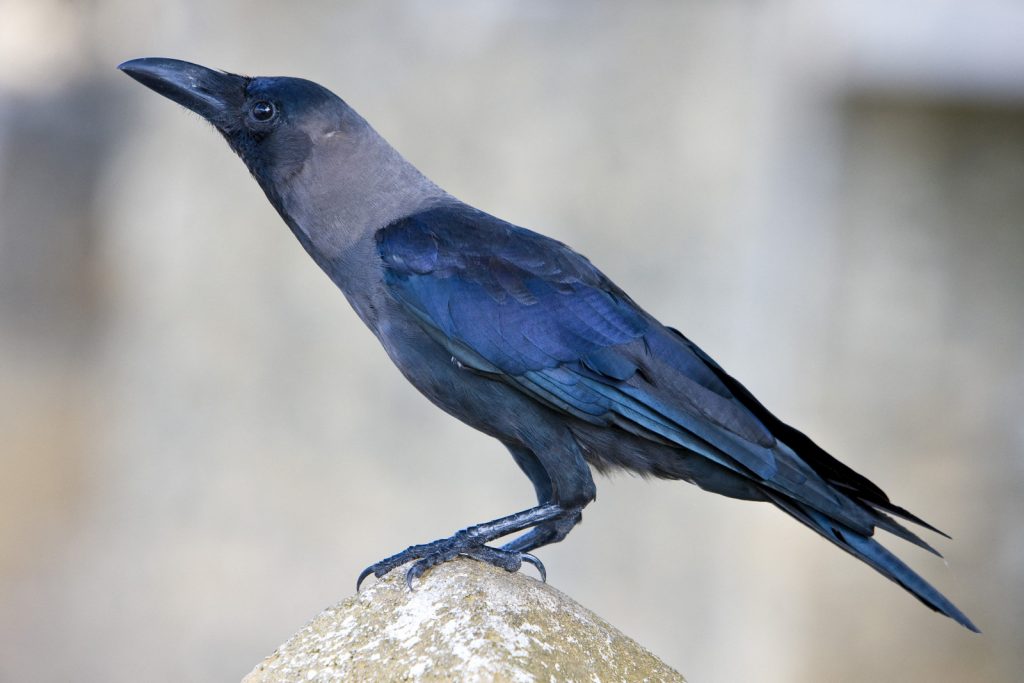 The house crow. (Photo by Michel Gunther / Mau / Biosphoto / Biosphoto via AFP)
What’s being done in South Africa?
Modise said teams are employed under service providers and municipalities to “treat” invasive bird populations. Various methods that suit the targeted species are being used.
But there is no control programme for the rose-ringed parakeet because of budget constraints, Modise said.
“The common myna populations around the areas where they are in small populations are being controlled by shooting, such as the protected areas, but [for] the large populations, there is no control as yet due to budget constraints.”
Tackling house crows in rural areas differs from those in urban densities. It is too risky to shoot large house crow populations in urban areas.
“The house crow populations are baited in pre-identified spots at feeding times. The bait, which contains the avicide DRC 1339, is given to the birds in food scraps. Teams return early the next morning to collect the carcasses for destruction.”
Trapping
These birds are also trapped using walk-in cages that are dropped off at predetermined locations. “Caught birds are collected and disposed of humanely. Trained Expanded Public Works Programme teams are used to remove nests in the beginning of the breeding season, and if the first clutch of eggs have already been laid, they are humanely euthanised.
Egg oiling, which involves coating shells with oil such as liquid paraffin, is effective because the adults will continue to incubate the eggs but “there is a concern around the second half of the embryo’s development when it starts feeling pain”, Modise said.
Mallard ducks are also being controlled using baiting programmes, which differ slightly to those for the common house crow because they feed among indigenous waterfowl.
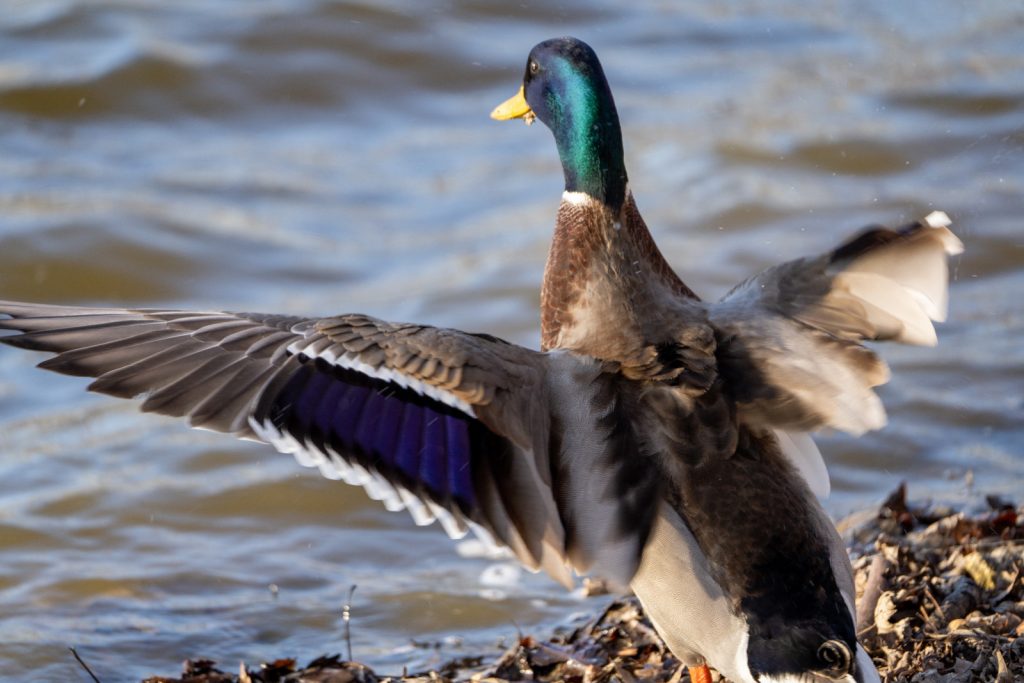 A mallard duck. Photo by Jason Whitman/NurPhoto) (Photo by Jason Whitman / NurPhoto / NurPhoto via AFP)
“The mallards are baited with an avicide tranquilliser, alphachloralose, which is mixed into the bait in the evenings when the waterfowl feed. All the waterfowl, including the mallards will eat the bait and be put to sleep when returning to their roosts one to two hours later.”
The teams then go to the mallard roosts, collect the birds, humanely euthanise them and transport them to an incinerator.
National strategies
Modise said a national house crow strategy is being finalised and will be completed by 31 January, while a national mallard strategy is at a similar stage. A national common myna strategy has been drafted but has not been presented to the committee.
“The rose-ringed parakeet strategy is still in process … The department is in the process of developing a national strategy to deal with feral populations of the species in consultation with the [pet-trade] industry.”
The department has listed the rose-ringed parakeet as a category two invasive species, and
 The common myna. (Photo by PSI / Science Photo Library via AFP)
permits may be issued for restricted activities such as possession, breeding and selling, he said.
“Engagements between the department and industry associations have resulted in people undertaking rose-ringed parakeet breeding that are registered with the relevant industry association be exempted from requiring a permit for all restricted activities, provided that such association is in possession of a valid permit … and provided such person complies with all permit conditions in the relevant association’s permit.”
Climate influence
Modise said climate change has led to regional redistributions of species, but the combination of human transportation, climate and land-cover changes will probably accelerate the redistribution of species globally.
“Birds are able to cover great distances and cross geographic barriers, allowing them to expand their ranges relatively quickly. This means that they can spread quickly once they are introduced to a new place.”
Parakeets, for example, can conserve energy in extremely cold situations, showing no sign of hypothermia at 5˚C, despite being a tropical species.
“The species proliferates in areas with climatic conditions, therefore they are described as successful avian global invaders,” he said, adding it is believed that climate change and other human-induced environmental damage helps in the spread of common mynas, too.
[/membership]