No sudden moves: President Cyril Ramaphosa addresses people protesting against gender-based violence outside parliament. Photo: Ziyaad Douglas/Gallo Images
In December 2021, Police Minister Bheki Cele gazetted the names of the five members of the Critical Infrastructure Council.
Four months later, he published the regulations that would guide the work of the council, intended to advise him on protecting critical infrastructure from theft, sabotage and other threats. It stipulates that the council should meet quarterly but, to date, it has not convened once — a fact one of the members lamented in a recent email to President Cyril Ramaphosa, which has so far gone unanswered.
The council member, who asked not to be named, stressed in his letter to the president not just Eskom, but Transnet infrastructure, national roads, schools, hospitals, dams and parliament itself “are all victims of arson, theft, sabotage and vandalism”.
“This is an urgent matter,” he added.
“As an elected council we have not yet met to start the work of the identification and declaration of infrastructure as critical infrastructure; we have not set up any guidelines, measures nor other controls to protect, safeguard and ensure the resilience of infrastructure.”
The delay is partly due to the fact that the security vetting of the five members is yet to be completed, according to responses they have received from the police secretariat.
“I only went for my lie-detector test in September and, of all five, I seem to be furthest ahead in the process. But how do you appoint people without vetting them?”
It was frustrating to watch the fallout from routine vandalism of electricity substations from the sidelines when you have been appointed to help find a solution, he added.
“It goes to the very heart of what we are supposed to be doing but it is not just Eskom. It is a war we are facing. The economy has been severely hampered because our roads are impassable … trucks are burnt on key arteries. People are nonchalant about this — even the leaders of our country.”
The council members have asked that they be allowed to hold an informal workshop to begin to formulate a plan of action but have not been given the green light.
The head of the infrastructure and investment office in the presidency, Kgosientsho Ramokgopa, did not respond to questions regarding the council.
The president’s penchant for commissioning strategic plans and appointing advisory councils in areas of concern is well-documented. We will name just a few.
The Economic Advisory Council was appointed in 2019 and, the following year, Ramaphosa set up the Presidential State-Owned Enterprises Council to support efforts to reposition parastatals as instruments of development.
In 2020, he also launched the National Strategic Plan on Gender-based Violence and Femicide, followed in February 2021 by a response fund that attracted generous donations.
However, the creation of a council that would disburse the funds has hit a familiar bureaucratic wall, despite the president hosting a second summit on ending gender-based violence late last year — and to the deep frustration of activists demanding progress.
Political analyst and author Mcebisi Ndletyana said South African presidents have historically had a fondness for consultation and establishing multiple committees when looming decisions involve many stakeholders but it was far more pronounced in Ramaphosa than his predecessors.
“He is a tentative leader,” he said.
“He does not want to take the fire all alone but prefers the cover of that consultative, collective decision and what tends to happen is decisions are painfully slow to be taken, and that slowness has earned him a lot of disapproval, and to some degree contempt, from many people.”
He thought it was partly a function of character, partly of the fact that he lacked the numbers in the ANC to move fast.
Only one of those factors have changed since the ANC’s December conference.
“Conditions are such that they should enable him to move fast when it comes to taking decisions but then you still have the character issue to deal with.”
A year ago, the president named the Presidential Climate Finance Task Team, to lead efforts to secure money for a just energy transition, with tangible results. South Africa has secured combined pledges of $8.5 billion from the United States, United Kingdom, France, Germany and the European Union to support decarbonisation and a shift to renewable energy.
As the Eskom crisis deepened, Ramaphosa launched the Energy Action Plan in July. As part of the plan, the National Energy Crisis Committee (Necom) was established, comprising top government officials from relevant departments and led by the director general of the presidency Phindile Baleni.
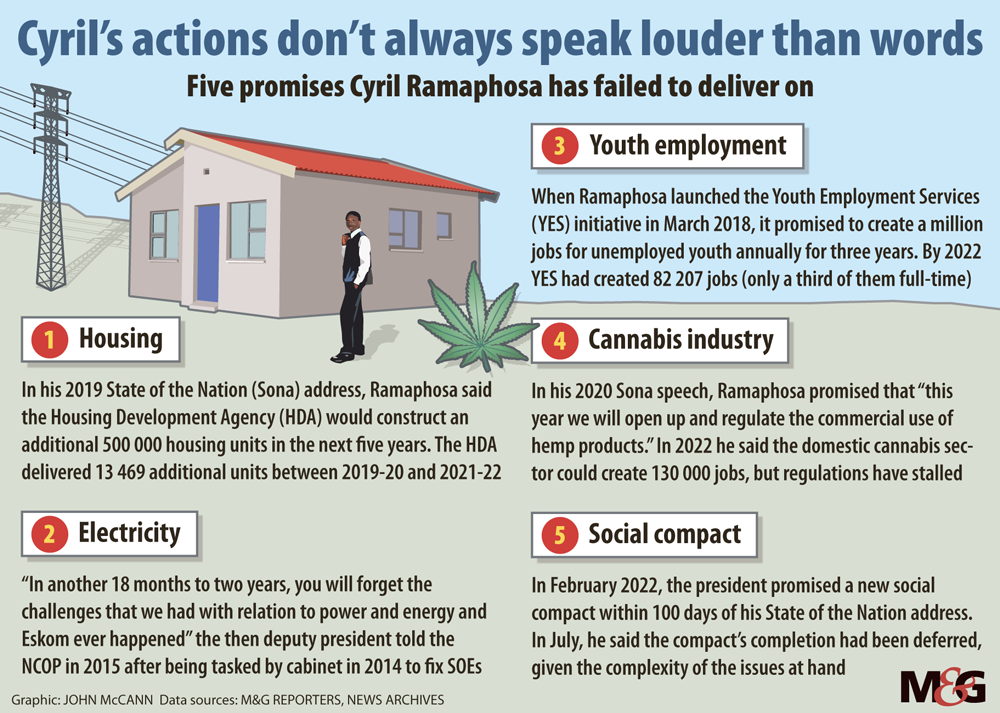 (John McCann/M&G)
There is consensus that the efforts of Necom, along with the project management office in the presidency, have helped clear bureaucratic obstacles. There are now more than 100 private sector projects in the pipeline that will add, the president said recently, 9 000 megawatt to the grid.
But little has happened to ensure transmission can accommodate more renewable energy from the south of the country and to enable electricity generators to wheel power into and across areas supplied by municipalities. In addition, questions have been asked as to whether Necom was constituted to look for solutions in a nimble fashion.
Constant load-shedding this summer, plus looming court battles on the subject, has meant constant pressure on Ramaphosa to devise a credible plan to end it.
In mid-January, Necom identified five priorities, including fixing Eskom’s plants faster, addressing criminality and introducing emergency legislation to speed up approval for power stations. Energy analysts said the list had overlooked several measures that would help to alleviate the crisis, among them the expansion, and necessary separation, of the transmission grid.
A fortnight ago, US Treasury secretary Janet Yellen warned South Africa it should waste no time in acting on the transition plan. And a fair amount of the funding is earmarked for the transmission needed to connect new generation to the grid.
There was no mention of this on Tuesday when ANC secretary general Fikile Mbalula trumpeted the party’s resolve to declare a state of disaster to end load-shedding by the end of the year or sooner.
Energy analyst Chris Yelland expressed concern that the latest attempt to be seen to be acting could be informed more by the ANC’s fear of losing its electoral majority next year than a vision of interventions that can be fast-tracked to overcome the crisis.
Yelland said a state of disaster could effectively be used to bypass the bureaucracy of National Energy Regulator of South Africa working out tariffs in municipalities and to introduce rebates for rooftop solar and solar geysers.
“It should be used for specific, identified and approved measures that can expedite certain actions that would otherwise be bogged down by red tape. There is merit in having a state of disaster for that specific purpose,” he said.
“It should not be a blank cheque, and, if it is used for political motives, then I think it is a bad thing. To be honest, I think they are doing this not for load-shedding but for vote-shedding.”
Ndletyana said what was missing was the government declaring what it was unable to do at the moment to alleviate the problem that it could affect by way of disaster regulations.
“It is not evidently clear if everything has been done so far to deal with this crisis, and they have failed, and therefore they need a state of disaster. I haven’t heard that explanation,” he said, adding that it was imperative in a country where leaders have lost popular trust.
“In the absence of that explanation, especially because of our previous experience [during the Covid-19 state of disaster], we are justified in being sceptical. You cannot behave as though you have massive goodwill behind you.
“This government doesn’t. It doesn’t have credibility. It needs to work harder to convince people.”
[/membership]