A view of the Vaal River after heavy rains caused floods in Parys town of Orange Free state, South Africa on February 19, 2023. (Photo by Stringer/Anadolu Agency via Getty Images)
“There are people who had a house on Friday and on Sunday morning they only had a foundation. Their entire house was washed away.”
This is according to Storm Zurcher, the community policing forum chairperson of the Loch Vaal neighbourhood watch area, who was referring to the widespread destruction of homes, roads and bridges in Loch Vaal, Vanderbijlpark and other parts of the Vaal after devastating flooding at the weekend.
On Saturday, the department of water and sanitation announced that a further two floodgates had been opened at the Vaal Dam to ease pressure after heavy rains, which unleashed flooding in the region. The total number of floodgates that have been opened stands at 12.
Heavy rain showers means that the Vaal and Orange river system experience rising water levels, the department said, noting how it is continuing to “assess and implement measures to mitigate the effects of the increase”.
The continuing heavy rains in large parts of South Africa meant that many rivers “are overflowing and most dams are full and spilling”, the department said, urging all residents in settlements along lower areas of the Vaal Dam to move to higher-lying areas.
‘Total chaos’
Zucher said that down the Rietspruit and into the Loch Vaal area and from the wall of the barrage, “it’s total chaos”. Mopping-up operations are underway. “It’s an absolutely devastated area. The whole community has been affected, every home that’s there has been affected in some or other way,” he said.
“It was a matter of 20 minutes and I was underwater on Saturday. When we started removing people out of their homes, their homes were already knee deep in water. Within another 10 minutes it had reached their roofs.
“We were running from one house to the next, from one farm homestead to the next, up and down the Barrage area, it was an absolute nightmare. We were only concentrating on getting people off house roofs, getting to people stuck inside their homes, sitting on top of cupboards … We saved a tremendous number of dogs and animals.”
At one stage, Zucher was driving around in his vehicle with 35 dogs, four children and two adults “and still being pushed by the river because it had come up so quickly”. Fortunately his vehicle was able to get muddle through, he said.
In Vereeniging, Kevin Jackson, of the Vereeniging Business Corporation, told Mail & Guardian how of the three access roads into Three Rivers, only one could be used.
“The Klip River and Sugarbush River that flow into the Vaal get backlogged. What happens is those rivers tend to push back and you’re obviously getting the rain coming down from Joburg’s side or on the Sugarbush side further eastwards, so that water flows down into the Vaal.
“When they’re opening the sluice gates, there’s a lot of water flowing in. It tends to create a bit of a pushback, so the water that is supposed to go into the Vaal sort of pushes back further and further so it starts flooding inside Vereeniging.”
‘Many houses are gone’
Danie Boshoff, of the Vaal Reaction Unit on the smallholdings, said the level of the Vaal Dam had dropped somewhat.
“The water is going down now a little bit, but there are about 60 or 70 houses still there by the river side, not in the Loch Vaal, that are underwater. It’s hectic … Everything has been washed away,” he said.
He estimated that around 150 houses had been destroyed in Loch Vaal alone, and said two bridges, one in Fochville and another in Loch Vaal, had been completely destroyed.
Boshoff also praised the Vaal community for pulling together.
“If the community stands together you will see results. The guys from the SA police service, the diving unit, the National Sea Rescue Institute, there were just too many people to rescue and we jumped in and we helped them. They were fantastic. Not one person hesitated when I called them. It was indescribable.”
‘We lost everything’
Loch Vaal resident Ryno Moolman, who lives on the banks of the Rietspruit, told M&G how the stream is normally about 4m to 5m wide and became dramatically wider. “On Saturday, I was standing in the lounge looking out at the river, and told my wife that the water was spilling over its banks again.
“We closed all the doors and tried to be precautionary. Fifteen minutes later, we were again knee-deep in water. One of the doors broke open, water came rushing in and we evacuated everyone.”
His family has lost everything, he said.
“Of the house, all we’ve got is a shell. We’re going to have to take off the roof, everything’s gone … We tried to move the cars and we managed to save all the lives,” said Moolman, who had to swim back home to rescue the family’s pet rabbit.
“It happened so fast. We were busy moving cars and the water was at the bumper level of my bakkie and when I looked back again, it was totally flooded.”
Moolman said he and other residents of Loch Vaal were threatening to launch a “legal battle” against the department and Rand Water because it was “not a flood but a flood of negligence”.
“Last Wednesday, the water in our home was already knee deep … but they did not want to open the gates on the [Vaal] Barrage as they were supposed to,” he said.
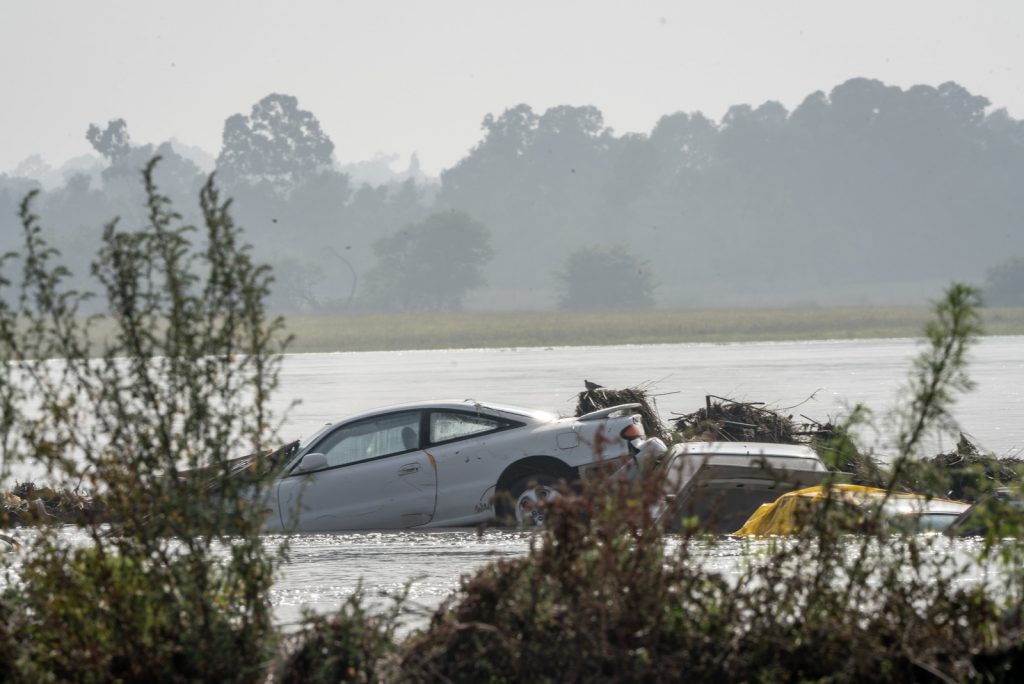 (Photo by Stringer/Anadolu Agency via Getty Images)
Vaal at 120% capacity
Wisane Mavasa, the spokesperson for the department, said the Vaal Dam is at 120% capacity, therefore 12 floodgates remained open and outflow at Bloemhof Dam was kept at 3 200 cubic metres.
“According to hydrological monitoring and forecasting systems, the Vaal Dam is receiving about 3 000 cubic metres per second and releasing 2 300 cubic metres per second through the opened gates. At the [Vaal] Barrage, water levels remain at 99% throughout the releases.”
The department, Mavasa said, gradually implemented the releasing protocols from 11 February when the first gate was opened and three additional gates were opened on intervals on 12 February and the fifth gate on 13 February.
“The pattern continued throughout the week and by 17 February, 10 gates were opened and two more on Saturday as inflow increased due to the heavy rainfall.”
The department had noted that along the Vaal River, the Vaal Barrage was also experiencing rising water levels that may have been caused by the inflows from Suikerboschrand, Klip and Rietspruit tributaries over the high flow period due to the heavy rains in the catchment of these rivers, she said.
“Through various platforms, the department engages, shares hydrology reports and updates on a weekly basis on the water levels in the dam, and on a daily and hourly basis when there are rainfall and/or possibility of floods due to rising water levels upstream the dam, with recommendations in order to send early warning systems and activate evacuation plans in case of flooding.”
She said the department and Rand Water follow operating rules and procedures when releasing water from the Vaal Dam and the Barrage during the national state of disaster “necessitated by the ongoing floods due to heavy rains”.
[/membership]