More businesses are now using solar panels for energy. Photo: David Harrison
As load-shedding continues, households and businesses are seeking alternative ways to cover most of their electricity needs while still remaining connected to the Eskom grid.
This month, President Cyril Ramaphosa announced that the government is considering additional mechanisms to address the electricity crisis.
“These measures include helping households and small businesses install solar power and energy-saving devices. There would also be support for households with rechargeable lights, and working with learners to catch up where load-shedding interrupts lessons,” he said.
Financing companies are offering consumers a rent-to-buy option, which means they will pay a monthly fee for solar energy installations and will eventually own the equipment after about five to seven years.
The costs typically work out to be R3 500 a month for a household that pays R2 500 for electricity.
These companies have partnered with banks to offer consumers payment plans and different payment methods.
Banks and lenders have realised the growing demand for solar power systems and are creating new products and services to make the move easier.
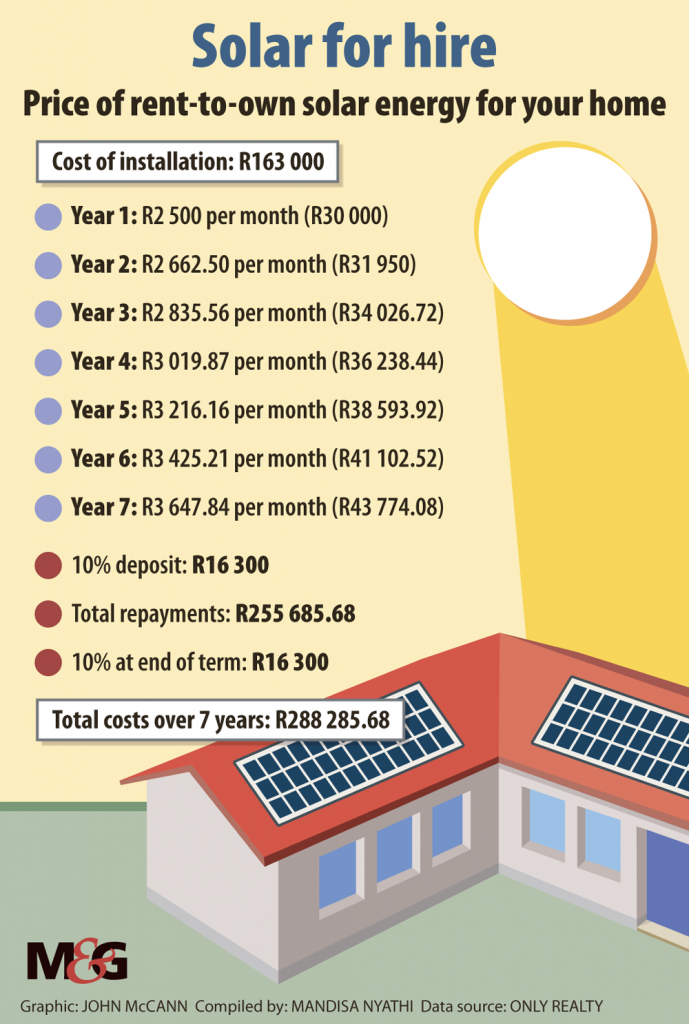 (John McCann/M&G)
What’s on offer?
Standard Bank has launched an online portal and marketplace called LookSee for
homeowners that include suggestions for saving on energy costs. These include energy meters, back-up lights, generators, solar geysers, solar power backup systems and geyser controllers.
Steven Barker, the head of banking products at Standard Bank, said the demand for solar power systems has shot up since load-shedding became a daily reality.
“We set up Looksee.co.za as a way to help homeowners focus on reducing monthly running costs, as well as to manage, maintain and improve their homes,” he said.
“We have a panel of suppliers that we have vetted, so anyone filling out a form on Looksee can get three different quotes, and then select the best system.
“With the current bout of load-shedding, most people are trying to find a solution that gets them over that, but we encourage them to dig a little deeper and make sure they know what it is they are trying to solve.”
The average solar power system financed by Standard Bank starts at about R100 000, which usually covers the cost of a 5kW (kilowatts) inverter system, solar roof panels, battery backup and installation. This will be sufficient to run a few computers, lights and some appliances.
Nedbank offers clients a solar system loan for six years (72 months).
Nedbank’s solar partner, Hohm Energy, which links homeowners to solar installers and financing options, offers a useful tool to determine what size system is required, based on current consumption and expenditure on electricity.
Nedbank has also partnered with ooba, which offers home loans, and Hippo, which compares prices to help their clients with solar services
Hohm Energy said most people who have taken out a loan for six years from Nedbank start recovering their costs after three years and this may take up to eight years.
Grant Smee, the managing director of Only Realty Property Group, said consumers can increase an existing home loan. “This will allow homeowners to access a portion or the total amount of their original home loan and use it towards the installation cost of the solar system.”
He added that another option is to apply for a re-advance, which allows homeowners to get a portion or all of their original home loan.
Absa’s load-shedding finance calculator estimates that a household that spends R2 500 a month on electricity would need to spend about R190 000 to go off-grid through the use of solar panels, an off-grid inverter, battery storage and a backup generator.
Capitec estimates that the cost of installing a solar system to go off-grid can range from R150 000 to R350 000. But the bank noted that prospective solar users don’t need to go off-grid, because interim solutions are available.
Other options
Other electricity solutions include leasing options that can be found on Wetility, a platform that allows consumers to pay for the power they use under a power purchase agreement or lease. There is no upfront cost for the system.
For homeowners who do not have a home loan, banks such as Absa, FNB and Nedbank offer various options to take out loans specifically for solar and backup systems to guard against load-shedding.
Standard Bank announced this year that it will offer loan services for commercial and industrial clients depending on the size of the solar panels.
Consumers should weigh up which of the options are better — rent-to-own, a generator or inverter.
Finance options
South African Photovoltaic Industry (Sapvia) says the cost of a solar PV system varies, depending on its size and whether it is linked to the grid or is off-grid and uses batteries.
The rent-to-own option is increasingly popular with customers upgrading their homes, according to Sapvia. “Costs range from R1 500 to R3 000 a month, depending on the system size and contract duration.
“A typical system with 6kW solar PV modules, 5kW inverter, and 10kWh [kilowatt hour] battery storage would have a cost ranging from R95 000 to R190 000, depending on the quality of components and the quality of the installation or labour costs,” Sapvia added.
“Costs that are lower than these benchmarks for the system components listed should be treated with scepticism.”
Smee said the cost of a solar solution depends on the scale of the product or what type of system consumers choose.
[/membership]