Police use water cannons to disperse anti-government demonstrators and university students during a protest demanding the release of Inter University Students' Federation leaders and the country's economic crisis, in Colombo on March 8, 2023. (Photo by ISHARA S. KODIKARA / AFP)
Since the unrest that swept through parts of the country in in July 2021, analysts have warned that simmering tensions could lead to another bout of social upheaval.
This discontent is not only a South African phenomenon, as a growing sense of insecurity — set off by global economic instability, government austerity and higher living costs — has sparked more frequent mass action worldwide.
Strike action is a common phenomenon globally, notes Lawrence Abiwu, an adjunct lecturer at the School of Management, IT and Governance at the University of KwaZulu-Natal. But the indicator of growing discontent among citizens is the magnitude or the frequency of this phenomenon.
According to a a study by German non-profit Friedrich-Ebert-Stiftung (FES), last year saw an unprecedented wave of protest action over food, energy and the rising cost of living.
People took to the streets in over 12 500 protests between 1 November 2021 and 31 October, the study found. Protests erupted across regions, in all political regime types and in rich-, middle- and low-income countries.
The wave of protests, the FES study noted, signals a global failure to deliver basic goods at affordable prices. Although unrest has been triggered by the cost-of-living crisis, there are other grievances, including complaints about corrupt governments, who are often seen as being in collusion with economic elites.
“Universally, the risk factors for discontent, disruption and unrest are the same,” Lizette Lancaster, manager at the crime justice information hub at the Institute for Security Studies, told the Mail & Guardian this week.
These risk factors include the deterioration of public services, severe economic decline and the absence of democratic processes during decision-making about governance and national policies.
“At the heart of it all is that some people feel discontent if they believe that they are carrying all the risk but not getting any rewards for taking that risk,” Lancaster said.
“Political and economic decision-makers are doing what they please, as they please. And that impacts on people’s sense of fairness.”
South Africans, Lancaster noted, are so “used to high levels of inequality and economic deprivation” that they have relatively low expectations.
However, citizens in countries where governance and services generally “run like clockwork”, prices are stable and interest rates are low, develop a sense of insecurity when their circumstances abruptly change.
“We see severe disruptions in places, even in Europe, like France [and] the Netherlands … protest action can now be seen across the world because of growing feelings of insecurity and dissatisfaction with political leaders,” Lancaster said.
Inflation rose globally as the world’s supply chains adapted to the rebound in economic activity after the Covid-related lockdowns. Although a number of central bankers believed elevated inflation would be transitory, Russia’s war on Ukraine quickly proved that prices would remain stubbornly high.
Sanctions against Russia — the world’s second-largest oil and natural gas producer — sent shock waves through energy markets, causing fuel prices to soar. The war, which cut off two key agricultural players, also triggered a food crisis. Last year, the Food and Agriculture Organisation’s food price index rose to its highest level in at least 17 years.
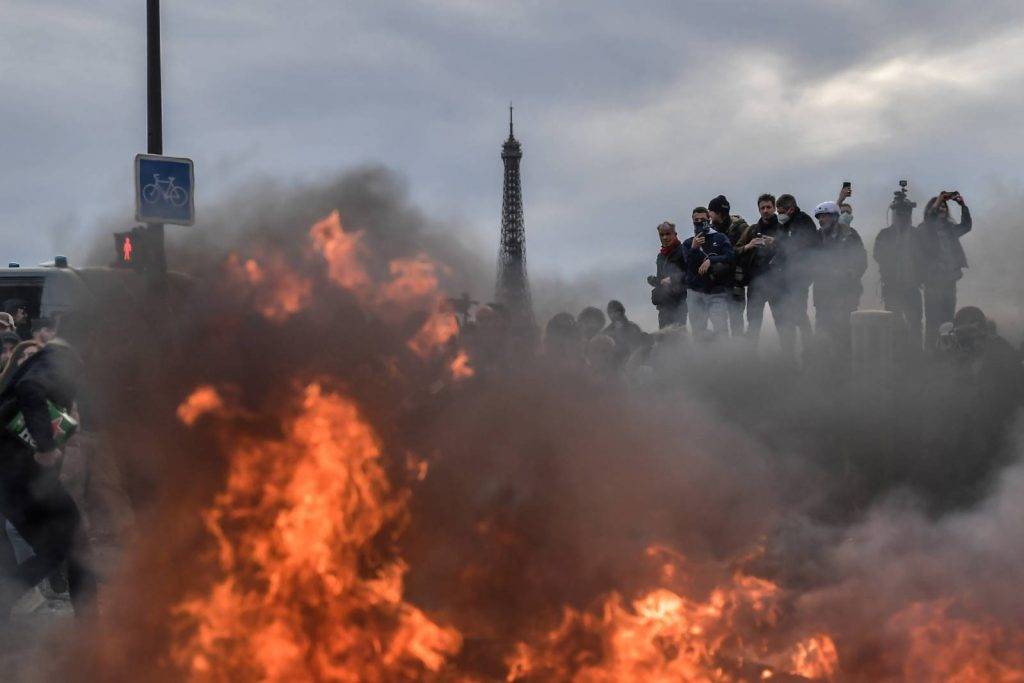 PARIS, FRANCE – March 16: Eiffel Tower is seen while protesters set fire as clashes take place with riot police during a demonstration against French government’s plan to raise the legal retirement age in Paris, on March 16, 2023. (Photo by Firas Abdullah/Anadolu Agency via Getty Images)
The global cost-of-living crisis has coincided with the deterioration of disposable incomes across the world due to the pandemic’s economic onslaught.
For the very first time in the 21st century, real wage growth fell into negative territory in the first half of last year, according to the International Labour Organisation Global Wage Report 2022-2023.
“The multiple global crises we are facing have led to a decline in real wages. It has placed tens of millions of workers in a dire situation as they face increasing uncertainties,” said the organisation’s director general Gilbert Houngbo, who further cautioned that failure to recover from the pandemic “could fuel further social unrest across the world and undermine the goal of achieving prosperity and peace for all”.
Tough financial conditions have added fuel to simmering tension. Protesters in Sri Lanka took on their government last year over the country’s economic crisis, severe inflation, blackouts and fuel shortages. Then president Gotabaya Rajapaksa fled the country in July in the wake of the mass protests.
In September, protesters in Italy burned their energy bills and, in October, thousands in France took to the streets to show their ire over rising costs.
In Africa, demonstrations cost the lives of several people last month. In Ethiopia, intercommunal violence left about eight dead, while clashes between security forces and opposition protesters in Guinea saw two people killed, 58 hurt and 47 detained on 15 and 16 February, according to the International Crisis Group.
Just this week, thousands of junior doctors working for Britain’s National Health Service (NHS) disrupted medical services during a three-day strike due to wage disputes across England. The national medical director for NHS England, Stephen Powis, told a local radio station the strike “is likely to be the most disruptive set of industrial action days that we’ve seen all winter”.
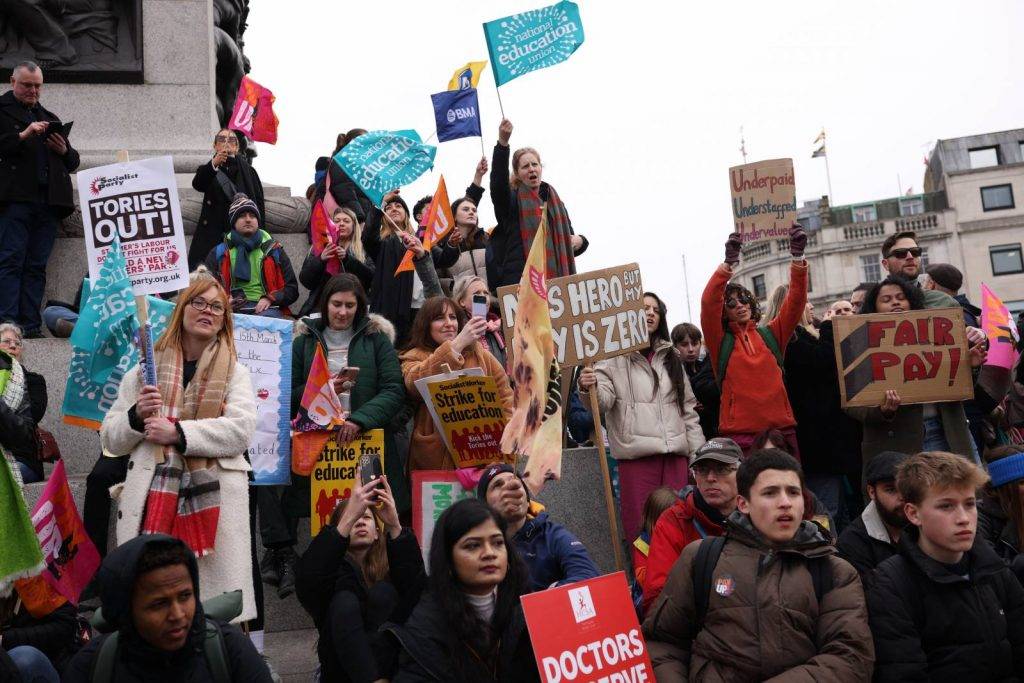 Striking teachers and NHS staff demonstrate with supporters in Trafalgar Square on March 15, 2023 in London, England. UK. (Photo by Dan Kitwood/Getty Images)
A nationwide public sector strike, one of many in the UK over the last year, coincided with Chancellor of the Exchequer Jeremy Hunt’s tabling of the country’s spring budget.
Although Hunt’s spending plans include efforts to shield households from the cost-of-living crisis, the budget failed to make provision for pay raises in the public sector, which has been decimated by the UK’s austerity programme since 2010.
The UK is set to see a number of public sector strikes throughout the rest of this month.
The wave of industrial action in Britain’s public sector, and the political and economic ructions that have set them off, are not dissimilar to what has been seen in South Africa, which has recently endured a devastating strike by health workers.
The strike by members of the National Education, Health and Allied Workers’ Union also arose as a result of spending cuts in the public sector over the years, which workers say have left them out of pocket while having to shoulder a significantly heavier workload.
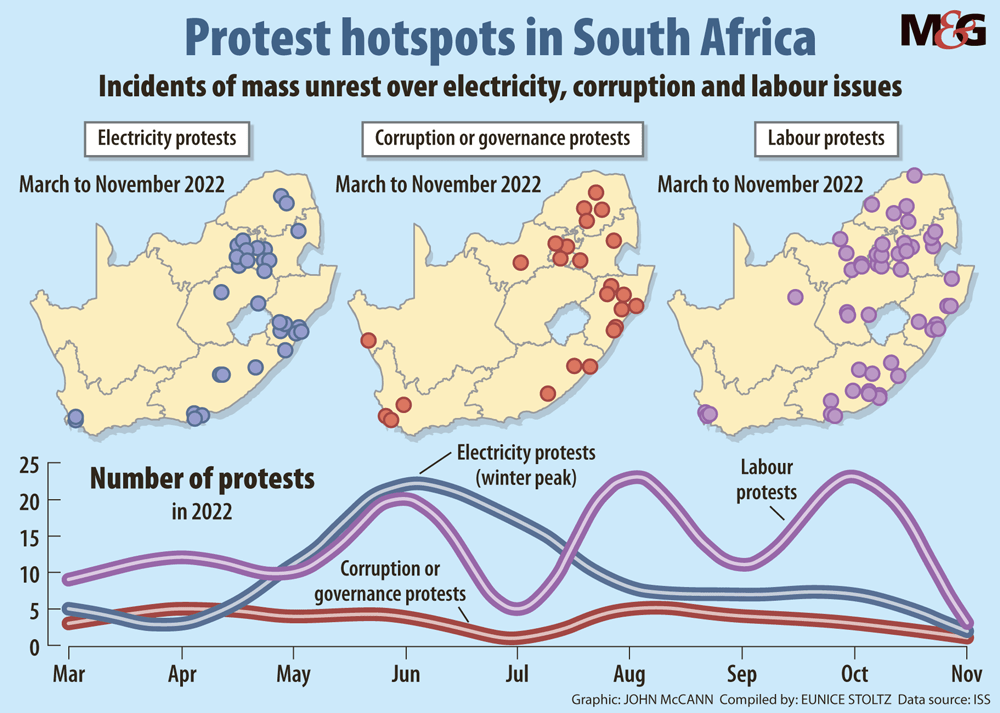 (John McCann/M&G)
The ratio of healthcare workers to 100 000 users of the system fell from 722 to 669 between 2012 and 2021, according to an analysis by the Public Economy Project.
Finance Minister Enoch Godongwana’s 2023 budget, delivered last month, dealt another blow to healthcare spending. According to the Institute for Economic Justice. According to the Institute for Economic Justice, there will be a R47 billion shortfall — an under-allocation compared to if allocations had risen in line with inflation — in spending on health over the next three years.
The country is gearing up for further disruptions on Monday, 20 March when the Economic Freedom Fighters is expected to voice the party’s grievances with the state by embarking on a so-called national shutdown.
The opposition party will be joined by the South African Federation of Trade Unions (Saftu). Among other things, Saftu is demanding that the government improve service delivery by reversing spending cuts and expanding the public sector. The federation is also demanding better pay for civil servants.
 Unhealthy state of affairs: Nehawu members protest outside Bheki Mlangeni Hospital in Soweto last week. Photo: Fani Mahuntsi/Gallo Images
By reducing the public sector’s share in the economy, the government has opened the country to deteriorating service delivery.
Specialised local government data and intelligence organisation Municipal IQ says service delivery protests are back to pre-Covid-19 levels, with 193 recorded nationwide last year. Such protests have become a “regularly occurring and firmly entrenched social phenomenon”, managing director of Municipal IQ Kevin Allan told the M&G last month.
The Institute for Security Studies’ Lancaster described South Africa’s protests as relatively peaceful, where the majority are not prone to violence. However, high levels of youth unemployment, persistent blackouts, the high cost of living and widespread corruption by public officials increases the country’s volatility.
Considering the deadly protests in Sri Lanka and Venezuela, there is a direct correlation between the intensity and size of protests and the severe economic decline those countries experienced, explained Lancaster.
“It has to be a lesson to us.
“South Africans are still expressing themselves through democratic means, being through political participation in traditional forms like voting, or through peaceful protests or through freedom of speech and being able to criticise government.
“But of course, you know, there’s always a tipping point.”