The passageway of Sumaiya Sidat’s house in Robertsham, in Johannesburg’s southern suburbs, is lined with water containers. Buckets are stacked inside the bathroom while large cooking pots filled with water warm on the stove, ready for the family’s bucket baths.
“This is how we have to live now,” said Sidat. “It’s the new normal. I think it’s better we take it as a test from God trying to show us something, then it will make it a little bit easier for us to cope.”
For nearly three weeks, Sidat and her neighbours in parts of the suburb have had to endure water shortages, which Johannesburg Water has blamed on infrastructure failures at Rand Water plants.
“We can’t do our washing, cooking is kept to a minimum, you have to drive around searching for water and that’s an extra expense,” she said. “If it wasn’t for the residents with boreholes, I don’t know what we would have done. Water is something that you need; there’s no improvisation for it.”
Her neighbour, Sajid Tambay, said that without water, caring for his 76-year-old mother who recently had brain surgery, had become a nightmare.
Last week, she had to move in with his brother, who lives in Buccleuch, Sandton, and has water.
“We had this water situation in October and now it’s becoming a repeat,” said Tambay. “For the past three weeks, it’s been on and off; it comes for two three hours and then it goes off. For the past few days, there’s not even a drop. Forget the taps, my pipes are even dry.”
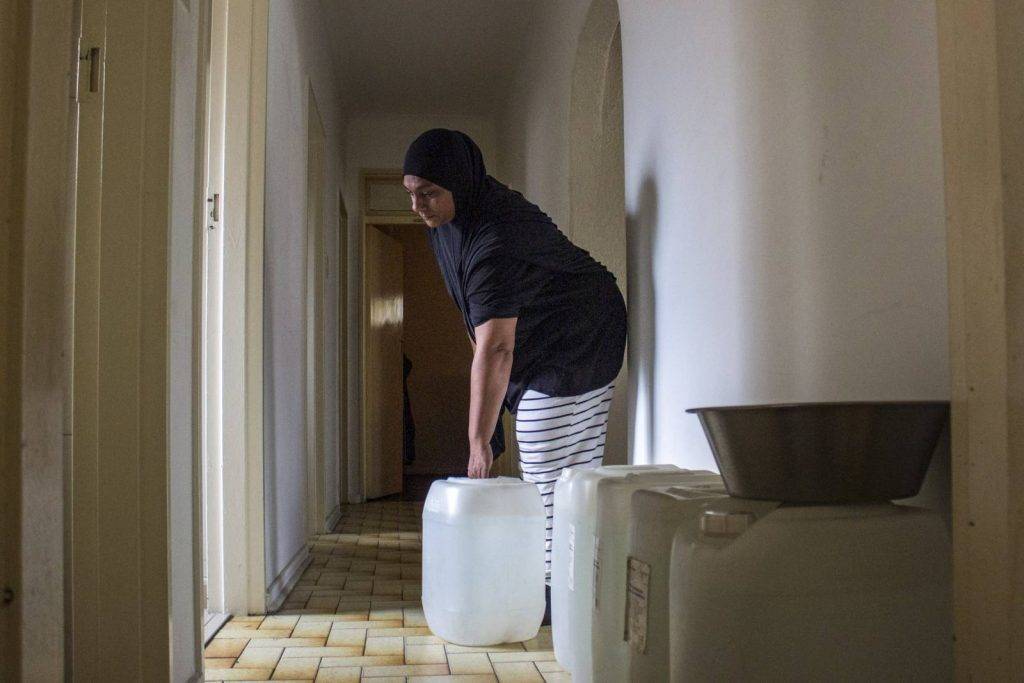 For nearly three weeks, Sumaiya Sidat and her neighbours in parts of the suburb have had to endure water shortages, which Johannesburg Water has blamed on infrastructure failures at Rand Water plants. (Delwyn Verasamy/M&G)
The family has two sets of water, one for cleaning and sanitation and the other for drinking. Tambay is blind and said it was difficult to know which water is clean and which isn’t. He has to ask his wife or children which water he can drink. “If there’s no one at home, I just have to wait.”
At her home a few streets away, Elize Bickerton sat on her veranda, depressed.
“These water problems have been going on for two years, on and off, but never this bad. We’ve now been more than a month without water … We have water for a few hours and it’s gone for a few days. I can’t have a relaxing shower, clean my house and do my laundry. I can’t do my stuff.”
Last week, they took part in a peaceful protest at Johannesburg Water’s Southdale depot, which was joined by residents from Robertsham, Turffontein and Crown Gardens.
 Sajid Tambay said that without water, caring for his 76-year-old mother who recently had brain surgery, had become a nightmare. (Delwyn Verasamy/M&G)
“I wrestled a police van,” said Bickerton. “The police got a report that it was a violent protest. It was a bunch of old ladies — I had my walking stick in my hand.”
Her husband, Glynn, says it’s like camping. “We have what we call bucket baths or bucket showers … When we do get water, it’s a trickle.”
His swimming pool is emptying because he cannot use the pump and “because of all the buckets of water that I’ve been carrying, flushing toilets, washing this, doing that. It’s getting from bad to worse.”
Robertsham has a large community of older people who struggle to collect water from Joburg Water’s roaming tankers or the water tank, said Moe Ally, the convenor of the Robertsham Action Group. “It’s really a crisis. We’ve set up little committees to assist elderly and vulnerable people with water … because we don’t get too much help.”
 Elize Bickertson. (Delwyn Verasamy/M&G)
He said there aren’t sufficient answers from authorities. “The bottom line is that Joburg Water is basically blaming Rand Water, saying Rand Water can’t supply them with water, but of course when you meet up with Rand Water, they’ll tell you Joburg Water is a problem. It looks like this thing is here to stay and we’re into water-shedding basically. This is bloody shocking for us.”
On Sunday, Ally was among a group of residents who attended a briefing on water interruptions held by the City of Johannesburg. “We expressed our view to the mayor that we demand water and that all the excuses they’re giving are not going to help us.”
Johannesburg mayor Thapelo Amad said: “What is most concerning in this moment of crisis for our city is the back and forth between Johannesburg Water and Rand Water leaving residents bewildered as to who is responsible for the problem.”
Jack Sekwaila, the MMC for environment and infrastructure services, said the briefing was held to reassure residents that the city is taking the matter seriously. He said Johannesburg Water’s system had been under immense pressure in the past 10 weeks because of Rand Water experiencing various failures on its bulk infrastructure.
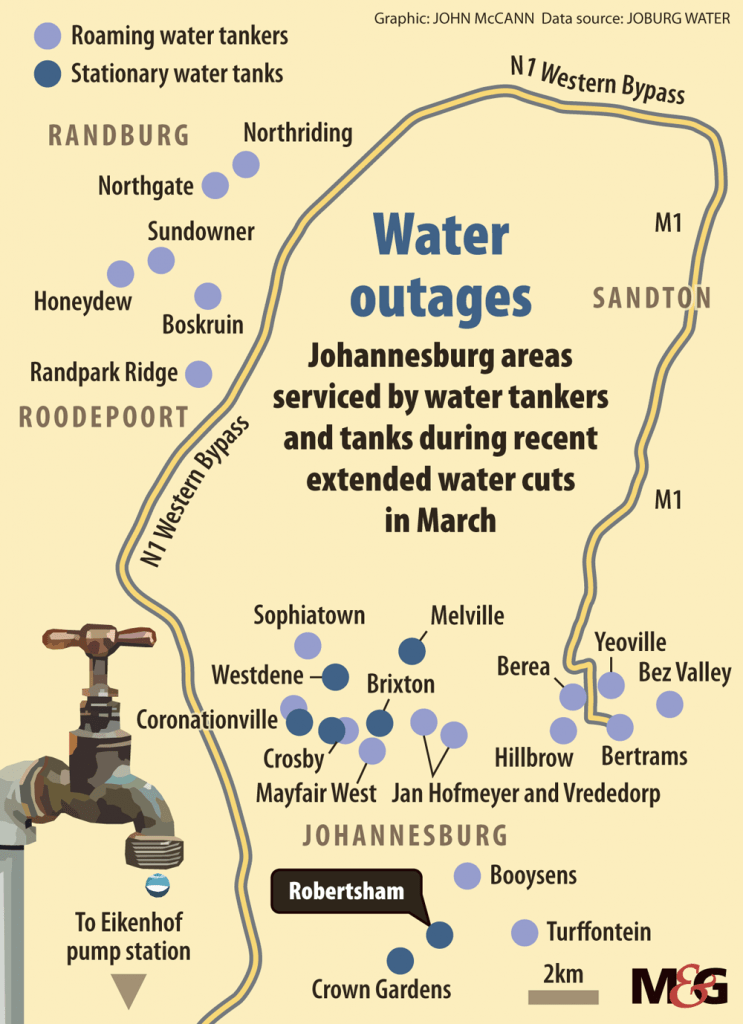 (John McCann/M&G)
The city is supplied by Rand Water’s Eikenhof, Zwartkopjes and Palmiet booster stations, which were affected by frequent power failures and vandalism to its infrastructure and planned infrastructure maintenance work.
Eikenhof, which supplies parts of the southern and western Joburg, Randburg, Roodepoort and Soweto, was affected by frequent power failures. Zwartkopjes, which supplies the central and northern parts of Johannesburg, was affected by vandalism and power failure. Palmiet, which supplies a portion of southern and eastern Joburg as well as Sandton, Midrand and Diepsloot, was affected by frequent power failures and vandalism.
“We have noted with great concern and sympathise with the mounting frustration of our residents and we’d like to take this opportunity to apologise profusely for interruptions in their daily lives and the inconvenience this has caused,” said Sekwaila.
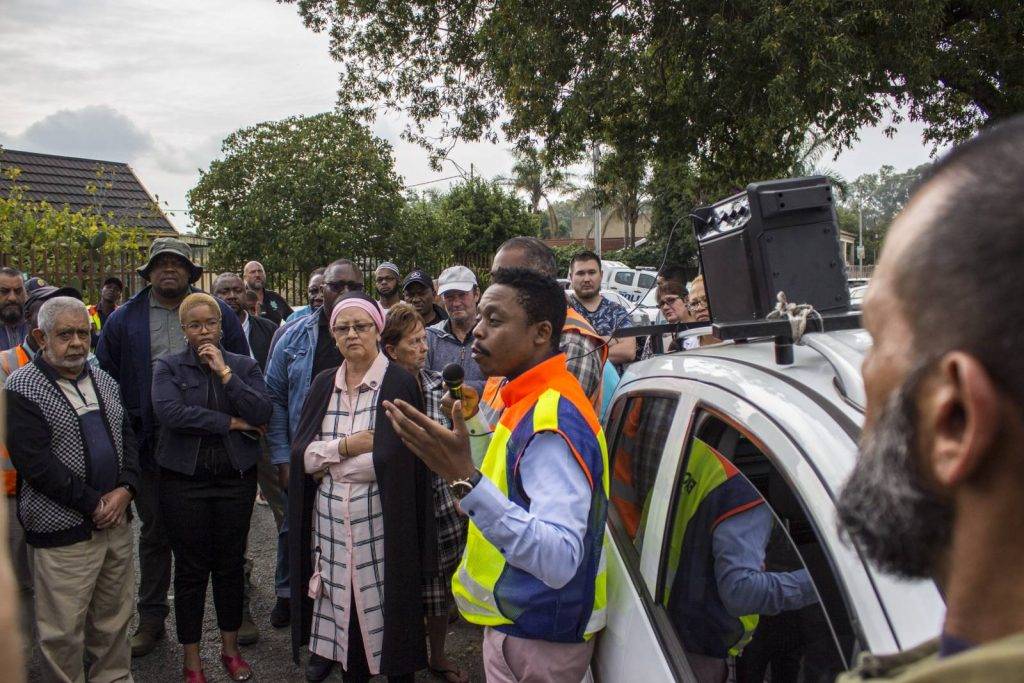 Johannesburg Mayor Thapelo Amad. (Delwyn Verasamy/M&G)
Ntshavheni Mukwevho, the managing director of Johannesburg Water, said the city receives 1.6 million litres of water daily that is purified by Rand Water to distribute to its customers. “That’s very important because if you look at some of the systems, which were hard hit, you’ll see that the main challenge we’re having is the required volume, which is not necessarily there [and] we won’t be able to meet demand for our residents.”
By Tuesday this week, most streets in Robertsham had their water restored. Johannesburg Water announced normal operations had resumed at the Crown Gardens system.
“In some areas, the pressure is still low,” Ally said. “It’s strange how quickly they could build capacity once residents decided to confront them. We just need to give it a few days to check if this is temporary.”
Nico de Jager, the Democratic Alliance’s Gauteng spokesperson for infrastructure development, blamed the years of neglect of water infrastructure in Gauteng, coupled with poor communication from Rand Water, for leaving residents with dry taps.
Rand Water blames vandalism for its woes when its job is to secure the infrastructure.
“The blame is shifted to municipalities when they should also be maintaining their own infrastructure,” De Jager said. “Every time the Vereeniging plant experiences an infrastructure failure, the Rand Water Eikenhof reservoir systems fails to supply water to large parts of Randburg, Roodepoort, Hursthill, Crosby and the Commando system that feeds water to Johannesburg south.
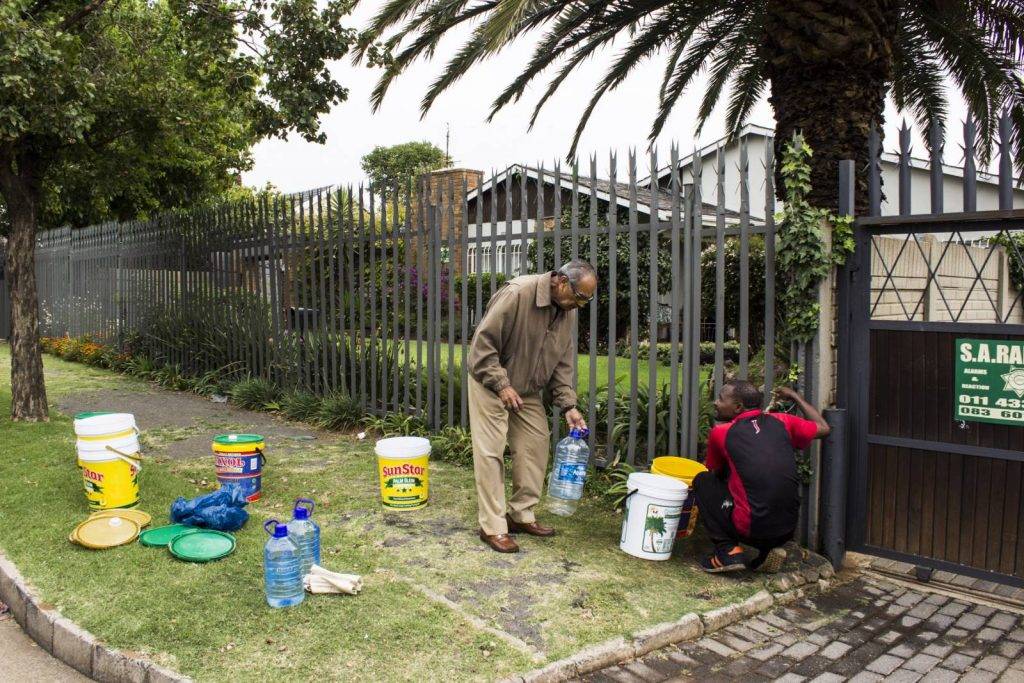 Borehole water collection in Johannesburg. (Delwyn Verasamy/M&G)
“As much as water entities would like to blame the system’s failures on load-shedding, neglect and the lack of electrical infrastructure, maintenance and upgrades have led to the current dire situation.”
Rand Water spokesperson Makenosi Maroo said the utility continues to supply water to its customers. “However, we have recently been experiencing incidents of theft and vandalism of our infrastructure as well as power failures from Eskom and municipalities.
“These incidents have led to water supply disruptions to municipalities and other customers,” she said, adding it does communicate these challenges to its customers and works with power suppliers to resolve power supply challenges.
Maroo said Rand Water is working on initiatives to prevent vandalism and theft of its water infrastructure, “including collaborating with municipalities and law enforcement agencies. We are encouraging communities to work together with the organisation to ensure that critical infrastructure is always protected”.
Maroo said a project is under way to construct infrastructure curbing vandalism incidents.
Water and Sanitation Minister Senzo Mchunu said Gauteng’s current water demand stands at 4.56 billion litres a day. Rand Water is able to supply 4.43 billion litres a day, leaving a shortfall of 396 million litres a day, or 9%.
Of this, at least 5% is lost in its system, leaving 3.97 billion litres a day reaching municipalities. Out of this, an estimated 45% is lost in the municipalities systems as non-revenue water, of which at least 20% is the result of leaks and burst pipes.