Hands up: Police conduct an operation in Hanover Park, Cape Town. The high incidence of gang activity in the area means ambulances need to have an armed escort. Photo: Marco Longari/AFP
The response time of the Western Cape emergency medical services (EMS) in gang red zone areas on the Cape Flats has again been thrust into the spotlight after the death of a woman who had to wait 24 hours for assistance.
Fatgiyah Boyes, 33, allegedly died of heart failure at her home in Donegal Court, Hanover Park, on 26 April. A day before her death, Boyes’ friend and neighbour, Zakiyah Petersen, requested an ambulance at about 12.50pm through 10177, the dedicated ambulance service number for Cape Town.
Petersen received a message from EMS confirming that an ambulance had arrived at the stipulated location, despite the fact that it had not. She received the same arrival message after her second request for an ambulance.
With two reference numbers, and no medical assistance, Boyes and Petersen’s mothers worked throughout the night to ease Boyes’s discomfort and pain.
On 26 April, a community group requested assistance for Boyes and a third reference number was logged. But Boyes died at about midday. The family waited another two hours for an ambulance to arrive and declare her dead.
EMS said the matter was under investigation.
“We acknowledge this complaint, have spoken to the person concerned, and will give feedback as per departmental policies to the complainant,” said Byron la Hoe, of the Western Cape department of health and wellness. “Once the investigation is completed, we will be able to provide adequate feedback.”
Petersen said this was not the first time residents had had to wait hours for emergency services. She named other patients who had waited for three hours for emergency medical assistance.
Hanover Park was declared a permanent red zone in September 2016. The implementation of red zones was in response to increased incidents of violence against ambulances and EMS officials in and around Cape Town.
Police spokesperson for the province Colonel Andre Traut said in the same way that the public and vehicles that travel through high-risk areas are exposed to criminal elements, so too are medical workers and vehicles.
Traut described the theft of items such as cellphones and wallets in previous attacks on medical staff as opportunistic crimes.
Between January and April, 16 assault incidents against medical staff and vehicles were reported in the Western Cape. Of the 16, one, described as “threatening behaviour”, took place in Hanover Park, in March.
Plagued by gangsterism and infighting, Hanover Park was at the top of the list to receive the latest instalment of the gunshot detection system known as SoundThinking (formerly called ShotSpotter), which the city procured last year. It was first introduced to the Cape Flats, including Hanover Park, in July 2016 and operated until 2019.
From January to last month, the system detected 60 to 74 gunshots a month. During a surge in gang fighting in December, 127 gunshots, with 460 rounds fired, were detected in Hanover Park.
When an area is declared a red zone, ambulances must be accompanied by armed law enforcement, though escorts are not limited to the South African Police Service (SAPS).
“The EMS vehicle meets the SAPS escort at a police station,” said La Hoe, but added that when a police escort was unavailable, “the EMS does receive assistance from the City of Cape Town law enforcement when escorts are required for ambulances.”
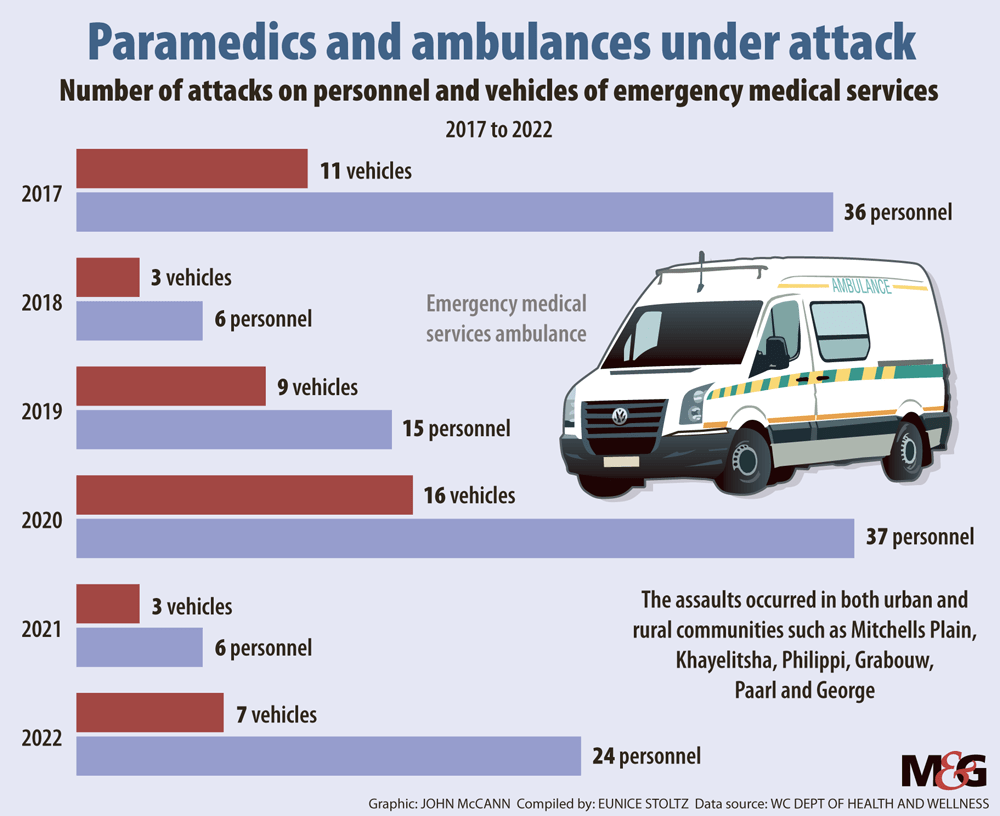 (John McCann/M&G)
Traut said: “Escorts are conducted on an integrated approach where SAPS [and] other law enforcement agencies offer services, depending on the location and availability of a patrol vehicle.”
He said it was standard practice that an emergency vehicle approaches a police station or calls to request an escort from an agreed-upon location.
“These escorts are conducted as a priority and delays are only caused when all available patrol vehicles are occupied with emergencies that are channelled our way.”
In the case of Boyes, it has been alleged that an ambulance could not reach the destination because there was no available police escort.
According to staff at Manenberg police station, which is about 6km from Donegal Court, the ambulance service would have requested an escort from the Philippi police station. The station is 2.2km from the requested location.
Although the Mail & Guardian’s inquiry was acknowledged, numerous attempts to speak to Philippi police to clarify whether an escort was requested on 25 or 26 April went unanswered.
An EMS official with close to 20 years’ experience agreed to speak to the M&G on condition of anonymity about the difficulties of working in such an environment.
The official said each EMS vehicle is supposed to be fitted with a mobile data terminal (MDT) system. The MDT system gives updates in real time in relation to dispatching services, communicating with the emergency control room, emergency stock and patient information. It also stores information for future use.
The MDT system, in the form of a handheld tablet, also “permanently flashes the red zones” at the bottom of the screen. “It is so integrated that we do not even have to take the radio and ask where the problems are,” said the official.
In a case where a patient is in a red zone, the emergency vehicle will go to the nearest police station, state the case “and the police go with you [to] go and save the patient”.
“That is in theory. Unfortunately, it does not always happen that way.”
In some cases, when medical staff request a police escort “they don’t add assertiveness to it and the police do not take them seriously”, said the official, adding that in some cases, there are no police vans available to act as escorts.
A 2018 study by the University of Boras in Sweden suggests the waiting times for EMS in Hanover Park increased in the period 2016 to 2018. The study formed part of an international Swedish scholarship called Minor Field Studies and enabled the author, Fia Gleby, to work with the universities of Cape Town and Stellenbosch. Gleby explored how access to ambulance services is affected by red zones.
Using a quantitative method, the study compared EMS response times for Cape Town and Hanover Park.
The response times in both areas increased in the 2016 to 2018 period but the time it took for the control centres to dispatch an ambulance to Hanover Park more than doubled in the two years. In the city, dispatch time increased from a median of four to almost nine minutes.
“In Hanover Park, the comparable numbers show an increase from eight minutes to almost 22 minutes” before an ambulance is dispatched to an emergency, the study found.
In addition, the time it took from dispatching an ambulance to collecting and transporting the patient to a hospital was 40% higher in Hanover Park than in Cape Town.
Gleby wrote: “By requiring a police escort for EMS when red zones are allocated, resources are allocated away from their primary function, which further limits SAPS capacity. In addition, having to wait for an escort during busy times likely severely affects EMS ability to offer an efficient and effective service.”
She added it may be “tempting” to remove the safety routine because it affected the waiting period for the patient and limited police capacity but said this would compromise the safety of medical staff.
La Hoe said the health department “is prioritising staff safety in the organisation and has implemented essential measures to ensure that EMS officials are kept safe”.
He said police escorts were dispatched to high-risk areas such as Chicago in Paarl, Beacon Valley and Tafelsig in Mitchells Plain and Hanover Park.
The department had adopted a “whole-of-society approach”, where neighbourhood watches and community groups partnered with the department and he urged the public to help protect and support EMS officials.