Businessman Roger Jardine is the leader of the new political party Change Starts Now, which is allegedly funded by a small group of very rich people. Photo supplied
ANC veteran Mavuso Msimang has been touted as one of the people who will join a party to be launched by top businessman Roger Jardine ahead of the 2024 elections.
Jardine is due to announce a new political movement on Sunday, when it is expected that several high-profile business and political leaders will be presented.
Msimang, however, said in a statement on Friday: “I am not considering any further involvement with formal party politics.
“I remain, however, a committed citizen of South Africa and intend to be a vocal commentator, supportive of South Africans who have a genuine interest in solving the many challenges facing our country,” he said.
Former ANC Eastern Cape premier Nosimo Balindlela, who defected to the Democratic Alliance (DA), is believed to be among those who are headed to the Jardine movement.
News24 reported that social activist Mark Heywood was also joining.
In a media statement on Thursday, Jardine’s team said he would be launching a movement and sharing his early ideas on how he intends to be part of the solution to the national crisis. A video poster released on Wednesday and bearing Jardine’s face invited the media to the event.
Jardine hit the headlines over the weekend with speculation that he was in talks with the DA to become the face of its campaign and that of the Multi-Party Charter.
The Sunday Times reported that Jardine had met DA leaders John Steenhuisen and Helen Zille in Cape Town last week to discuss a possible arrangement.
In a statement on Monday evening, the Multi-Party Charter quickly refuted this was an initiative of the DA and Steenhuisen. The charter said it has “capable” leaders to run the country should it emerge as the victor in the 2024 elections.
The charter consists of the DA, ActionSA, Inkatha Freedom Party (IFP), Freedom Front Plus, the Independent South African National Civic Organisation, the United Independent Movement, Spectrum SA and the African Christian Democratic Party.
“It is fully recognised that every party in the Multi-Party Charter has the autonomous right to engage with, and make decisions about their relationship with, different individuals and organisations,” the statement read.
“Notwithstanding this fact, the Multi-Party Charter For South Africa would like to point out that there have been no discussions relating to a joint presidential candidate for the charter.”
The charter said any decision to support a joint presidential candidate, either before or after the elections, would be based on the merit and mandate of the candidate.
The charter signed an agreement during its first convention in August, which stipulated that the leader of the coalition partner that secures the largest number of votes will become the leader of government business in a coalition cabinet.
As things stand, this would guarantee Steenhuisen the post of deputy president of the country as the leader of the largest opposition party, should they make it over the line in the next elections.
The issue of who becomes president would be resolved through a vote in parliament because it is MPs, not voters, who elect South Africa’s head of state.
The parties would share cabinet posts on a proportional system based on the number of votes they secure, but have also agreed in principle to review the size of South Africa’s cabinet should they come to power.
They agreed to carry out lifestyle audits on all members of the executive, and that the party which is dominant in the cabinet will not enjoy the same dominance in parliament.
Corporate South Africa is said to have been fielding names over the past months on whom it would use resources to back in the coming elections.
The business community had turned to Ramaphosa ahead of the ANC’s elective conference in 2017, funding his successful CR17 campaign that saw him defeat the Radical Economic Transformation (RET) faction’s Nkosazana Dlamini Zuma for the presidency.
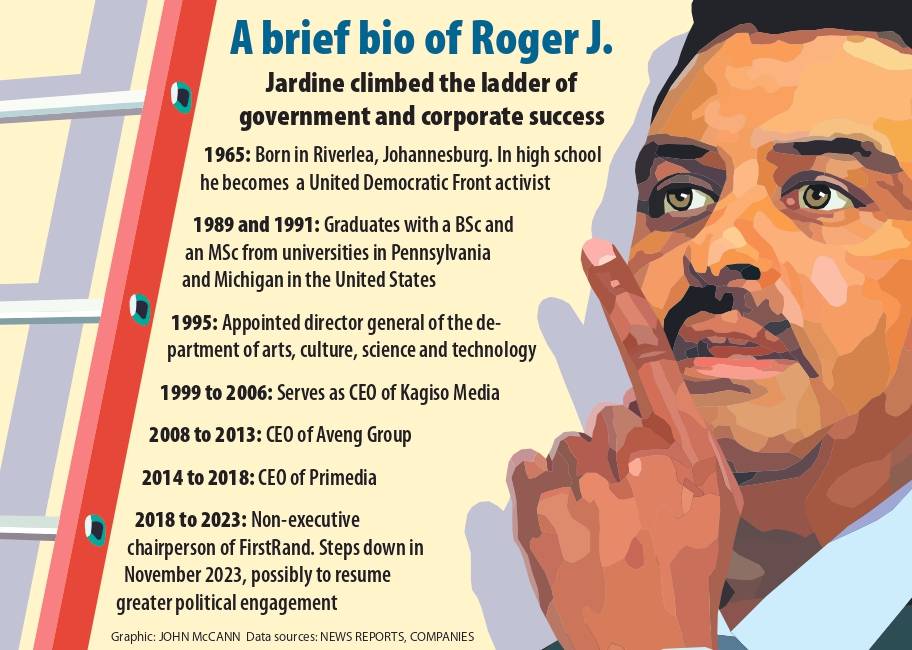 (Graphic: John McCann/M&G)
But the relationship has since soured, with the country’s business tycoons unhappy with Ramaphosa’s consultative leadership style, which they say has stalled the recovery of the economy.
The country’s investors and business executives also appear to have run out of patience with Ramaphosa’s failure to drive real reform in the ANC and are now turning elsewhere.
In June, business leaders including Nedbank group chairperson Daniel Mminele and MTN group chief executive Ralph Mupita called for urgency in resolving domestic hindrances to economic growth and warned the country is at risk of becoming a “failed state”, Bloomberg reported.
One business leader said Jardine has credibility among the private sector.
“But I could say the same thing about Cyril Ramaphosa … I think we need to be very cautious about idolising one individual,” they added.
“My concern about Roger is that, if you look at the ANC or the EFF [Economic Freedom Fighters] or DA, they have real boots on the ground. That’s what makes the difference. Of course, I would like to hope that we get an investor-friendly leadership which has the interests of the country at heart and is responsible about the policies that they implement and takes decisive action.”
For the longest time, South Africa’s business and investment community have been invested in the idea of the reconstruction of the ANC after the ruinous presidency of Jacob Zuma that exposed the depths of corruption in the party that has fed into the functioning of the state.
Ramaphosa’s inability to gain their confidence over his first term that he can deal with the collapse of governance and that he can professionalise the state has seen this bloc turn their back on not only him but the ANC as a whole.
But, fearing the prospect of corruption in ANC in opposition benches and the disruption that it can cause given the influence of the lobby, the influential bloc of big business and its most influential business people are considering a future where the party is part of a ruling coalition.
Knowing the unelectability of Steenhuisen as the country’s president — by polling and even by their estimation — some have rallied behind the entry of Jardine into a governing coalition and ultimately as state president.
The business fraternity believes Jardine, from his time at Kagiso Media, Aveng and as chairperson of FirstRand, has the nous to understand market and investor needs when it comes to South Africa.
“Let’s imagine that at the table of South Africa there are two birthday cakes — the one is the ANC and the other is the DA. Putting the icing on the cake and the cherry on top is really what this whole thing is about. But the cake is the cake,” a respected business leader said.
“At the end of the day, the electorate is going to see the ANC and the DA. And what Roger seems to be doing is trying to put icing on the DA cake. Whatever business wants or doesn’t want, the country will cast its vote. It’s not going to change the picture. It’s going to be an ANC-versus-DA picture.”
Last month, Momentum Investments economist Sanisha Packirisamy suggested that markets might be happy to see a coalition between the ANC and the DA. This would certainly be more palatable than the ruling party forming a government with the EFF — an outcome that would be viewed negatively by markets, she said.
A top ANC leader confirmed that the party was in talks with the DA and the IFP for possible power sharing deals should it fail to gain the majority in next year’s elections.
The official said Steenhuisen and IFP leader Velenkosini Hlabisa have been in discussion with the ANC over the past few months.
Another ANC insider said that Hlabisa, Zille and ANC deputy president Paul Mashatile met on three separate occasions in Cape Town.
Zille has denied meeting the ANC.
Msimang — who endorsed and campaigned for Ramaphosa during his first term and was also instrumental in the downfall of Zuma as part of the 101 Elders — criticised the ANC as having enabled corruption and of being led by corrupt individuals.
A party member for 60 years, Msimang was recently elected as the ANC Veterans’ League deputy president.
His blistering indictment of the ANC’s leadership is set to send the party’s already damaged reputation to the gutters.
In his four-page letter, signed on 6 December, Msimang said the ANC’s track record of corruption was “a cause of great shame”, given that it held the “moral high ground” when it took over government in 1994.
He said the corruption was now part of its DNA, which had “dire consequences for the most vulnerable members of our society”.
“As ANC leaders publicly proclaim ownership of obscenely wealthy homesteads and other possessions and send their children to the best schools in the land, there are still many South Africans whose children continue to be exposed to the risk of dropping into pit latrines in poorly equipped public schools and dying horrendous and humiliating deaths,” he wrote.
“There are children in rural areas who miss classes when streams and rivers are in flood because there are no bridges.”
A leader in the Multi-Party Charter said the timing of Jardine’s launch with the banks manipulation scandal would probably hurt any chances of him becoming a face of a coalition.
They said that although Jardine had the backing of big business, many South Africans were disillusioned with the corporate sector.
“Yes, you need the money from business but that is not where you get the votes. The banks are feeling the fallout in terms of the public sentiment. Ordinary people are feeling the pinch and the economic pain. It’s very easy to blame the private sector.”
“But what I can tell you is that they got bucket loads of money and are not scared to use it.”
Jardine did not respond to the Mail & Guardian’s questions.
This article has been updated to reflect Msimang’s comments, which were received on Friday morning.