Essential: Although trade unions no longer occupy the same status they did during apartheid, they remain vital for vulnerable workers. Photo: Delwyn Verasamy
The Marikana Massacre, when 34 miners were shot and killed by police while protesting for a wage increase at Lonmin’s platinum mine, exposed deep cracks in labour representation. For many, it marked a collapse in the relationship between workers and the unions meant to protect them.
“Marikana was a dramatic collapse of engagement between worker and employer, which left a sour taste in society around unions and a bad memory that unions don’t help,” said Katlego Letlonkane, a workplace culture and inclusion specialist at Stellenbosch University.
Trade unions were central to South Africa’s liberation struggle. From the 1973 Durban strikes to their role in the mass democratic movement of the 1980s, unions provided both protection and political voice for the working class.
Yet Marikana revealed a crisis of legitimacy. Workers bypassed their own union, the Association of Mineworkers and Construction Union (Amcu), signalling a loss of faith in traditional structures.
“Marikana was not only a turning point — it was a warning,” said Mario Jacobs, a researcher at the Centre for Transformative Regulation of Work at the University of the Western Cape. “It revealed a disconnect between union leadership and the rank-and-file, a gap that continues to widen, particularly among younger workers.”
Despite this, Jacobs insists that organised labour remains essential to South Africa’s democracy. “The need for unions remains. But whether they occupy the same position is another matter.”
For Justice Nkomo, a property officer at the Mogale City local municipality and a member of the South African Municipal Workers’ Union (Samwu), unions remain a powerful force.
Nkomo joined Samwu in 2015, paying R80 a month in membership fees. The return, he says, has been transformative.
“The union ensured I had a decent job. No one can wake up and chase me away from work like I’m in the informal sector. The union made me a human being. I don’t work like a slave.”
Nkomo started off as a contract municipal worker. When the contract ended, Samwu pushed for the municipality to make temporary staff permanent in 2017. Since then, he has received benefits such as medical aid for his children, a pension fund, paid sick leave and access to housing finance.
Samwu, which has about 165 000 members, has also defended the contentious Extended Public Works Programme and recently negotiated a 6% wage increase.
Still, the rising cost of living, high unemployment — currently at 31.9% — and threats of “no work, no pay” during strikes deter many workers from joining unions.
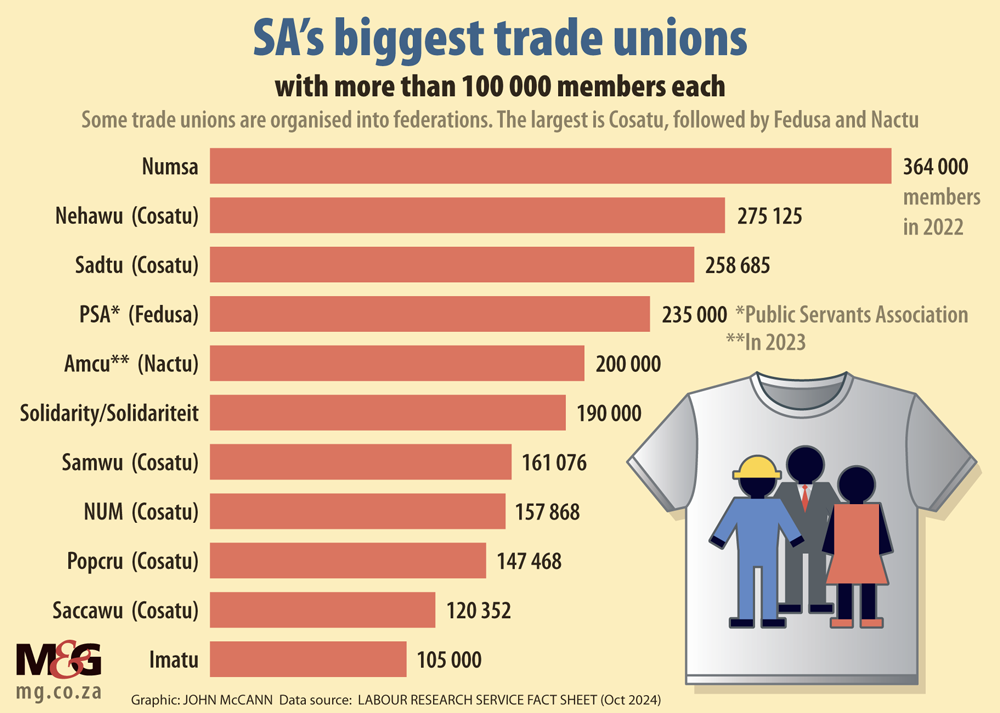 (Graphic: John McCann/M&G)
“Some workers don’t know they have rights — they think they’re here on a favour,” says Nkomo. “When we are supposed to protest, the employer says: ‘No work, no pay.’ That scares people away. “I know people who got dismissed on allegations and, because they didn’t have representation, they could not come back to work.”
Agnes Ngubeni, 40, is a human resources clerk at the Roodepoort police station and a shop steward for the Police and Prisons Civil Rights Union (Popcru).
She has been a member since 2008 and pays R77 a month. She recalls being unfairly overlooked for a promotion.
“I knew I was a better candidate than the person they hired. So I asked the union to intervene.”
Popcru successfully appealed her case, and she was promoted from personnel officer to her current job.
Ngubeni also sits on the workplace bargaining forum and recently helped negotiate new shift schedules to accommodate parental responsibilities.
“It is for your benefit to join a union,” she says. “Unions are whistleblowers — they ensure the Labour Relations Act is followed.”
Ngubeni says unions today offer more than workplace protection. “Many unions now offer life insurance, grocery vouchers and bursaries. It’s not just about fighting; it’s about empowering.”
Lindokuhle Khanyi, 30, is a ride operator at Gold Reef City. His R50 monthly membership with the Transport Retail and General Workers’ Union (Thorn), affiliated to the South African Federation of Trade Unions (Saftu), resulted in two consecutive annual salary increases after five years without any.
“I had to join because of the working conditions,” Khanyi says. “It was very hard. We had unfair dismissals, unpaid bonuses and no salary increase despite it being in the contract.”
Thorn also runs quarterly training sessions on workplace rights and labour law. Khanyi says these have helped protect him from victimisation.
He says many colleagues remain unorganised. “They fear becoming targets. They think if they stay quiet, the employer will be lenient.”
Letlonkane warns that union power is increasingly eroded in the private sector.
“There’s been a systematic undermining of unions,” she says. “Employers prefer individual contracts, which disadvantage workers.”
Globalisation, weak political education and public disillusionment have further weakened the position of unions. Activism is increasingly perceived as confrontational, and fear of job loss stifles demands for better conditions.
“Even when workers know there are better conditions elsewhere, they suppress their demands for the sake of job security.”
The data backs this up. Public sector union density hovers around 70%, while in the private sector it’s just 23%, according to Jacobs.
The collective bargaining framework is supposed to ensure that workers have a voice. But uneven power dynamics, poor coordination and legal delays are weakening its effectiveness.
Letlonkane believes the Marikana moment should have prompted a renewal of organised labour, not its retreat. “It shouldn’t have been a moment that collapses unions but rather one that rebuilds trust — particularly in the public eye.”
Yet the narrative of ineffective unions who escalate confrontation has been difficult to shift.
“When municipal workers strike, the community blames the union, not the structural issues behind the protest,” says Jacobs. “The need for unions remains. But whether they occupy the same position is another matter.”
Despite criticism, unions play a vital role in protecting workers. Whether fighting for permanent employment, enforcing fair promotions or negotiating equitable shifts, they remain one of the few institutional checks on employer power.
“The power of organised labour cannot be replaced. There is a reason for it and that reason is still there,” says Letlonkane. “We have to strive for the balance of in the power asymmetries between worker and employer and I don’t see how we are going to do that without unions.”
Jacobs agrees, saying unions must rebuild credibility and prove that they’re not only reactive, but proactive — able to shape policy, education and economic inclusion.
Nkomo says the chaos in municipal coalitions has introduced further instability, making bargaining harder and increasingly dependent on court decisions.
“Since coalitions started, we have been relying on the courts for labour issues. There is no consistency in terms of bargaining.”
Municipal coalition politics also make outcomes unpredictable especially when they have to restart with a new mayor.
Twelve years after Marikana, unions are yet to regain their good image of effective arbitrator. But for workers like Nkomo, Ngubeni and Khanyi, it has been unions that have fought for their workplace dignity.