


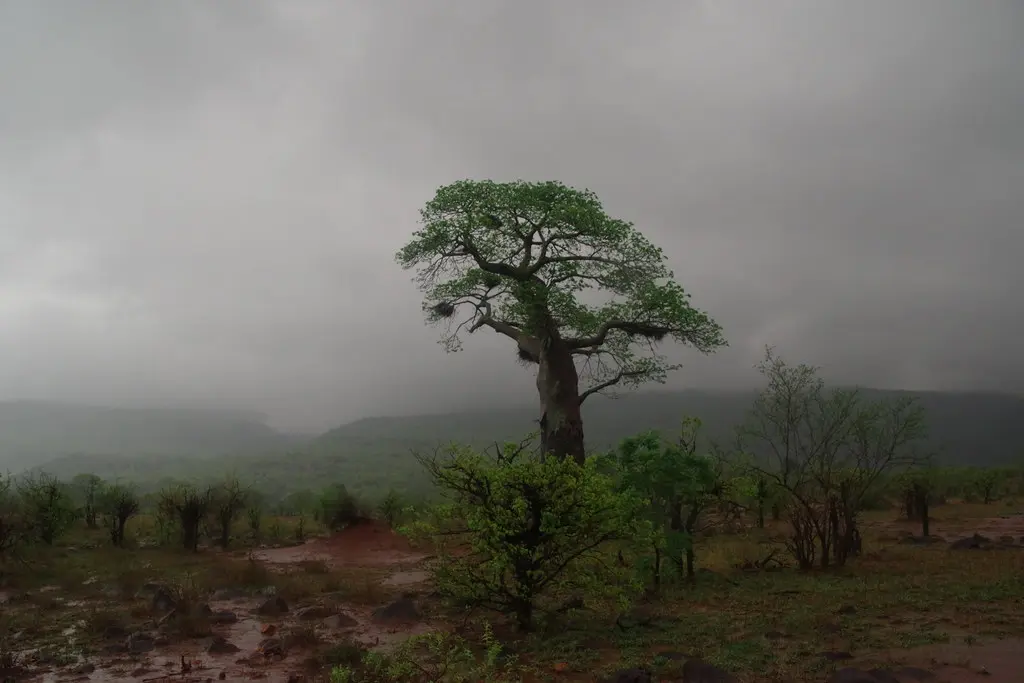
The heavy rainfall that swept across parts of the Kruger National Park at the beginning of this year caused widespread flooding but the park-wide rainfall average for the year was slightly lower than that recorded during the major 1999/2000 flood year, according to a new analysis by SANParks scientists.
Dr Tercia Midzi, the senior manager for systems ecology, and Judith Botha, the science manager for knowledge support, said Kruger’s long history of rainfall monitoring provided an important perspective on the exceptional rains.
Rainfall has been recorded at stations across the park for decades, with some records extending from 1910. The long-term datasets allow current rainfall events to be compared with more than a century of observations.
Each year, SANParks calculates a park-wide average rainfall for the 12 months ending in July, known as a climatic year.
Although several parts of Kruger received much higher than normal rainfall during the beginning of 2026, the park-wide average for the year did not exceed the rainfall recorded during the 1999/2000 flood year.
There were several reasons for that, the scientists said. During the exceptionally heavy rainfall in January 2026, personnel had to be evacuated from several rainfall-recording stations, meaning some rainfall observations could not be collected.
The recorded totals at the stations were therefore likely to be lower than the rainfall.
Rainfall was also unevenly distributed across the park. While some areas experienced exceptional rainfall, many stations in southern Kruger received considerably less rainfall than during the 1999/2000 rainfall year.
When rainfall was averaged across the entire park, the regional differences became important because the higher values were reduced when all readings were combined.
Rainfall outside the park also contributed significantly to the flooding impacts observed inside Kruger.
Despite being slightly lower than in 1999/2000, the 2026 park-wide rainfall was significantly above Kruger’s long-term mean annual rainfall of 551.4mm.
The exceptionally wet year also shifted Kruger’s long-term rainfall statistics. Including the latest rainfall year increased the calculated mean annual rainfall by about 5mm.
The scientists said the long-term record was important because a single wet or dry year showed conditions at a particular point in time, while more than a century of rainfall data allowed researchers to put those events into perspective.
“It helps us distinguish an unusually wet year from an unprecedented one, identify periods of drought and high rainfall and understand how rainfall patterns vary through time,” Midzi and Botha said.
Kruger’s long-term rainfall records, they said, were therefore more than a historical archive. They provided an increasingly valuable dataset for understanding environmental change and interpreting the climatic conditions affecting the park’s ecosystems.