

Global trade is remarkably efficient at moving things. It takes the product of one country’s labour and ecology and delivers it to warehouses and supermarkets in another with so little friction that consumers barely register the distance.
But some things do not travel down the supply chain. One of them is stench.
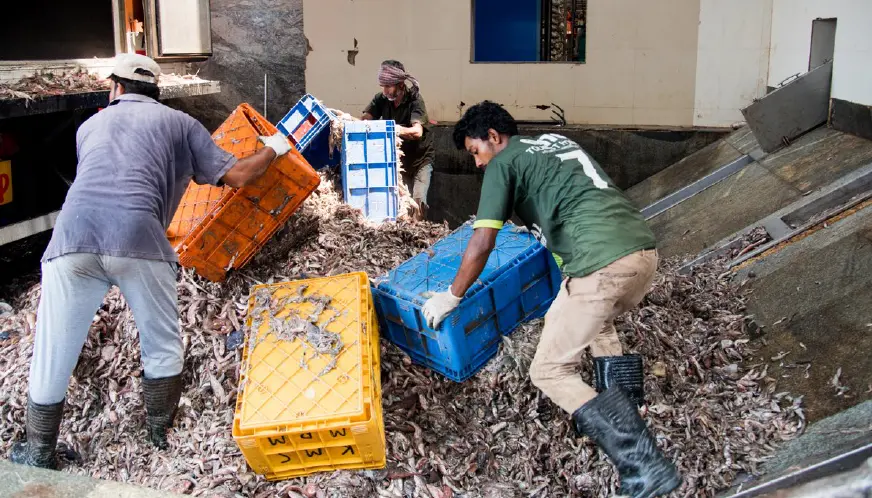
Consider the case of fishmeal, the protein-rich powder made from turning fish into feed, especially for aquaculture. The foul air produced by fishmeal factories stays in the poorer coastal communities where the fish is unloaded, cooked, pressed, dried, and ground — far from the dinner plates where the seafood gets eaten.
In Mauritania, Senegal and The Gambia, among other countries, the fishmeal industry has brought millions of dollars in tax revenue and thousands of jobs while helping grow more seafood to meet burgeoning world demand.
And yet, while the fishmeal industry has benefited some people, it has harmed others. The question that separates the two groups is not whether fishmeal and aquaculture have benefits but for whom. And who pays the hidden costs?
A sweeping investigation by The Outlaw Ocean Project, a news organization in Washington, DC, uncovered a variety of those costs, including the loss of artisanal fishing jobs, chronic chemical exposure, avoidable worker deaths and violent pro-tests typically spurred by the stench from fishmeal factories.

In Sanyang, The Gambia, in March 2021, demonstrators burnt down a police station and attacked a fishmeal plant. The unrest was sparked by a worker at the Nessim facility killing a Gambian man the previous day but was fuelled by broader grievances, including pollution by the factory.
In Kayar, Senegal, in August 2022, at least 50 protesters spilt into the streets to demand the closure of a nearby fishmeal plant, Touba Protein Marine. The factory, they said, had been built less than 500m from residential homes, triggering health problems and violating local zoning laws.
In Joal Fadhiouth, Senegal, in July 2024, dozens of residents marched in front of the Omega fishmeal plant to demand its closure. They said it had been built in the middle of the city, exposing anyone nearby to dangerous air pollution caused by the black smoke the factory churned out. During meals, one resident added, the pollutants were “like ash falling into their meals”.
The investigation mapped roughly the entire global fishmeal industry, including more than 1 400 fishmeal factories across 64 countries, tracing supply chains from fishing vessels to processing plants, feed mills, fish farms, and seafood retailers. The goal was to chronicle what economists call “externalities” — the hidden and displaced social costs of producing this feed that rarely appear on the balance sheets of the seafood companies that depend on it.
The investigation revealed that the industry’s rancid odour was among the least tracked yet most widely suffered impacts of this growing market. Half the seafood eaten globally comes from fish farms, most of them powered by fishmeal and fish oil. More than 9.5 million people worldwide live within 1.5km of fishmeal plants, according to Bait to Plate, an online tool that tracks the fishing and seafood industries.
Beginning in the early 2010s, foreign investment — largely from Chinese and European firms — poured into West Africa to build fishmeal and fish oil factories geared towards export markets in Europe and Asia.
By 2019, roughly 50 fishmeal and fish oil plants were operating across Mauritania, Senegal and The Gambia, according to Greenpeace, collectively consuming an estimated half a million metric tons of fish each year.
Over the decade leading up to 2021, the industry expanded tenfold along the West African coast.
Plant neighbours told reporters about nausea, headaches, eye irritation, dizziness, coughing fits and loss of appetite. The investigation documented more than 70 cases of neighbours complaining about the stench from at least 60 plants in 15 countries.
The stink from these plants is more than just a nuisance. It’s also an indicator of the release of noxious chemicals like ammonia, hydrogen sulfide, cyanide and methane, which have been known to cause serious health problems.
The worst part of the stench is from trimethylamine, or TMA, a colourless gas characterised by a “fishy” smell. In 2021, the Society of Chemical Industry identified TMA as “strongly toxic and carcinogenic”.
Humans’ sensitivity to foul odours is a visceral reaction which also brings intense feelings of disgust and anxiety that lead to negative health consequences when exposures last longer than several minutes, according to a 2016 study from the journal Brain Sciences.
In many countries, chemical waste is closely regulated, particularly if it makes people sick or harms the environment. But emitting bad smells is typically seen as more of an inconvenience. Little research has concentrated on the “impact of olfactory nuisance”, according to a 2021 study published in the Environmental Health journal.
Stinky industries like chemical refineries and landfills are typically limited by zoning laws to prevent them from being too close to homes. Most fishmeal plants are located in poorer nations or regions where the rules either do not exist or are not applied. In Senegal, for example, where there are at least nine fishmeal plants, zoning rules forbid fishmeal companies from building plants within 500m of a residential area. But the investigation’s review of satellite imagery of the country’s plants vis-a-vis residences indicated that the rule was routinely violated.
In Nouadhibou, Mauritania, in 2022, researchers for the Food and Agriculture Organisation (FAO) released a report about the complex socio-economic and biological impacts of the growing fish-based feed industry.
They acknowledged that Mauritania failed to set strict regulations for the fishmeal sector to keep up with its rapid growth in the 2010s. Investors promised to install technology to control the odour.
“However, the commitments are almost never respected once the factory is operational,” the report found. Nouadhibou residents told the researchers that due to these regulatory failures, the factories frequently polluted the air, leading to asthma and skin diseases among children and the elderly.
Methods for measuring airborne TMA have been around since at least the 1970s. Over the past few decades, the more standard approach has involved techniques that are precise but pricey — sometimes costing tens of thousands of dollars.
In 2009, a Peruvian scientist named Josué Padilla Lauriano set out to find a cheaper option. Using standard tools found in nearly every chemistry lab and adapting a technique originally developed to detect TMA in dead fish, Lauriano and his team spent 20 months collecting samples in Chimbote. Lauriano’s device cost a few hundred dollars.
Under local regulations, plants’ emissions were supposed to stay under 12 parts per million (ppm) but Lauriano found that at nighttime, when the plants cooked the most, they averaged above 17ppm. The maximum reading from a plant topped 32ppm. Even when testing was feasible, many countries did not have emissions standards that included thresholds for foul odours, according to a 2025 paper published in Applied Sciences.
“The mechanism of human odour detection is still not fully understood,” which, the paper said, is one reason why stench is so difficult to measure and regulate objectively.
The countries that set standards for how much TMA could be released usually did not focus on smell or quality-of-life concerns but on the level at which it began to negatively affect human health. In the US, regulators typically set long-term exposure limits between five and 10ppm; TMA can be detected at concentrations as low as 0.0002ppm, according to the FAO.
Fishmeal stench is not unsolvable. Over the past two decades, in the US, South Africa and Yemen, plant owners have installed various types of devices, some called scrubbers, that researchers later concluded had drastically reduced the foulest-smelling chemicals.
Scrubbers are not more common partly because they can cost upwards of a million dollars.
Costs notwithstanding, there are deeper reasons that stench stays far from consumers.
In wealthier nations, plant neighbours more often successfully pressure their governments for odour controls. In poorer countries, people living near these plants usually lack political clout. Their governments are also more desperate for revenue and more reluctant to put up regulatory burdens that may scare away foreign investment.
Far-away, slow-moving, and intangible harms like stench are the very ones that globalised economies have become especially efficient at disappearing for the customers at the wealthier tail end of long supply chains.
The reporting for this story was part of a larger investigation conducted by an international team of journalists based at The Outlaw Ocean Project.