

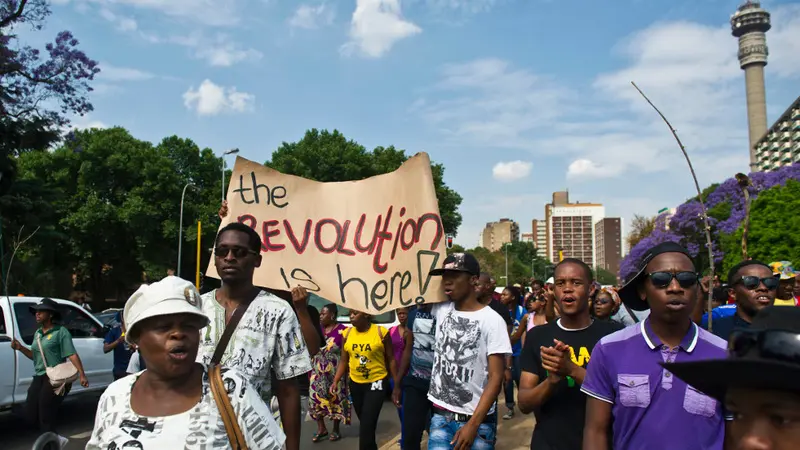
Every year on 16 June, South Africa pauses to remember the courageous schoolchildren who marched through Soweto in 1976. We remember the children — armed only with conviction — who faced bullets. We remember a generation that refused to accept injustice as inevitable and demanded the right to shape its own future.
Fifty years later, we are told their struggle was a triumph. Democracy prevailed. Freedom was won. The future they fought for arrived.
But for many young people, that story feels incomplete.
The youth of 1976 fought to inherit democracy. The youth of 2026 are fighting to make democracy deliver.
The promise of democracy was never merely the right to vote. It was the promise that each generation would inherit a society more just, more secure and more prosperous than the one before it. For too many young people today that promise remains unfulfilled.
That is not simply a South African story. It is a global one.
Across the world, young people continue to stand on the frontlines of struggles for freedom, dignity and accountability.
In Sudan, a generation that helped mobilise one of Africa's most remarkable democratic movements now faces war, displacement and the collapse of hopes for democratic transition.
In Palestine, generations have come of age amid occupation and recurring conflict, inheriting insecurity before they have had the opportunity to inherit peace.
In Kenya, young people took to the streets demanding accountability from a political system they felt no longer served them.
Different histories. Different governments. Different grievances.Yet a common pattern emerges.Young people continue to bear a disproportionate share of the consequences of political failure.
History repeatedly demonstrates that when institutions fail, young people are often the first to act and the first to pay the price. From the pupils of Soweto to the Arab Spring, from Khartoum to Nairobi, youth have consistently been asked to carry burdens that should never have belonged to them alone.
For decades, political leaders have described us as the future.
The phrase appears in speeches, campaign rallies and policy documents, with near ritualistic regularity. We are praised as innovators, celebrated as changemakers and invoked whenever hope is required.
Yet despite constituting the largest youth generation in human history, we remain excluded from many of the decisions that will define our lives.
Increasingly, political systems have become mechanisms for transferring risk downward and forward: onto younger generations and into the future.
Our future was not stolen by time. It was stolen by choices. By political leaders who postponed difficult decisions. By economic systems that concentrated opportunity for some while excluding millions of others. By governments that found resources for crisis response but not prevention, for conflict but not peace, for managing instability but not addressing its root causes. By institutions that praised young people as the future while denying them a meaningful voice in the present.
Nowhere is this contradiction more visible than in public spending priorities.
Global military expenditure reached a record $2.887 trillion in 2025. Governments routinely find resources for military expansion, surveillance infrastructure and conflict response. There is money for weapons. Money for walls. Money for surveillance. Money for managing instability once it arrives.
But when it comes to education, youth employment, mental healthcare, social protection and climate resilience, we are told to be patient.
We are told to wait.
Wait until the economy improves.
Wait until the next election.
Wait until the next budget.
Wait until the next summit.
Wait until the next reform package.
Wait for climate action.
Wait for peace.
Wait for democracy to deliver.
We have been told to wait for so long that waiting itself has become a political strategy.
Meanwhile, the bill keeps arriving in our name and at our expense.
My generation has come of age amid economic instability, democratic backsliding, climate disruption, pandemics, escalating conflict, housing insecurity and a growing mental health crisis.
We are called the born-free generation, yet for many young South Africans, freedom has become something we commemorate more easily than we experience.
Many of us have never known apartheid, yet we have grown up knowing economic insecurity, violence, political disappointment and the persistent feeling that the future keeps receding just beyond our reach.
Climate change offers perhaps the clearest example of generational injustice.
For years, young people warned of the dangers ahead. We marched. We organised. We petitioned. We demanded action.
We were told the crisis belonged to the future.
The future arrived.
The floods, droughts, heatwaves and environmental shocks that scientists warned about are no longer distant projections. They are present realities. Yet meaningful action continues to be delayed while the costs are transferred to younger and future generations.
The problem is not simply a lack of resources. It is a lack of political will.
Budgets are moral documents. They reveal what societies choose to protect, what they choose to prioritise and whose futures they consider worth investing in.
If young people are our greatest asset, why do so many experience democracy primarily through unemployment, insecurity, exclusion and fear?
The question carries particular urgency in Africa.
The continent is the youngest in the world. Nearly 70% of sub-Saharan Africa's population is under the age of 30. Never before has Africa possessed such extraordinary demographic potential.
Yet millions of young Africans continue to confront unemployment, displacement, conflict, democratic backsliding and shrinking civic space. The continent's greatest resource is too often treated as an afterthought.
In South Africa, the contradiction is especially stark.
Three decades after democracy, millions of young people remain locked out of meaningful economic opportunity. More than 4.7 million young South Africans are unemployed. For many, unemployment is not a temporary setback. It has become a defining feature of young adulthood.
The promise of freedom becomes difficult to realise when opportunity remains permanently out of reach.
For young women and girls, the contradiction is even sharper.
South Africa's gender-based violence crisis continues to shape everyday life in profound ways. Freedom of movement, participation and opportunity remain constrained by a reality in which safety can never be taken for granted.
Young women learn fear before hope. We learn risk assessment before independence.We learn vigilance before freedom. We learn how to share our locations, check the back seat of a car and calculate the safest route home before we learn what it means to move through society without fear.
A social contract that cannot guarantee safety for half its population remains unfinished.
This raises a difficult question: What does democracy mean when citizens remain economically excluded from it, physically unsafe within it and politically disillusioned by it?
The answer cannot simply be resilience. Resilience has become one of the defining words used to describe young people. We celebrate youth resilience. We praise youth adaptability. We admire youth perseverance. Yet resilience is often celebrated most enthusiastically by systems that continually require it.
A generation should not have to become resilient simply to survive conditions that should have been addressed decades earlier.
The tragedy is not that young people continue to fight for democracy. The tragedy is that, half a century after the youth uprising, young people remain the shock absorbers of political failure.
When democratic institutions weaken, young people are expected to defend them.
When economies stagnate, young people absorb the highest levels of unemployment.
When wars begin, young people fight them, flee them or die in them.
When governments delay climate action, young people will live longest with the consequences.
Youth Day should not simply be a commemoration of sacrifice. It should be a measure of progress.
The students of 1976 marched because they believed a different future was possible. Fifty years later, young people still carry that belief, that idealism. We continue to organise, advocate, innovate and participate despite conflict, exclusion and disappointment.
But belief alone cannot sustain a generation forever. We are tired of inheriting crises. Tired of financing failures we did not create.Tired of being told that our concerns are tomorrow's problem while living with their consequences today.
The real question is whether those who hold political and economic power are prepared to carry their share of the burden and make room for those who will inherit the consequences of today's decisions.
Young people do not need another speech reminding us that we are the future.
We are aware. What we need is a present worth believing in. Because the greatest tribute we can pay to the youth of 1976 is not remembrance alone. It is ensuring that future generations are no longer required to sacrifice so much simply to secure what should be ours.Because the youth of 1976 marched and died for the future. Fifty years later, we are still waiting for it.
Rabia Turnbull is a Mail & Guardian Top 200 Young South African (2025), youth fellow at the International Youth Think Tank, research lead at the African Youth Security Network and director for Sub-Saharan Africa at React. She holds a joint Master's degree in Security, Intelligence and Strategic Studies from the University of Glasgow, Università di Trento and Charles University Prague. Her work focuses on youth participation, governance, security and democratisation in Africa and the Middle East.