

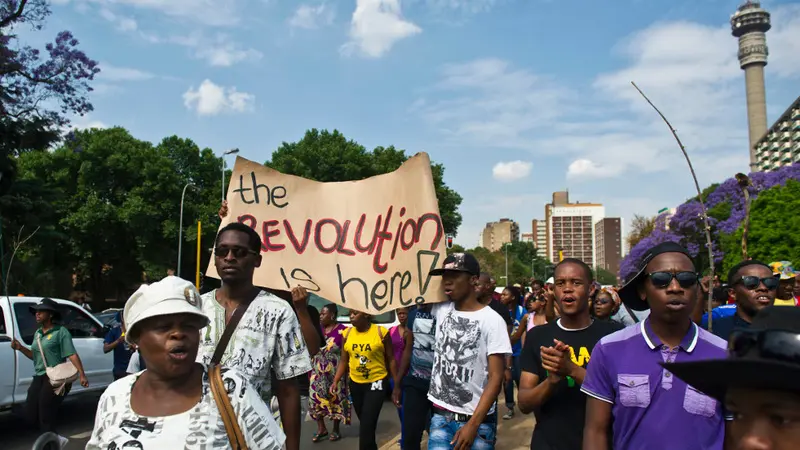
I turned 50 this year. I was barely four months old when young people took to the streets of Soweto on 16 June 1976. Schoolchildren in uniform were told by the apartheid state what language they must learn in, what future they must accept and what kind of human beings they were allowed to become.
They marched against the imposition of Afrikaans as a medium of instruction, yes. But we diminish June 16 if we reduce it to a language protest. It was a revolt against being designed by someone else: a refusal to have the mind colonised, the future narrowed and the classroom turned into a factory for obedience.
Those children went to war with apartheid. Not because they loved war or were reckless. They did it because there comes a time when innocence sees clearly what adults have learnt to negotiate with.
I grew up in the shadow of that moment. Mine was a hippie home. There was Bob Marley. There was joy. Later, my father became a lay preacher. Church, community, school and civic life became the places where one learnt to speak, serve, organise, listen and sometimes lead.
By the early 1990s, as the old South Africa was cracking and a new one was struggling to be born, I entered youth forums where leadership was not simply claimed. It was tested.
The question came often; and sharply: Who do you represent? And then: What is your mandate?
The questions were not bureaucratic. They were moral. Leadership was not a performance of intelligence or charisma. Leadership had to be rooted somewhere. It had to return somewhere. It had to consult.
We were often sent back to speak to our constituencies. We had to consult, persuade, listen and return with a mandate, not merely an opinion. One such process helped me become the first chairperson of the KwaZulu-Natal Youth Council.
The experience shaped my view of leadership for life. Leadership was about making the circle bigger, bringing others into the room and taking seriously those who were not in it.
I worry that something has changed.
Not because young people today are weak. They are not. Many are more informed than we were. They have access to language, frameworks and global debates we did not have. But sometimes I wonder whether we have produced young leaders who are fluent in struggle but distant from struggling people.
There is a danger in becoming a post-colonial bot. A progressive bot. A person who can speak the language of justice but has lost the discipline of proximity. Our devices give us a sense of community. But they also tempt us into mistaking visibility for organising.
A “like” on a post is not a mandate. A following on social media is not a constituency. A viral hashtag is not a programme of action. Outrage is not courage. Being seen to care is not the same as doing the slow, unglamorous work of care.
The young people of 1976 organised under surveillance. This generation performs under visibility. That is not an insult. It is a warning.
The apartheid state was visible in its cruelty. Today’s injustice is less honest. It hides in school quality, inherited wealth, geography, data costs, transport routes, unpaid internships, English confidence, social capital, political patronage, tender networks and the quiet humiliation of being poor in a country that tells you that you are free and should be thriving.
Under apartheid, poverty was widely understood as the product of an evil system. Today, poverty often carries shame. Democracy has given people rights but the market and society whisper that if you are still poor, perhaps you did not try hard enough. That whisper is a lie.
Fifty years after June 16, South Africa’s young people are not facing the same enemy as the class of 1976. But they are facing an enemy worthy of moral revolt. Statistics SA’s first-quarter 2026 labour data show unemployment at 60.9% for those aged 15 to 24 and 40.6% for those aged 25 to 34. More than four in 10 young people aged 15 to 34 are not in employment, education or training.
These are delayed adulthood, deferred dreams and families carrying grown children who want to work but cannot find work. They are communities where talent is abundant but opportunity is rationed.
This is why June 16 must not become a heritage performance.
We cannot keep placing wreaths in memory of young courage while asking too little of young leadership. We cannot celebrate the children of 1976 while producing a politics that uses young people as campaign energy, social media amplification, conference decoration and voting blocs.
If the spirit of 1976 means anything, young people are not props in someone else’s struggle. They are authors of their own.
But authorship requires more than anger. It requires discipline, study, organising, the humility to consult and the courage to be corrected by the people you claim to represent.
For my generation, the challenge is also uncomfortable. Have we made the circle bigger or guarded access? Have we created pathways or merely selection panels? Have we mentored with generosity or demanded applause for surviving what we did not sufficiently transform?
Anger must grow up into leadership. And leadership must return to mandate.
Who do you represent? What is your mandate? Who have you consulted? Whose pain has shaped your politics? Who can call you back when your leadership becomes ego?
South Africa does not need young people to repeat 1976. But we do need them to recover their moral clarity.
Not the romance of struggle. The discipline of it. Not the slogan. The organising. Not leadership as a personal brand. Leadership as public duty.
Fifty years later, the class of 1976 is not asking us to remember them politely. They are asking whether today’s youth have the courage to see their own moment clearly and, having seen it, to march differently but with the same moral fire.
Wayne Alexander is a South African civic and political leadership practitioner in Cape Town. He works on democratic leadership, youth development, public representative politics and the relationship between freedom, dignity and social justice.