


Driving past a marula tree, its mottled bark peeling in patches under a blanket of burnt-orange sunset, while the dusty gravel gives you a rocky massage as the ranger steers our Toyota through the Lowveld, you feel a sense of hurried peace.
We’re looking for animals of all shapes and sizes. As long as it moves, we’re ready to sit still for it.
Observation is the game; patience is the price of admission. Back at the hotel, I caught myself applying the same habit to the building. Why is the pond behind the laundry green? And why haven’t I touched any single-use plastic since I checked in?
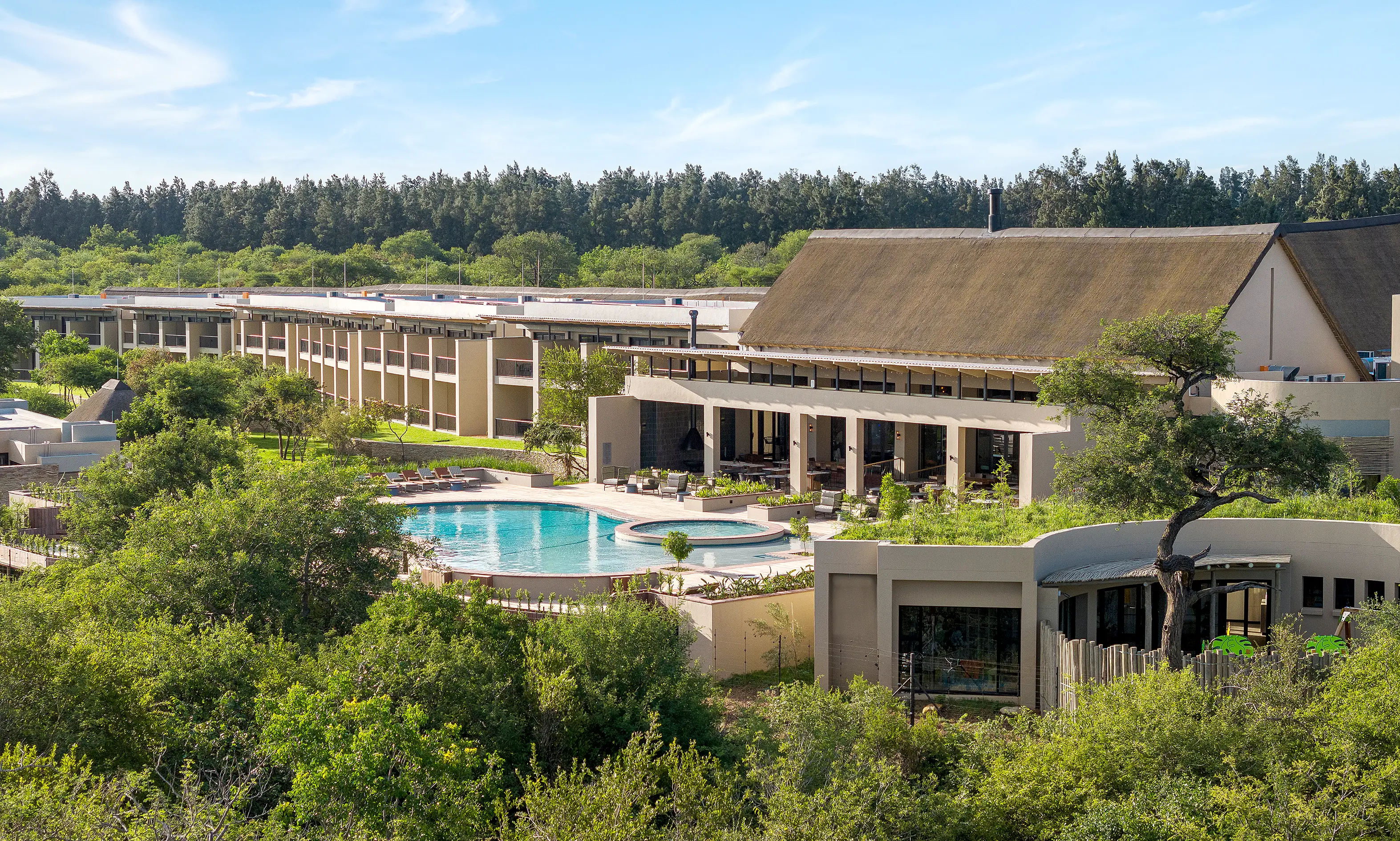
I recently spent some time at the Radisson Safari Hotel in Hoedspruit, the first verified net-zero hotel in Africa. Every hotel creates greenhouse gas emissions. Some are obvious, like a gas stove or the coal-fired electricity we buy from Eskom. Most hide in the supply chain, from the food on your plate to the minibus that brings staff to work.
To earn this net-zero label, a hotel must stop burning fossil fuels and run on renewable power, then shrink its supply-chain footprint as far as it can. Whatever is left is offset with carbon removal credits, which means paying a project elsewhere to pull the same amount of carbon out of the air. TÜV Rheinland, an independent German certification company, maintains the international standard.

Radisson Hotel Group has committed to net zero by 2050 across more than 1 600 hotels. It started in 2025 with two pilots, one in the UK and one in Norway. Hoedspruit is number 10. Inge Huijbrechts, the group’s chief sustainability and security officer, who walked us around the property, said nine of the 10 are conversions of buildings from the 1970s and 1980s. The goal is 100 by 2030.
Its Hoedspruit hotel opened in February 2024. Sandra Kneubuhler, Radisson Hotel Group’s managing director for Africa, said half the education was learning how much energy the hotel used. It took a year and she was firm that nobody gets there without the right partners.
The owner, Gerrit Jan van der Grijn of Lowland Developments, is a Dutchman who knew the bush but, by his own admission, nothing about hotels. He went to the Indaba in Durban to work out who was who in the hospitality zoo, as he put it.
A Radisson Hotel Group development executive told him the group wasn’t interested in Hoedspruit. Van der Grijn mentioned his feasibility study. Two days later, the same man was sitting in his office.
Construction was two months in when Covid stopped everything and after the hotel finally opened, a lightning strike closed it again. He kept going because he saw a gap in South Africa’s self-styled safari capital, Hoedspruit, which had no large international brand for weddings and conferences.
For guests of a net-zero hotel, the keycard switches on the power, which is standard in most hotels. Less standard is the sensor on the patio door that turns off the air conditioning the moment you open it. Shampoo comes from large refillable pumps that go back to the supplier for recycling. The coffee pods and tea bags are compostable and the toothbrush is plastic-free. Need floss? You order it through the STAY e-concierge on your phone and someone brings it.
The hotel says this order system cut amenity waste by 40% because the little extras no longer sit by the basin, where a single splash can ruin a sealed shower cap, cotton-bud pack or paper-wrapped soap and housekeeping no longer has to bin them without anyone ever opening them.

The challenge for a hotel like this is making sustainability so smooth that guests take part without noticing they’re doing it. A sensor that kills the aircon is invisible and most of what I saw passes that test. A QR code for every request is less invisible. It assumes you’d rather scroll than call reception and Radisson Hotel Group will need to make sure older and international guests don’t feel they’re doing the hotel’s work for it.
Food and beverage make up nearly half of the hotel’s operational footprint, so the menus now carry carbon labels from A (very low) to E (very high), calculated by a platform called Klimato. The chef writes his menu, the software rates each dish and he adjusts until most land between A and C. According to Radisson Hotel Group, about three-quarters of restaurant dishes and 81% of buffet items now do.
Food waste goes to Egg Brothers, which supplies the hotel’s eggs and takes back its wet waste, feeding it to black soldier fly larvae that end up as chicken feed and compost. Since July, 9.3 tonnes have been collected and September was the first month the hotel sent nothing to landfill.
The part of the tour I didn’t expect to enjoy was the wastewater plant. Every drop of grey and black water flows through chambers where solids settle and break down, then through three ponds that filter it naturally, around the clock, with no chemicals. The water is green because it’s full of nitrates.
Roughly 30 000 litres come in each day and about 25 000 litres go back out to irrigate gardens planted only with indigenous species.
You won’t find the palm trees that seem compulsory at resorts. The golf carts and garden tools are electric and the hotel’s EV fast charger fills a battery in about 45 minutes. As far as staff know, it’s the only charger within 100km.
The hotel’s 602 solar panels produce about 374 000kWh a year, roughly 20% of its electricity. The rest is matched with renewable energy certificates. From 2027, with a wheeling agreement through SolarAfrica, where a solar farm elsewhere feeds power into the national grid and the hotel is credited with the same amount.
After all the cuts, the hotel’s supply chain footprint still came to about 1 173 tonnes of carbon dioxide equivalent. That’s offset by credits from the GRASS project, run by carbon developer TASC, which works with more than 10 000 communal farmers to improve grazing, so the soil stores more carbon.
Tim Cordon, Radisson Hotel Group’s chief operating officer, Middle East, Africa and South East Asia Pacific, said energy became more expensive every year and relying on the grid was a risk. The group has 99 hotels open or in development in Africa and wants to prove the model works on existing buildings so it can convert more. Radisson Hotel Group also claims its net zero hotels earn up to four percentage points more in revenue per available room. I’d treat that as a company figure until we see local results.
Booking.com’s 2025 survey of 32 000 travellers in 34 countries found that 84% say sustainable travel remains important to them. The stronger push is corporate. Listed companies have carbon targets that reach into travel and conference budgets. In commercial property, we watched the same thing happen with Green Star-rated offices. First, they were a marketing extra, then a box corporate tenants had to tick before signing.
The executives were candid that net zero isn’t feasible for every property. Lorraine Jenks of Hotelstuff, who has spent 36 years trying to get South African hotels to go green, told us that Radisson Hotel Group had finally done it.
As you enter the hotel, you are greeted by a totem built from 600 poaching snares, collected by Down to the Wire, a group that turns snare wire into jewellery and uses the proceeds to pay vets to free trapped animals. The message: brutality turned into hope. Nearby, the Nourish eco village runs a crèche and feeding scheme alongside hospitality training and its organic farm supplies the hotel kitchen.
Travel and tourism supports about 1.9 million South African jobs, or 11.3% of all employment, according to the World Travel & Tourism Council. Those jobs depend on the Lowveld staying wild enough for people to keep coming to sit in the back of a Toyota, waiting for movement in the beautiful bush. One hotel counting its carbon won’t protect that on its own. However, it does prove that the sums can be done in the safari capital.