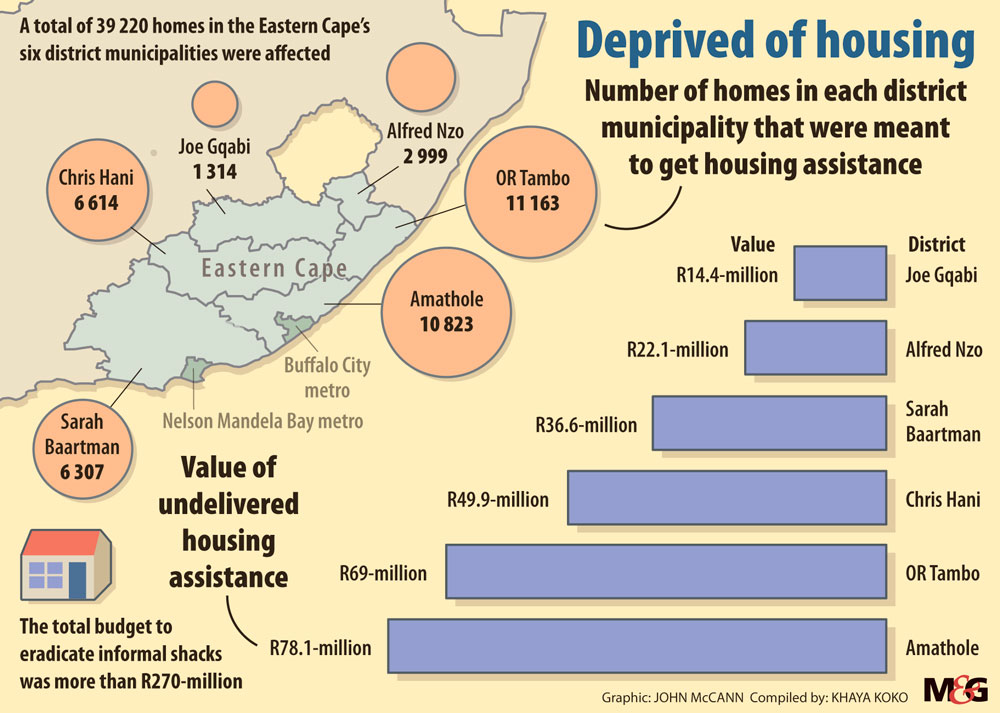
The national human settlements department was allegedly complicit in an attempted “housing heist”, which left 39 220 families living in dilapidated corrugated iron homes after R270-million was squandered.
The R270-million is part of the R338-million left unspent from the provincial human settlements department budget, announced by Human Settlements Minister Lindiwe Sisulu last month, and was to have been used to upgrade informal housing in the province’s six districts, incorporating 23 municipalities.
A parliamentary portfolio committee meeting heard on 5 June last year that the provincial human settlements department had a budget of R1.5-billion for the 2020-21 financial year and 113 informal settlements had been identified to benefit from R270-million allocated towards housing upgrades.
A business plan, seen by the Mail & Guardian, was drawn up with the approval of the treasury for the project to be implemented by the provincial human settlements department.
But documents show that the housing department’s accounting officer, Tabisa Poswa, instead tried to disburse R270-million to dysfunctional municipalities as implementing agents for the upgrades, outside the treasury-approved business plan.
Poswa and the national human settlements director-general, Mbulelo Tshangana, sent emails in March this year, less than a week before the end of the 2020-21 financial year, advocating for a deviation from the business plan, and for funds to be sent straight to the municipalities.
In one email, dated 26 March, Poswa told the provincial department’s chief financial officer Ouma Diutlwileng, that she should sign off the claims and pay municipalities their money.
“[You] are hereby instructed to sign the claims for payments to municipalities and to ensure that they are captured by no later than [11am] today [26 March]. I am advised that those claims were submitted to you on 19 March and again on 23 March 2021 and that on both occasions you refused to receive and sign them,” Poswa wrote
“Should you not comply with this instruction, I intend to take [an] urgent and appropriate decision in the best interests of the department.”
Diutlwileng wrote back that she would only disburse the funds after she received “written instructions” from Poswa for her to do so. Diutlwileng was subsequently suspended from her position. She declined to comment when contacted by the M&G.
Tshangana, on behalf of the national government, wrote a letter dated 25 March to the head of the Eastern Cape treasury, Daluhlanga Majeke, saying it was “the considered view of the [national human settlements department] that the funds may be transferred to non-accredited municipalities to implement the Upgrading of Informal Settlements Programme”.
Both Tshangana and Poswa appeared to have acted in defiance of a national treasury directive that the funds should not be disbursed because this would contravene the Division of Revenue Act.
A letter from Ogalaletseng Gaarekwe, treasury’s chief director responsible for provincial budget analysis, said making payments to non-accredited municipalities was against the law.
“It is evident that these transfers were no part of the business plan that was approved at the beginning of the [financial] year and the plan cannot be adjusted now, as the [budget] framework does not allow for the business plans to be amended after 30 October 2020,” Gaarekwe wrote on behalf of treasury, in a letter dated 26 March.
“The last date to publish an amendment gazette was 5 February 2021, as provided for in section 30 of the Division of Revenue Act.”
Despite this, the human settlements department made the transfers, drawing the ire of Majeke’s treasury department, which sent a letter to Standard Bank on 29 March, two days before the end of the financial year, asking for the transfers to be reversed.
“Kindly note that the processed amounts may differ from the list [sent to Standard Bank], especially those that were processed as EFTs [electronic funds transfers], thus the bank needs to ensure that no payments to the above municipalities are to be processed,” Majeke wrote.
“The bank is further requested to recall all EFTs to the municipalities listed above that may have been on tape runs for Thursday, 25 March, and Friday, 26 March.”
Pumelele Godongwana, spokesperson for the provincial treasury, said: “Our position as provincial treasury on this matter is contained in our official correspondence that we sent to the department of human settlements in the province and, therefore, [we] have no further comment. Other details around it can be sourced from the department of human settlements.”
In a statement to the M&G, the treasury said it welcomed the stance taken by Majeke because the transfers of those funds to the municipalities would have breached legislative prescripts.
“Firstly, such a transfer would have necessitated a change to the business plans, before such transfers were made; we found no evidence of the business plans being amended or approved by the national department of human settlements,” it said.
“Secondly, section 17 of the [Division of Revenue] Act states that before transfers are made to another organ of state, there must be an agreement and a payment schedule between the transferring officer and the organ or state, and the national department of human settlements and the national treasury must be notified of this — in this case national treasury was not made aware of any agreement. The transfers further needed to be gazetted, and were not done as the deadline set by the Act had passed.
“The third aspect, which we did not include in the letter, pertains to the risk of fiscal dumping by making transfers late into the financial year. There was also the issue of the capacity of municipalities to implement the projects, within three months remaining before their financial year ends on 30 June 2021,” it added.
Several sources, who spoke on condition of anonymity, said the reason for the “fiscal dumping” was an alleged corruption strategy known as “javelin throwing”.
“Basically, the monies would have been thrown to the dysfunctional municipalities knowing that there was no capacity for them to deal with projects,” one source said.
“Then Poswa and other officials would go and fetch the money by appointing predetermined tenderpreneurs, who would share the loot with them. Hence the term ‘javelin’. This is part of some sort of housing heist in the province.”
Poswa, in a statement to the M&G, conceded that there were differences between the provincial housing department and the treasury regarding the payment to municipalities, but added that disagreements were normal in government.
Poswa said she had obtained legal opinion that it was lawful for the R270-million to be sent to municipalities, and that this advice was shared with the provincial treasury.
There was no collusion between her department and the national government, and the advice given by Tshangana to disburse funds was “sound and manifestly in the interest of the residents of the Eastern Cape”, she added.
“You have not provided any facts or evidence for the suggestion that the money would have been looted. I certainly am not aware of any such facts or evidence. I would invite your sources to disclose any information which they may have in this regard to the appropriate authorities so that the allegations may be thoroughly investigated,” Poswa said.
“It is also necessary to point out that there is nothing sinister about the utilisation of municipalities as implementing agents. The discussions in this regard in the provincial government have been ongoing since the latter part of 2020, and there was broad agreement at the highest levels of government that this was the appropriate mechanism to expedite service delivery.
“The department was satisfied that the municipalities concerned had the necessary capacity to successfully complete the projects in question with the support of the department.”
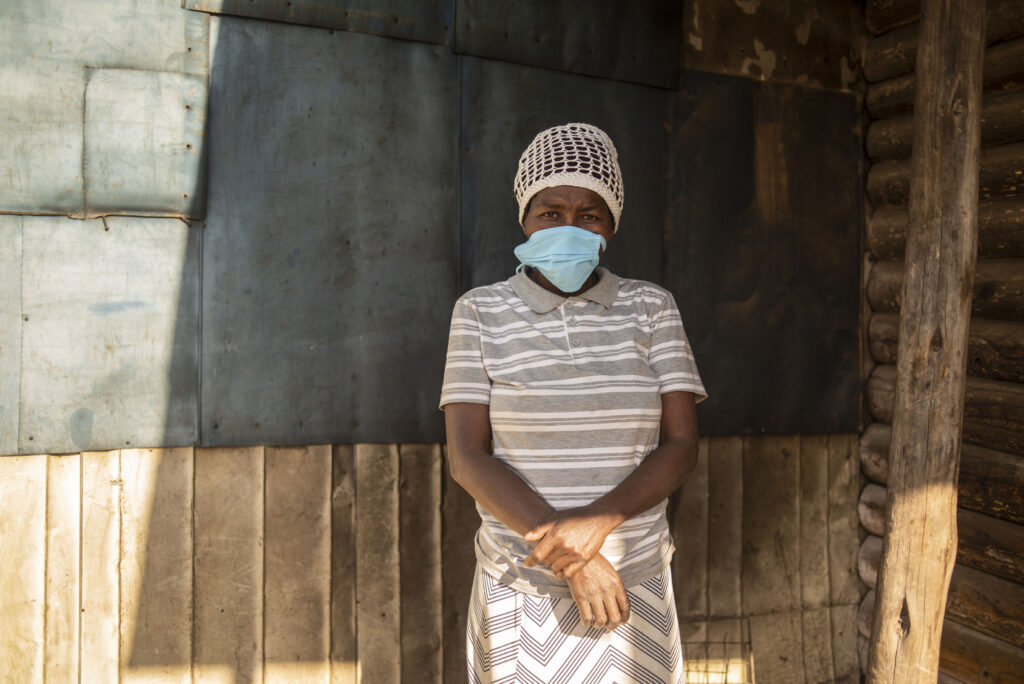 Nomzukisi Ngcuza lives in a section of eGcuwa called Khayelitsha, which does not have a sewage system and other services. (Andy Mkosi)
Steve Motale, the spokesperson for the human settlements department, called the M&G on 14 July, threatening to “expose” this reporter as a “hired gun” and “paid agent” sent to destroy Sisulu.
When he eventually answered the questions sent to him, Motale said Sisulu was not involved in operational matters and that the questions would be best answered by the provincial human settlements department. “You might have noticed the minister took away some money after it was unspent by the Eastern Cape province. Our special request is that please refrain from your obsession of using the minister’s name on matters that have nothing to do with her,” Motale said.
“Part of the minister’s responsibility is around policy and political direction of the department, not operational matters of provincial departments.”
 (John McCann/M&G)
‘I dug a hole so I don’t have to go in the bush’
Walking slowly on a windy day down towards her rusted corrugated iron home, Nomzukisi Ngcuzana has shame etched on her face after having to relieve herself in the bush.
She and her neighbour, Nowanele Mpangela, who live in eGcuwa (Butterworth), speak of bleak conditions with no water, electricity or proper ablution facilities.
“At least I have dug a deep hole so I don’t have to go into the bush like my neighbour, Nomzukisi. But when my pit latrine fills up, the stench is unbearable, as you can smell for yourself,” a visibly distressed Mpangela said.
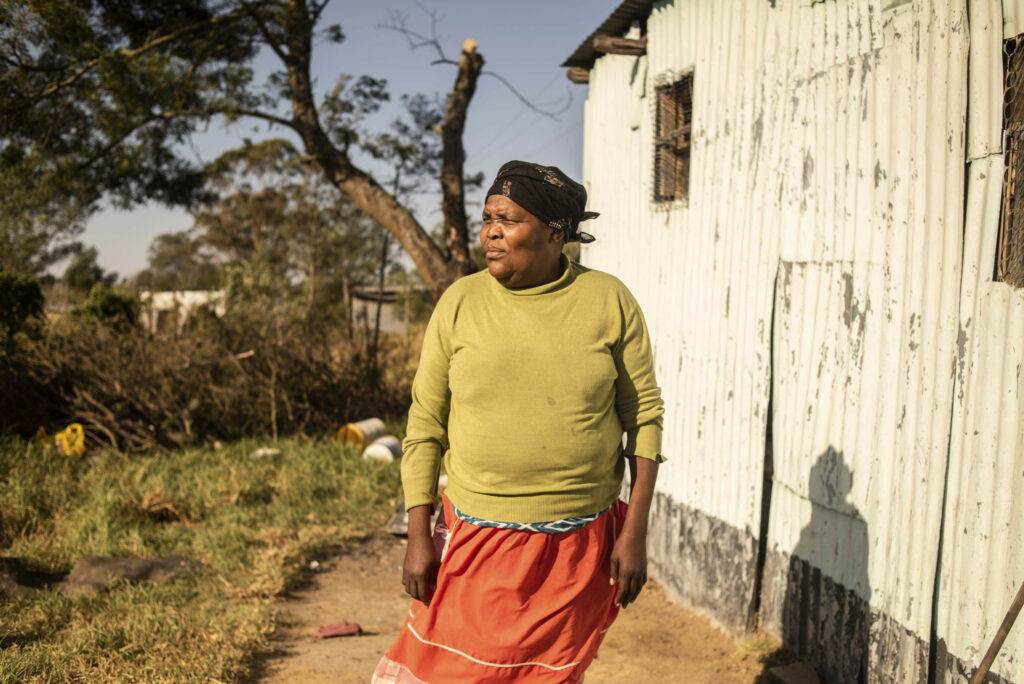 Waiting: Nowanele Mpanga lives in eGcuwa, an area earmarked for a R11.4-million upgrade, but it never happened. (Andy Mkosi)
eGcuwa is part of the Mnquma municipality which, under the housing programme’s business plan, would have received more than R11.4-million to upgrade an estimated 1 642 homes, including those of the Ngcuzana and Mpangela families.
Walking through the densely populated settlement, the Mail & Guardian came across a group of teenage girls, who had turned a barren patch of land into a netball court, using makeshift wooden poles.
Their laughter, which reverberated across the area, shows this is a much-needed, if temporary, escape from the bleak surroundings they were born into, and live in.
[/membership]