File: A prison officer unlocks the gates to the prison to release convicted men at Chikurubi Maximum Prison in Harare, Zimbabwe. (Photo by Tafadzwa Ufumeli/Getty Images)
When Lloyd Nyoni* returned to Zimbabwe from South Africa more than two decades ago, he was a fresh-faced, immaculately dressed man in his early 30s.
Nyoni quickly established himself in a Bulawayo neighbourhood as one who had put in the hours in a foreign land. He had in triple every household possession imaginable and purchased a four-roomed house in a neighbouring township, an impressive achievement in a place where unemployed young men were witnessing Zimbabwe’s rapid economic decline.
It wasn’t long before there were whispers about Nyoni’s source of the good life: he had obtained illegal firearms in South Africa and was using them for armed robbery in Bulawayo.
At the time, Bulawayo’s daily newspaper reported cab drivers being shoved into the boots of their taxis at gunpoint, and their cars and day’s takings stolen. Nyoni was said to be behind the crimes, and had started recruiting local youths. This was a period in the city where gun-related crime was uncommon.
Nyoni was eventually caught by detectives while having a “nice time” with his girlfriend, as reported by a local daily, and a bag of cash was found in his possession.
He died of tuberculosis in 2003 inside the intimidating walls of Khami Maximum Prison on the outskirts of Bulawayo, unidentifiable by his relatives.
It was a cautionary township tale.
Increase in fatal robberies
Fast forward more than 20 years and armed robberies are the new game not just in Bulawayo — the country’s second city long considered to have historical ties with South Africa — but across the country.
While Nyoni’s era of gun-toting bandits rarely claimed lives, today’s criminal enterprise has assumed a deadly recklessness.
In May last year, armed robbers pounced on a liquor outlet in Bulawayo’s suburban Ascot shopping centre and shot and killed a female cashier.
According to the Zimbabwe Republic Police (ZRP), between January and October 2021, 922 armed robberies were reported across the country, up from 744 the previous year during the same period.
According to the 2019 Zimstats Quarterly Digest of Statistics, 429 armed robberies were recorded in 2017. The number spiked to 1 022 in 2019.
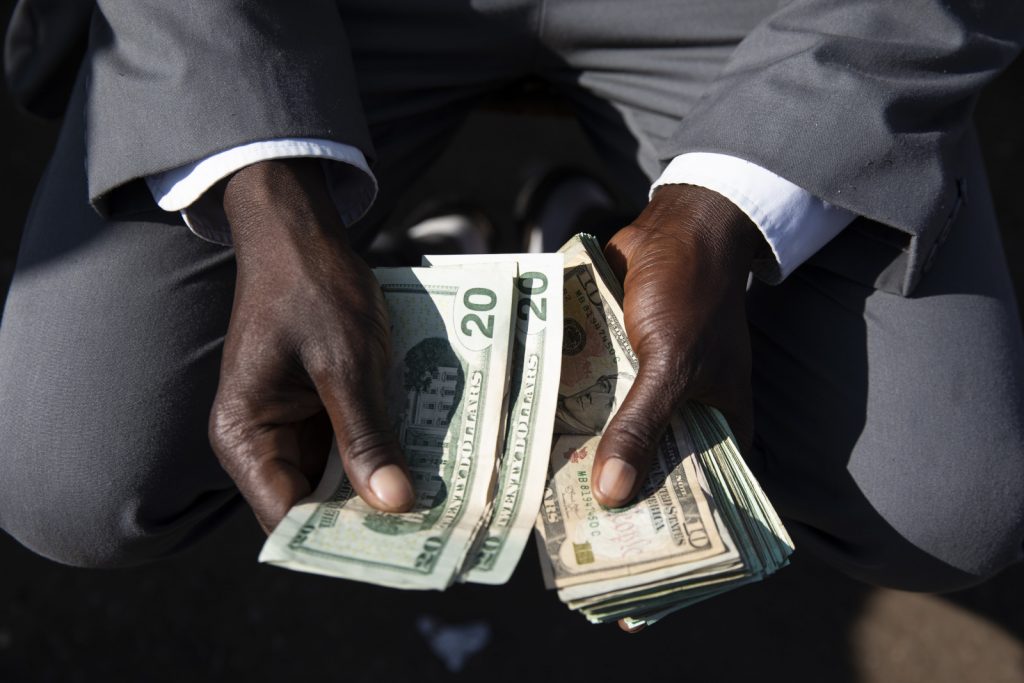 A man holds Zimbabwean Dollar Bond Notes. (Photo by Dan Kitwood/Getty Images)
“How to address this is very difficult given the current economic and social situation in the country,” said Anthony Reeler, founding director of the Research Advocacy Unit in Harare.
“Crime increases in times of economic hardship, it is not just Zimbabwe. It is for just this reason that the Human Rights Forum pointed out the ‘fragility’ of Zimbabwe and the relationship between fragility and crime.”
In July, police spokesperson Paul Nyathi issued a statement warning that “the police will not hesitate to enforce the withdrawal of the firearm licences, besides effecting arrests on anyone who abuses the privilege of legally owning a firearm”.
Cash unbanked
This was as armed robberies escalated, with licensed gun owners under suspicion of fuelling hold-ups that have become routine in a country where citizens have stopped trusting banking institutions with their money.
A huge and thriving informal sector has given birth to a repository of foreign currency despite the authorities insisting on citizens using banks for their own safety.
No one knows exactly how much foreign currency exchanges hands on the bustling sidewalks but the country’s central bank governor. John Mangudya, said diaspora remittances alone reached almost $800-million in the first six months of this year.
Added to this is what have become regular social media posts of “gold barons” flaunting stacks of United States dollars, with increasing reports that gold dealers have specifically been targeted for armed robberies.
Loss of currency value
There was a time when Zimbabweans woke up to news that their American dollar deposits were pegged at one Zimbabwe dollar to one US dollar. The effects were profound as the internationally recognised benchmarks of the US dollar as a stable unit of exchange was rendered useless. It came as no surprise that depositors vowed they would stop banking their hard-earned forex with local financial institutions.
There are still lingering fears that monetary authorities may one day wake up and withhold forex accounts, as happened previously. Amid such fiscal policies, the country has been taken back to the era where people kept their money at home under pillows, making easy pickings for criminals.
For some in Bulawayo, Nyoni became an exemplar of the origin of violent armed robberies, and decades later current police accounts maintain that some firearms and gun crime are imports from across the Limpopo border.
In recent years as the country’s civil servants entered the ranks of the impoverished, soldiers and police officers got caught up in the crime vortex, turning their service firearms into income generating tools.
The army and the police have complained about “rogue elements” that have brought the security sector into disrepute, routinely committing armed robberies to supplement meagre salaries; the police were once some of the best paid government employees.
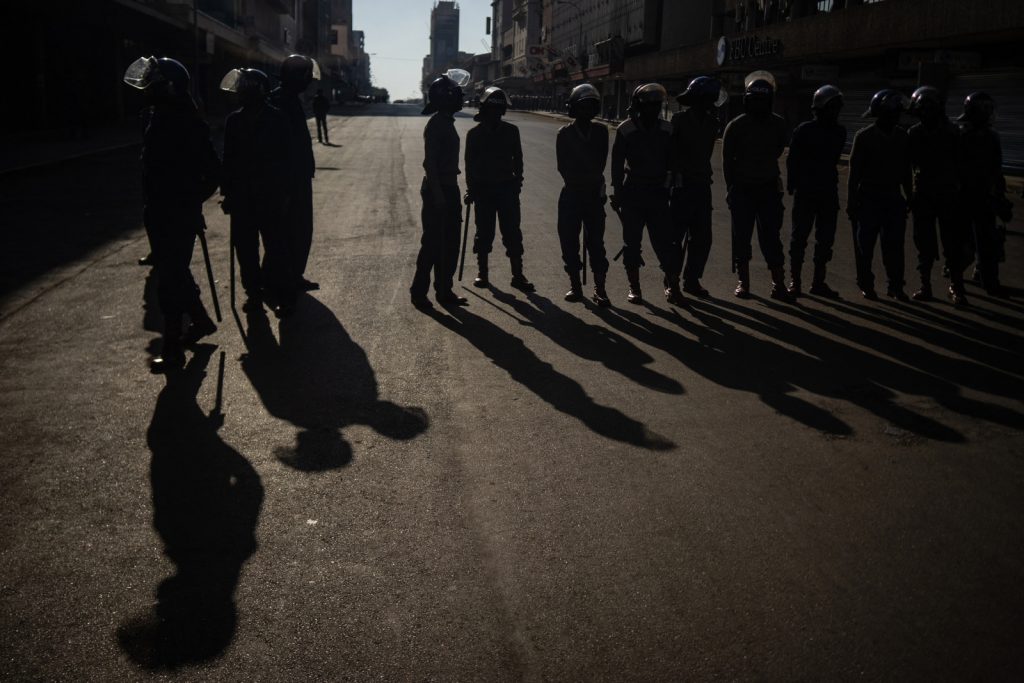 Zimbabwean anti-riot policemen cast shadows as they stand guard in front of the Movement For Democratic Change headquarters. (Photo by Zinyange Auntony / AFP)
While police say armed robbers have used pistols and revolvers, with some suspects confessing to the police that they smuggled the firearms from South Africa, the use of AK47 assault rifles in some robberies has only served to confirm the involvement of security officers.
“The spate of armed robberies we are seeing lately are a product of the rising political and economic crisis characterised by high unemployment, poverty and hunger,” said Effie Ncube, an independent researcher and analyst. “Among the least paid are people with guns like soldiers and police officers. Inevitably they steal the guns and use them in robberies.”
It is still fairly easy to own a registered firearm in Zimbabwe, at least according to a police schedule on gun ownership, which states that it costs $10 for a firearm certificate.
The Firearms Act that permits gun ownership first came into effect in 1957 and has failed to keep up with the proliferation of illegal firearms.
The police have complained that in some instances, legally-owned guns have been bequeathed to surviving relatives after the gun owner’s death, resulting in the abuse of the firearms.
Gun amnesty
Early this year, in the wake of a spike in armed robberies, the police announced a gun amnesty, inviting people to hand in legal and illegal firearms, no questions asked.
By mid-September, the police said 455 guns had been handed over.
Police officials would not say whether the amnesty guns would be turned into ploughshares, but with the appearances of police officers and soldiers in court for armed robbery, the guns may well be finding their way back to the street.
Amid such problems, researchers contend more needs to be done to arrest the escalation of gun-related crimes in Zimbabwe because it points to broader socioeconomic issues.
“The rise in violent crime is a further indicator of Zimbabwe’s social decay that has accompanied the prolonged economic crisis that has impoverished the majority,” said Piers Pigou, senior analyst at the International Crisis Group.
“We have seen an uptick in the involvement of serving and former members of the security forces in violent crime. At the same time law enforcement and prosecution services are failing to deliver, another indicator of the State’s slow decay, and the breakdown of the wider social contract.”
Because of Zimbabwe’s porous borders, criminals are believed to flee to neighbouring countries, effectively making it difficult for the police to make quick arrests, while joint cross-border crime crackdowns struggle to control the illicit movement of firearms.
Zimbabwe is a signatory to the 2001 Southern African Development Community Protocol on Firearms, which notes that “illegal firearms, most commonly used in the perpetration of crime, contribute to high levels of instability, extended conflict, violence and social dislocation as a whole within the SADC region”.
The protocol was updated in 2020 to “provide a framework for combating the proliferation of small arms and light weapons” with the Institute for Security Studies, which helped draft the protocol, noting that “information sharing around regional firearms control needed to be strengthened”.
[/membership]