Courting trouble: President Cyril Ramaphosa faces a challenge from the African Transformation Movement over the Phala Phala matter. (Delwyn Verasamy/M&G)
Politically, last year wrapped with President Cyril Ramaphosa surviving to fight another term as ANC leader but in terms of litigation, loose ends remain regarding the report that recommended he face an impeachment inquiry, and brought him to the brink of resigning in December.
The African Transformation Movement (ATM) has asked the Western Cape high court to set aside the National Assembly vote in which the report was rejected by 214 votes to 148, and to order a rerun, this time by secret ballot.
In an application filed four days before Christmas, the party argued that speaker Nosiviwe Mapisa-Nqakula failed to apply the correct legal test when she considered and denied an opposition request for a closed ballot.
She erred, it said, by insisting that as a rule voting is an open process and whoever wants it otherwise bears an onus to show compelling reasons for secrecy.
“In rejecting the ATM’s request for a closed ballot, and prescribing an open ballot procedure, the speaker required that there be ‘exceptional circumstances’ for her to deviate ‘from the principle of openness’,” ATM leader Vuyo Zungula said in his founding affidavit.
“The speaker is wrong because the principle of openness is not the default position, and therefore cannot be ‘deviated from’.”
The ATM is drawing on legal precedent, established in late 2021 in the supreme court of appeal (SCA) when the two-seat party prevailed there in a court battle with former speaker Thandi Modise after she refused its request for a secret vote on a motion of no confidence in the president and his cabinet.
It also argues, as it did then, that the political climate is too fraught for MPs to vote according to their conscience without fear of reprisal, meaning the legislature cannot discharge its duty to hold the executive to account.
The vote on the report happened days before the ANC’s Nasrec elective conference in December and it can hardly be disputed that party chairperson Gwede Mantashe told television news that the handful of party MPs who voted in favour of the report had presumably tired of belonging to the organisation.
The thornier issue perhaps is the remedy of substitution the ATM is seeking, arguing that past experience in the courts on the same subject has proved that it is pointless to refer the decision back to that office. The speaker is due to file papers next week.
It is understood that counsel has asked that the deputy judge president of the high court set the matter down for hearing by a full bench on 26 January, along with the ATM’s challenge to the speaker’s decision to again refuse a secret ballot in the no confidence vote after the appellate court remitted the matter to her when it set aside Modise’s decision.
In the meanwhile, the ATM has filed papers in reply in the related matter of the president’s application to the apex court to have the Ngcobo report set aside.
Ramaphosa argued in his founding affidavit that the panel headed by former chief justice Sandile Ngcobo woefully misread its mandate to arrive at the conclusion that he has, on the face of it, a case to answer on the theft of foreign currency from his Limpopo game farm.
The report flowed from a preliminary assessment — conducted in terms of rules governing impeachment under section 89 of the Constitution — prompted by a motion the ATM moved, and the party is obviously doing its damnedest to ensure it inflicts political damage. Its approach to the high court proves that Ramaphosa would have been ill-advised, in political terms, to withdraw the review application after the parliamentary vote went in his favour.
As a source close to the matter said this week: “The high court application revives, if you will, the issues raised in the papers before the constitutional court.”
The constitutional court still has to issue directions as to whether it considers it in the interests of justice to hear it and accepts the president’s argument for direct access, or takes the view, put forward by the ATM in its replying affidavit, that the matter should first be heard in the high court.
The party’s main argument is that the Ngcobo report is not reviewable because it sets out a recommendation, not a final decision with direct consequences. Therefore Ramaphosa’s application undermined the discretion of parliament to decide whether to adopt the report, and hence the separation of powers.
But if the court disagreed on this count, it said, the president has still failed to clear the high bar for setting aside conduct on the basis of irrationality, the ATM said.
This is, it continued, because the work of the panel cannot be misconstrued as a function of parliament because, as its name indicates, it is meant to be independent of the National Assembly and its findings cannot give rise to a failure on the part of parliament.
Ramaphosa’s challenge therefore does not trigger section 167 (4)(e) of the Constitution because he was not asking the court to determine whether a section of the Constitution that imposed an obligation on the legislature had been breached, but merely asking the court to set aside a non-binding report.
That, the party said, does not fall within the exclusive jurisdiction of the apex court, hence the decision about granting direct access rests solely on whether it will be in the interests of justice to do so. But since there are disputes of fact between the parties, the ATM argues that the case belongs in the high court.
The ANC power struggle spawned litigation of a wholly different nature that Ramaphosa is trying to nip in the bud, and he has the law on his side. Jacob Zuma has attempted, with summons filed on the eve of the ANC conference, to add the president as an accused in his private prosecution of state prosecutor Billy Downer and journalist Karyn Maughan, although he lacks the requisite nolle prosequi certificate from the National Prosecuting Authority to do so.
Ramaphosa has called it an attempt to prevent him from serving a term as ANC president and asked the Johannesburg high court to grant him an interdict halting the private prosecution and to declare it unconstitutional and invalid. The president, who is seeking punitive costs, is awaiting a hearing date. He is also waiting for judgment from the apex court in the wrangle on whether his decision to suspend Busisiwe Mkhwebane as public protector was lawful after the high court held it was vitiated by bias.
Zuma will, for the coming year at least, remain a fixture on the court calendar. The constitutional court has to rule on his bid to appeal the SCA order that he return to prison to serve his sentence of contempt of court after it upheld a high court ruling that his release on medical parole was unlawful.
And on 30 January, Judge Piet Koen will indicate whether he will continue presiding in the former president’s arms deal corruption trial, where Zuma’s line of defence remains delaying reckoning by repeatedly attacking Downer’s standing to lead the prosecution.
There has been no formal application from the defence for Koen to recuse himself, but the judge in October said he needed to consider his position to protect the integrity of the trial.
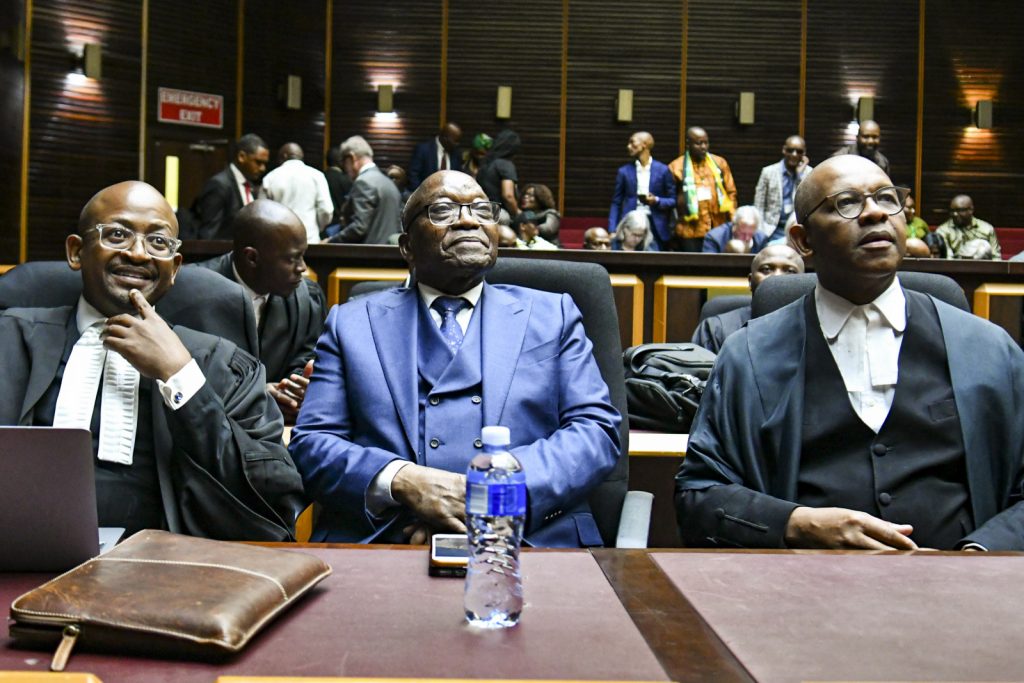 Former president Jacob Zuma is still fighting to prevent the arms deal case from continuing. (Darren Stewart/Gallo Images)
That it came to this was partly a function of the legal feedback loop of Zuma’s campaign against the prosecutor. Koen was faced with an argument from Zuma that his latest approach to the apex court suspended the operation of his ruling dismissing a special plea designed to remove Downer from the case. He then questioned whether it would be proper for him to decide given the views he had expressed on the merits of Zuma’s complaint.
The next hearing date in his prosecution of Downer and Maughan is 2 February. Both have brought applications asking the high court to throw out the case, and these will be heard in March.
If there are several state capture cases before the courts in early stages, the Nulane Investments fraud matter which directly implicates the Gupta brothers will proceed to trial on 23 January without them in the dock. It has been more than six months since the state asked for the extradition of Rajesh and Atul Gupta but authorities in the United Arab Emirates have yet to set a court date to hear the application.
[/membership]