“We don’t have a city anymore. The city is lost.”
Nearly a week after a deadly fire tore through her rundown home at 80 Albert Street in Marshalltown, Asyatu Madi sat on the hard pavement within sight of the charred remains of the five-storey building, silent and still shell-shocked.
In the early hours of last Thursday, the blaze engulfed the derelict “hijacked” building in Marshalltown that housed more than 200 families.
In her desperate bid to escape, Madi, who is from Malawi, clutched her six-month-old daughter tightly in her arms and jumped from her fourth floor window. She broke her leg.
“My wife was very brave — she saved our child,” said her husband, Benjamin Moffet. “But we lost everything in the fire.”
Seventy-seven people were killed in the inferno — among them 12 children — while 88 were injured. Standing near the couple, a man from Zimbabwe, who did not want to be named, told how he escaped death.
“I woke up around 1am and there was smoke everywhere on the ground floor. It was like a black cloud,” he said. “Inside the building, there’s boards, partitions so that the rooms can be separate. It catches fire very fast … I don’t know how I managed to make it out but I saw terrible things that I can’t forget. I lost many friends. The building was just a living place for poor people, it’s not like we want to stay there.”
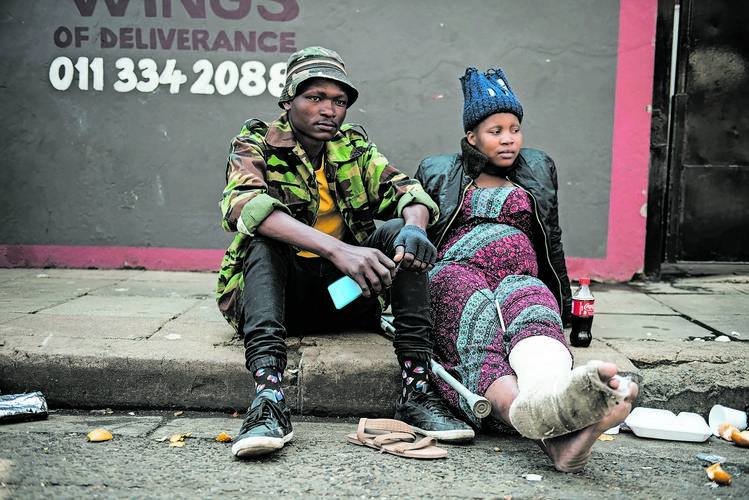 Decay: Asyatu Madi (left) jumped from the fourth floor of 80 Albert Street, saving her and Benjamin Moffet’s baby. (Delwyn Verasamy/M&G)
Two kilometres away, at the squalid Moth building on De Villiers Street, another city-owned building has fallen into ruin and a similar disaster looms.
In November 2009, Edith Mbambisa was among the nearly 150 inner city residents who were evicted from the derelict Dina Glassware building on Carr Street, Newtown. The city was ordered to accommodate them at Moth, a three-storey empty hall, for 12 months in what was meant to be temporary alternative accommodation.
One year has turned into 15 years for Mbambisa, while the building’s inhabitants have now swollen to more than 600 people, living on premises ripe with the stench of sewage and decay.
“It’s overcrowded and not sanitary,” said the 65-year-old as she showed the cramped maze of makeshift wooden shacks that residents have erected on each floor. “I am very scared of fire here.”
Fires are a constant threat, said Shereza Sibanda, the executive director of the nonprofit Inner City Resource Centre. In 2014, the top floor of Moth caught alight. “The people were only supposed to stay here for 12 months and then they would be moved to better places. It can’t be temporary accommodation for 15 years.
“By that time, they were still putting curtains to divide their spaces but then they put up these shacks inside so they can lock their doors and keep their goods safe. What happens if this building catches fire? This is a time bomb.”
The city pays rent monthly for the building — money it could use to renovate and make the building habitable, she added.
Yolanda Magwentshu, who moved in eight years ago from the Eastern Cape, said: “We can burn here anytime. With all these zozos, if one burns, the whole place will be gone. We will all die.”
Outside, a group of ANC inner-city councillors were hosting a media conference. Among them was ward 58 councillor Rickey Nair, who described the Moth building as a “total disaster waiting to happen”.
“As inner city councillors, we have to do something, even if we go building by building, we need to start making a difference. Today when we talk about 600 hijacked buildings in the inner city, most of us are saying ‘we give up, we don’t know where to start’, but we have to start somewhere or it will just get worse. There will be no city of Joburg.”
 Shereza Sibanda, of the Inner City Resource Centre, said people have been living ‘temporarily’ in the Moth building for 15 years. (Delwyn Verasamy/M&G)
Sibanda, meanwhile, fumed. “We came here with city officials to show them how this building is in August 2020, asking ‘can you assist the people’ and they left it like this up until today. They were walking on eggshells. They think it’s dirty people living here. These are human beings.
“If there was no fire [at Albert Street], would they be sitting here doing a press conference?”
Nthatisi Modingoane, spokesperson for the City of Johannesburg, said it had conducted an occupancy audit in 2020, where it was established that of the 169 households living in the facility, 75% are illegal occupiers occupying the Moth building.
The department is in the process of an eviction court application for those, he said. “There are only 43 legal occupiers, only six qualify for RDP. The rest do not qualify for any form of rental and therefore cannot transition into independent living.”
Modingoane explained that the city, too, has a huge backlog for the provision of temporary emergency accommodation (TEA). “The City currently solely funds the provision of TEA and so far nine city-funded facilities have been created. There are challenges in transitioning people from the TEA facilities.”
On Tuesday, Johannesburg mayor Kabelo Gwamanda said the city must confront the “uncomfortable truth” that “lies beneath the surface” of the devastating fire. “The Albert Street fire exposes deep-rooted issues concerning the state of our buildings in the inner city and the living conditions that its occupants are currently surviving under.”
The city’s group forensics and investigation services unit has 188 active cases involving hijacked buildings, he said. Of those, 167 are privately owned, 13 are city-owned and the remainder owned by other spheres of government.
“For the president himself to come and say it’s a wake-up call after so many buildings have caught fire in the inner city — were you waiting for so many people to die, because there were people who died before; one, two people, is too many.”
“The building in Albert Street is indeed a city-owned building. While I grapple with his tragedy, I keep asking how the City of Johannesburg left our assets to ruin, especially abandoning it to unlawful elements,” Gwamanda said, adding that this pointed to significant government and management shortcomings.
“It is essential that we hold those accountable responsible for their negligence and ensure that appropriate measures are put in place to prevent such disasters from happening in the near future.”
The city will adopt a precinct-based strategy aimed at reclaiming and rehabilitating city-owned properties, starting with an inventory of all its buildings in the inner city. Through law enforcement and safety compliance processes, it will identify and focus on buildings that have been “deemed condemned”, Gwamanda said.
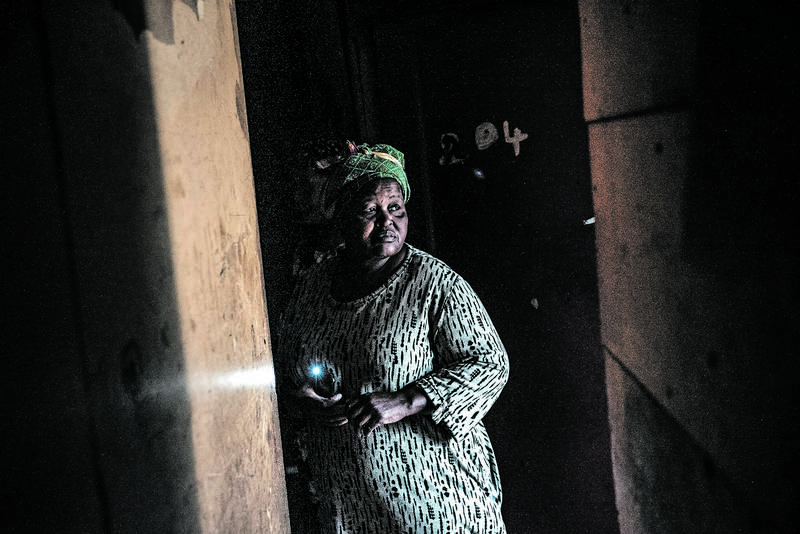 State of disaster: Edith Mbambisa was one of 150 people sent to Moth. (Delwyn Verasamy/M&G)
“Emergency accommodation and temporary relocation accommodation will be a priority of the department of housing since it’s the main cause of our impediments in our processes. The buildings will then be renovated and where required, repurposed.”
Johannesburg member of the mayoral committee for public safety Mgcini Tshwaku said his department had committed to continuing with thorough audits of all abandoned and hijacked buildings and their conditions.
On Monday, Gauteng Premier Panyaza Lesufi announced that retired constitutional court judge Sisi Khampepe would chair a commission of inquiry into last week’s blaze.
Tshwaku, noting the establishment of “yet another” inquiry, said the root cause behind the tragic Marshalltown fire is not mysterious or unknown; it’s the presence of hijacked buildings that “serve as a tinderbox for such calamities”.
Angela Rivers, the general manager of the Johannesburg Property Owners and Managers Association, whose members house about 250 000 people in affordable housing in the inner city, has a list of 57 hijacked buildings in the central business district alone, many owned by the city or the provincial government.
“This building [80 Albert Street] is number five on my list, which means it was reported to me when I first created this list eight years ago but it was just allowed,” she said. “Our buildings which are upgraded, beautiful and absolutely stunning get inspected all the time by building inspectors and fire inspectors.
“Why are they not inspecting these other buildings? They haven’t stepped in that building in 80 Albert Street since 2019 and if they have, they should be fired then because they would have seen the state of it and used the city’s problem property’s policy to sort it out,” she said, adding that this 2014 by-law policy is poorly enforced.
Modingoane said the property hijacking and compliance investigation unit, which is under the group forensic and investigation services department, conducts investigations into allegations of property hijacking and problem properties within the city.
“They deal with properties that do not comply with existing legislation regarding health, fire, town planning and building control regulations as well as enforcing the Problem Properties By-Laws.”
Edward Molopi, senior advocacy officer at the Socio-Economic Rights Institute, said the council had taken some steps to address the inner city housing crisis through the Johannesburg Inner City Housing Implementation Plan approved in 2017, which seeks to make the inner city housing market work better for the poor, but it has not been implemented.
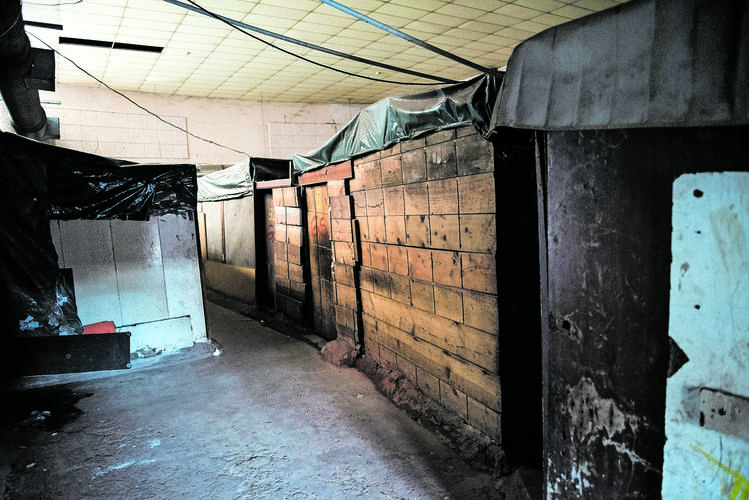 About 600 people live in Moth, erecting shacks in the building for safety. (Delwyn Verasamy/M&G)
This plan has three primary objectives: to establish public-private partnerships with developers and social housing institutions, improve the provision of temporary emergency accommodation and address hijacked buildings. The biggest problems are access to affordable housing and the rise in hijacked buildings.
“It is estimated that some 30 000 accommodation units are required in the short-term to address the needs of the most vulnerable households within the city,” it says.
Of the recent raids by city officials on some buildings in the inner city, Molopi said: “These are the same buildings that have been raided over and over since even before [former Johannesburg mayor Herman] Mashaba, but there are hundreds more that are in a similar situation.
“It’s not a genuine effort to try and to bring any solution to this — it is really just an attempt to be seen to be doing something without doing any work.”
Molopi said the government is not catering for the unemployed and for those earning R3 500 and less.
“There isn’t any place where people can go to rent at affordable prices in the inner city. There will be units that attempt affordable housing but in some cases they still charge way more than what people can afford. Where they go down low enough for people to actually [afford] them, you find that those units are actually very limited and oversubscribed,” he said.
“So, even if you’re in temporary emergency accommodation, there isn’t anything that you’re able to get out into after that, so people end up living in that emergency accommodation.”
In shifting the blame for the Albert Street fire to NGOs and foreigners, Sibanda said politicians had “made a mockery” of the deaths of the building’s inhabitants.
“They knew exactly what was happening in these buildings. They knew people were connecting illegally. It’s fire after fire and people are being evicted to the streets.
“From 2000, we’ve been sending memorandums, marching to the mayor’s office, the premier’s office … highlighting the issue of unsafe buildings, of people being subjected to rental payments to say how do we work together in order to resolve issues around in the inner city, being in and out of meetings with them, but it fell on deaf ears,” Sibanda said.
 Councillors hold a press conference on the housing problem years in the making. (Delwyn Verasamy/M&G)
“For the president himself to come and say it’s a wake-up call after so many buildings have caught fire in the inner city — were you waiting for so many people to die, because there were people who died before; one, two people, is too many.”
Standing on the dilapidated balcony of the Moth building, she pointed to the council building in Braamfontein.
“The mayor wakes up in the morning and finds this building so tell me this is a world-class African city,” she said, referring to the City of Johannesburg’s now much-panned promotional slogan.
“The inner city has become a slum. We don’t have a city anymore. The city is lost.”
*This story has been updated to reflect comment from the City of Johannesburg