Aerial view taken on December 16, 2013 in Inga shows the Inga 1 dam and Inga Falls on the Congo river. The Democratic Republic of Congo and South Africa vowed on October 16, 2015 to step up work on a massive new hydroelectric dam on the Congo River that could provide power to the entire continent. The Inga 3 Basse Chute project near Matadi would divert Congo River waters into a 12-kilometre (7.5-mile) channel and then pass them through a 100-metre-high (330-foot) hydropower dam in the Bundi Valley before releasing the water back into the river. The intake would be above the existing Inga 1 and Inga 2 dams, and the outflow downstream from both. (AFP PHOTO/MARC JOURDIER)
The government’s touted plans to procure power from the proposed Inga 3 hydroelectric dam project in the Democratic Republic of the Congo (DRC) would cost Eskom over R10-billion more a year compared to procuring the same energy from alternatives such as wind and solar, according to a new report.
This cost would probably fall on the shoulders of South Africans through increased tariffs or government subsidies and will be an “unmitigated disaster”, says the report, commissioned by two non-profit organisations, International Rivers and the WoMin African Alliance.
“This is set against a backdrop of electricity prices for consumers that have increased by 177% in the past decade, with a further 15.6% increase already expected in mid-2021. Vulnerable and poorer households would see their household costs increase, and women would be particularly and disproportionately affected.”
The report by TMP Systems offers accounting of the “true costs” of the project to South Africa.
“It’s really about the cost factor for us,” says Siziwe Mota, the Africa director at International Rivers. “You’ve got the Covid-19 economic downturn, Eskom debt sitting at about R450-billion, and now you want to add more costs? Importing power from Inga is going to cost us far more than if we were to produce the power locally. It doesn’t make sense.”
In 2013, South Africa agreed to purchase 2 500 megawatts from the proposed 4 800MW Inga 3 dam and to finance the costs of transmission from the DRC, through the Grand Inga Treaty, which is due to expire in 2023.
Inga 3 has also faced multiple problems, including the withdrawal of support from the World Bank and key developers, as well as an overall eight-year delay. The report says the scheme will probably be heavily delayed, if built at all, and would not begin producing power until 2032.
The cost of electricity from Inga 3, including the potential cost of the transmission lines, will probably be from $0.11 per kilowatt-hour to $0.122/kWh, more than three times higher than the current average weighted cost of energy production in South Africa and “would therefore lead to likely increases in the cost of electricity sold to South Africans”.
Solar and wind can respectively provide electricity priced 89% and 175% lower than Inga 3, by the expected operation date of 2032.
Despite Inga 3’s significance to South Africa’s energy plans, the government has not undertaken a feasibility study to show the project is financially viable or its purported benefits are attainable, according to the report. “This is startling, given that South Africa has experienced prolonged load-shedding and would be required to finance the transmission lines from the DRC border to South Africa. The World Bank estimates that this will cost South Africa about R28-billion to build and another R839-million a year to maintain.”
At more than 3 000km, Inga 3 would require the world’s longest and most expensive transmission line, which would have the added complexity of getting permission to traverse Zimbabwe and Zambia.
As much as 500MW of Inga’s power would be lost along the length of the transmission line, the report says.
“So we will losing power while we’re trying to get power,” says Mota.
“There are so many red flags. Why is our government intent on putting this in our Integrated Resources Plan [IRP]? They say it’s about regional integration but what is the cost to South Africa and to South Africans if by the time it comes online, if it does, it’s going to cost far more than what it would cost to have produced the power from wind and solar locally?”
The Inga 3 dam and its transmission line would have significant negative social effects on between 210 000 and 333 000 people in South Africa, and is likely to pass through environmentally sensitive areas, including areas of high forest cover, key biodiversity areas and protected areas.
“Our research shows that areas with low environmental risk and high renewable energy potential are abundant, offering a route to better environmental impact in energy planning,” the report says.
Inga 3, too, would create few new jobs in South Africa, while comparable investments in wind and solar could create about 8 096 full-time jobs for South Africans.
“What is the point of creating jobs in another country, not in your own country?” asks Mota.
If it goes ahead, the deal will have dire effects on women in South Africa and in the DRC, says Trusha Reddy, the coordinator of the women building power, energy and climate justice programme at the WoMin African Alliance. “The high costs of the power from Inga to South Africa will certainly lead to an increase in electricity tariffs, which as we already know with increases we face each year, affects the poorest, particularly women, the most.”
More egregiously, she says, poor rural and working class women will not benefit directly from the power produced, which will probably go mostly to industry and mining. “Women and their communities also stand to be displaced by the need for land to construct the transmission lines, starting from the DRC across at least two to three countries and then coming to South Africa.
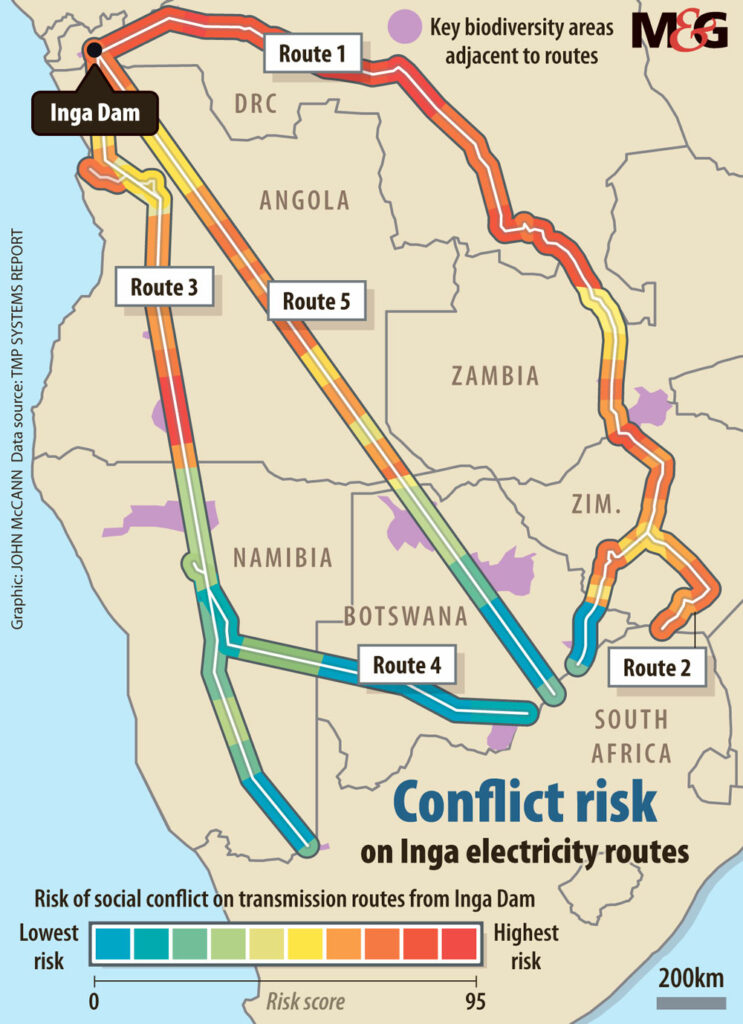 (John McCann/M&G)
“Women often end up being moved to areas which are not arable for farming or helpful in seeking any other kind of livelihood. There are also barely any jobs that will be created in South Africa from this project, and women will certainly not get even the few that may come our way.”
In the DRC at the site of Inga, women have been severely affected by Inga 1 and 2. “They have still not even received compensation from when they were relocated. Inga 3 only promises more displacements in the DRC, and capture of water resources from local women and their communities. Little known is that big dams have an environmental and climate impact, which is sure to be exacerbated by Inga 3.”
South Africa’s reliance on Inga 3 in its energy plans represents a risk to the country’s energy security, according to the report, which urges the government to withdraw from the treaty or risk being “saddled with an expensive and damaging source of energy at some uncertain point in the future, or be left with a giant hole in its energy plans, stifling development and the growth of renewable energy”.
After the approval of the 2019 IRP, the minister of mineral resources and energy, Gwede Mantashe, stated that the Inga project is in support of regional integration and energy trading, with some of the power intended for transmission to South Africa across the DRC, Zambia, Zimbabwe and Botswana.
“In addition to this generation option providing clean energy, the regional development drivers are compelling, especially given that currently there is very little energy trade between the SADC [Southern African Development Community] countries, due to the lack of infrastructure,” he said.
Meanwhile, International Rivers and the WoMin African Alliance have written to the parliamentary portfolio committees on energy and finance to request an opportunity to present the report to MPs calling for the immediate withdrawal of South Africa’s support for Inga 3. “We haven’t had a response yet,” Mota says. “We are following up.”
[/membership]