When a new road was cut through a hill near Grahamstown in the 1980s, Dr Rob Gess began to unearth fossils, including unusual fossilised scales from a giant fish, entombed in the fossil-rich, fine-grained shale rock.
Years of painstaking excavations and “detective work” would follow as the palaeontologist sought to unravel the identity of the ancient and massive fish species whose silvery-white fossilised remains were preserved at Waterloo Farm, now a world-renowned fossil site, near Makhanda.
Now, more than 30 years later, Gess, together with Swedish palaeontologist Per Ahlberg, has described the new species in the latest issue of the journal PLOS ONE, as Hyneria udlezinye. It is the biggest prehistoric bony fish ever to be discovered in southern Africa.
Udlezinye means “one who consumes others” in IsiXhosa. And that’s exactly what the giant killer fish did 360 million years ago, as it prowled the ancient freshwater estuary section of Waterloo Farm, devouring distant ancestors of humans and all four-legged animals — the aquatic tetrapods, Tutusius and Umzantsia.
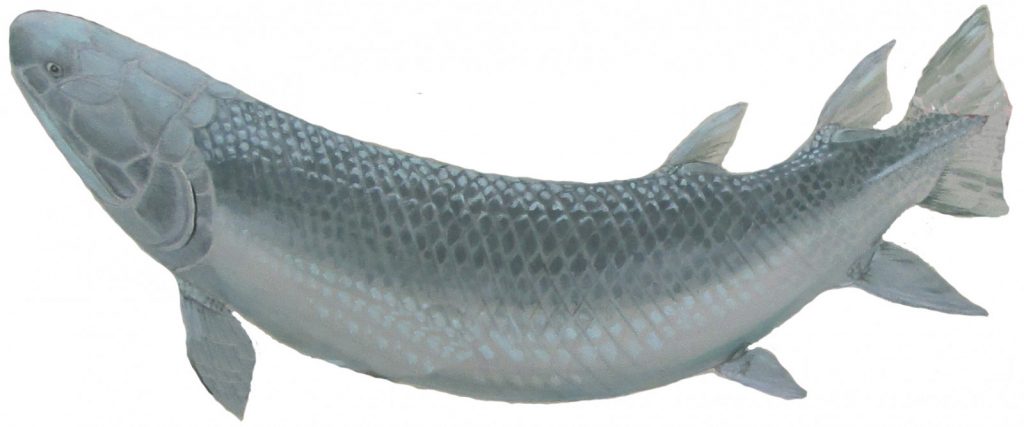
Measuring nearly 3m, the terrifying Hyneria udlezinye was an apex predator, armed with big rows of small teeth and huge fanged jaws. “You wouldn’t have wanted to meet it while out paddling in an estuary,” quipped Gess, a palaeontologist from the Albany Museum and Rhodes University. “He might just have taken your leg off.”
Hyneria udlezinye was a lie-in-wait predator. “They kind of lurked in the shadows and when something swam past they could put on a jet of speed and grab it and then go back
again. It would have been able to eat just about anything else living in the estuary and it probably did.”
‘Missing piece of the puzzle’
The scientific paper describes how the specimens were prepared mechanically by hand, without the use of power tools. “The soft sediment was in most cases slowly flaked off with a porcupine quill in order to protect the fragile and diagenetically altered bone compressions.”
The new species belongs to an extinct group of lobe-finned fish called the Tristichopterids, according to the researchers. This group were the fish most closely related to tetrapods — four-legged vertebrates.
Late in the Devonian Period, which occurred 420 million to 359 million years ago, one branch of the Tristichopterid family developed into a group of giant forms.
It is thought that these giant Tristichopterids arose in Gondwana, the early large supercontinent, before migrating to Euramerica. All but one genus of giant Tristichopterid were formally known from Gondwana, including some also found in Euramerica, they said.
Until recently, there was one enigmatic exception, Hyneria lindae, from North America. The discovery of a closely-related species, Hyneria udlezinye, from Gondwana “strongly supports the idea that these giants originated in Gondwana and is an important missing piece of the puzzle”.
It is also the only Tristichopterid known from polar regions. Most of the other Gondwanan
Tristichopterids come from Australia, which was on the tropical northern coast of Gondwana and had a far better-understood fossil record. Similarly, Euramerica was entirely situated within tropical and subtropical regions.
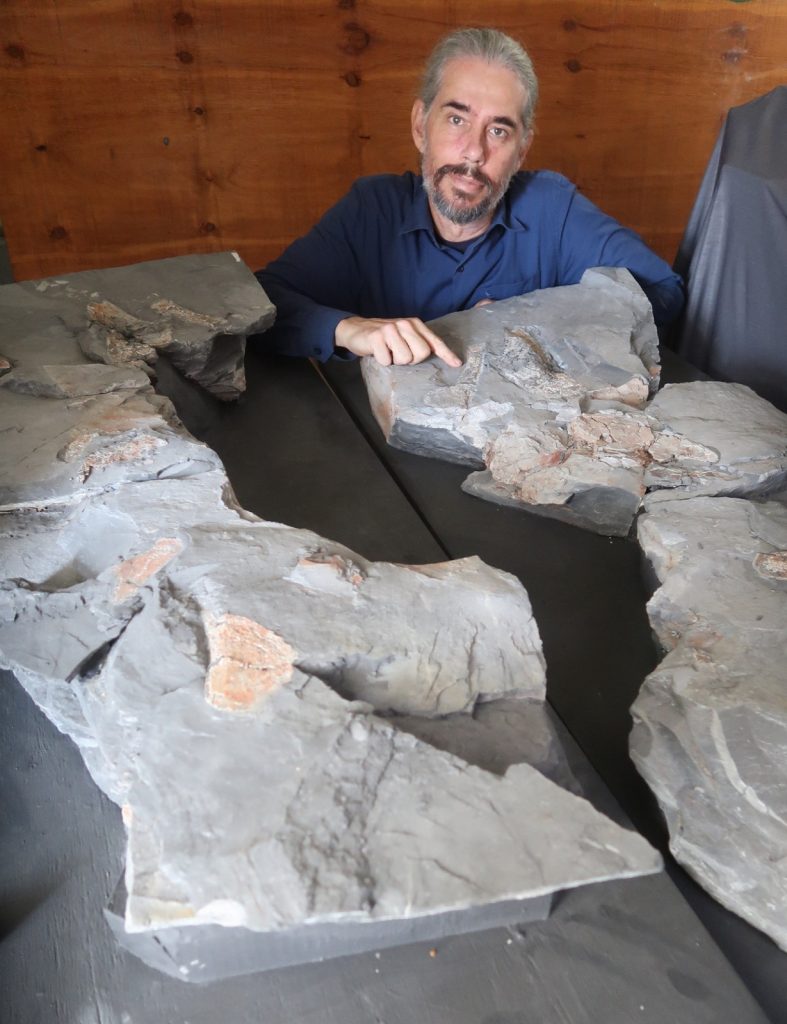 Dr Rob Gess
Long wait
On how the discovery unfolded, Gess, who is South Africa’s leading researcher on Devonian ecosystems and early vertebrates, explained that in the 1980s, the N2 went all the way through what was then Grahamstown and through the township.
“So it was possible for protesters to stop the traffic on the N2. For this reason, the government decided to build a bypass around the south of town, and in the process, they cut through the hills at Waterloo Farm to make road cuttings.”
Unexpectedly, in one of those road cuttings, there was a lot of black shale. “Myself, and a few others, started noticing there were interesting fossils in this black shale … It turned out there were also some bits of fish fossils, which were more unexpected and more exciting. Among the fish fossils coming out of the hill were fish scales, big round fish scales, with a very distinctive ornament.”
Gess knew they were from some kind of large lobe-skinned fish, but wasn’t exactly sure what fish it was. As an undergraduate student, he collected many more fossils from the site, under the mentorship of palaeontologist Dr Norton Hiller at Rhodes University. Gess finished his undergraduate degree and Heller secured funding for him to carry out an excavation at Waterloo Farm in the mid 1990s.
Slow collection
Over the next two years, Gess would find some of the bones, “which we have now finally got round to describing, though then it still wasn’t exactly clear what this thing was”. But Hiller emigrated in 1995 and the funding dried up.
“In 1999, because of the shale in the road cutting and the dip of the strata, the road cutting was very unstable. SANRAL decided to cut back the road cutting and I was like, ‘whoa, there’s a really important fossil site there.’
“They said ‘well, we’re not going to not cut back the road cutting.’ SANRAL and I came to an agreement whereby they sponsored labour and a flatbed truck for me and I and the team mined out by hand, because it’s very crumbly, about 30 tons of the black shale, which we moved to a shed to allow for ongoing excavations.”
He had always had an eye on one particular layer where a lot of the fish scales came out of. “I specifically made a point of getting down to that layer and I got out some big slabs with quite a lot of skull and shoulder girdle bones.
“Over the years, I’ve been excavating through those bits of rock we rescued there and more rock that we rescued in 2007 adding diverse fossils to the Museum collection, including from this fish slowly getting bone by bone, or a couple of bones.”
Ahead of new roadworks in 2007, they got another 70 tons of shale.
“While we were doing that fairly large-scale rock moving, I also found new bones. Right up to last year, the last bone in the paper is a partial jaw that myself and my PhD student, Ryan Nel, found while splitting the rocks in the sheds last year,” he said.
It took a long time for everything to fall into place.
“It’s not one of those things where you open a slab of rock and there is a perfect creature, then whoopee off you go and write a story. It’s a slow collection of the pieces until we seem to have a fairly full set of pieces when we put them all together.”
 Scientific reconstruction of Hyneria udlezinye
Detective work
Hyneria lindae, the North American species, had been poorly described in a scientific paper in 1968, based only on a “few bits and pieces”, he said.
While doing his PhD in 2008, Gess started to think the specimens he had assembled were similar to Hyneria lindae. “Mike Coates, my PHD supervisor at the time, said: You should actually write to Ted Daeschler, who was the person working on the rocks in Pennsylvania, and ask him to send you a photograph of the fish scales of Hyneria lindae.”
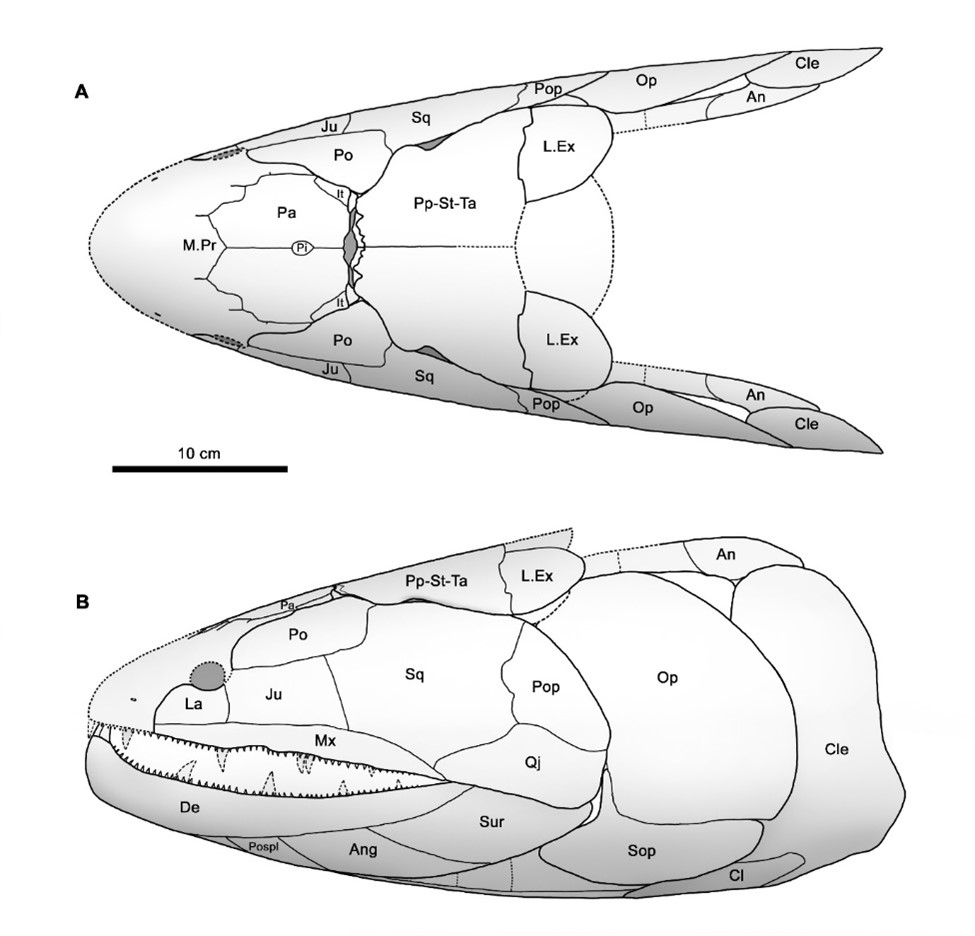
These pictures would reveal a “very, very close match”, he said. Daeschler had returned to the site and collected many more bones of the American species, publishing his detailed paper in 2018. “Then we could do a direct comparison and say yes, indeed, this thing is so close, it is the same genus but then, some of the bones were very consistently different in proportions, which means it’s a different species.”
Last year, Ahlberg, an international lobe-finned fish expert, teamed up with Gess to painstakingly fit their images of the fossil bones together like a giant jigsaw puzzle.
Fossil treasure
The astonishing fossils at Waterloo Farm were formed from remains of animals and plants that originally settled into the still mud of a swollen river mouth, which was open to the sea, the researchers said.
At the time, Africa did not exist as a separate continent, but was an inseparable part of a southern megacontinent, Gondwana, which included Madagascar, India, South America, Australia and Antarctica.
The Eastern Cape was on the southern edge of Gondwana during the Late Devonian, well within the Devonian Antarctic Circle. The rocks at Waterloo Farm provide humanity’s only comprehensive record of an entire ecosystem from within polar regions during the Late Devonian.
“Imagine that the Devonian world is largely entirely dark except that wherever there are fossil sites, they are sort of lamp poles so we can see what’s within the ambit of that light. In some parts of the world, there are lots of lamp posts so we can get a pretty good picture of what the landscape looks like, but then in some parts, there are virtually none. As you move south in Gondwana, there is only one lamp pole, so we can only see just that spot. And that’s Waterloo Farm.”
Gess said that so much of the international significance of the find, “is what it tells us of the distribution patterns and place of origin of Tristichopterids”.
Twenty-six species new to science, including plants, algae, fish and invertebrates, have been described at Waterloo Farm. “I would estimate that the fossils we already have — and we’re continuing with our excavations – probably include the remains of at least 60 organisms.”
[/membership]